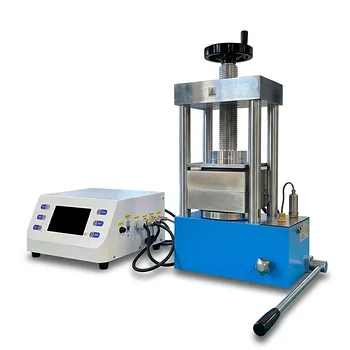
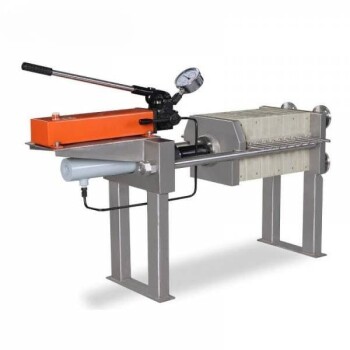
The primary function of a four-column hydraulic press in this context is to compact loose magnesium alloy powder into a solid, cohesive unit known as a "green body." By applying high pressure—typically around 200 MPa—at room temperature, the press transforms the raw powder into a defined shape with sufficient mechanical strength for handling.
The press acts as the critical bridge between loose raw material and the final alloy, mechanically interlocking particles to exclude air and establish the baseline density required for successful hot-pressing sintering.
The Mechanics of Cold Pressing
The fabrication of magnesium alloys begins with the challenge of converting loose powder into a solid form without melting it immediately. The hydraulic press solves this through a process called cold pressing.
Achieving High-Pressure Densification
The press utilizes a four-column structure to deliver stable, high-magnitude pressure, specifically targeting 200 MPa for magnesium alloys.
This immense force physically compresses the loose powder, significantly reducing the volume it occupies.
Establishing Initial Particle Contact
The pressure forces individual powder particles into tight physical contact with one another.
This contact is essential for creating a continuous network within the material, known as mechanical interlocking, which holds the shape together without the need for chemical binders or heat at this stage.
Preparing for Sintering
The green body is not the final product; rather, it is a foundational step designed to ensure the success of the subsequent hot-pressing sintering process.
Excluding Internal Air
Loose powder contains a significant amount of trapped air, which is detrimental to the integrity of the final alloy.
The compression process partially excludes this internal air, minimizing voids that could lead to defects later in fabrication.
Ensuring Handling Strength
A primary goal of the green body stage is to create an object that is robust enough to be moved.
The pressed magnesium alloy must possess defined green strength so it can be safely transferred from the press to the sintering furnace without crumbling or losing its shape.
Understanding the Process Limitations
While the hydraulic press is essential, it is important to recognize the limitations of the green body state to avoid processing errors.
The "Green" State vs. Final Strength
It is critical to remember that the green body possesses only mechanical strength, not metallurgical bond strength.
The particles are interlocked, not fused; the material remains brittle and susceptible to damage if mishandled before sintering.
Partial Air Exclusion
While the press reduces porosity, it only partially excludes air.
It does not create a fully dense material on its own; reliance on the press alone for final density without proper subsequent sintering will result in a porous, weak component.
Making the Right Choice for Your Goal
To maximize the effectiveness of the hydraulic pressing stage, align your process parameters with your specific fabrication objectives.
- If your primary focus is Handling Efficiency: Ensure the pressure is sufficient (approaching 200 MPa) to achieve high green strength, preventing breakage during transfer to the furnace.
- If your primary focus is Final Material Density: Prioritize the uniformity of the pressure application to maximize particle contact and air exclusion, setting a flawless foundation for the sintering phase.
The success of your magnesium alloy fabrication relies on using the hydraulic press not just to shape the powder, but to engineer the internal particle structure for the heat treatment to come.
Summary Table:
| Feature | Function in Magnesium Alloy Fabrication |
|---|---|
| Primary Goal | Compact loose powder into a cohesive "green body" |
| Applied Pressure | Typically 200 MPa at room temperature |
| Key Mechanism | Cold pressing and mechanical interlocking of particles |
| Structural Result | High green strength for handling and air exclusion |
| Next Stage | Preparation for successful hot-pressing sintering |
Elevate Your Materials Research with KINTEK Precision
Achieving the perfect green body is the foundation of high-performance magnesium alloys. KINTEK specializes in laboratory equipment and consumables, offering robust four-column hydraulic presses (pellet, hot, and isostatic) designed to deliver the precise pressure and stability your fabrication process demands.
Beyond pressing, our comprehensive portfolio supports your entire workflow with:
- High-temperature furnaces (muffle, vacuum, and CVD) for flawless sintering.
- Crushing and milling systems for optimal powder preparation.
- High-temperature high-pressure reactors and autoclaves for advanced material synthesis.
Ready to optimize your lab’s efficiency and material integrity? Contact us today to consult with our experts and find the ideal solution for your research and production needs.
Related Products
- 24T 30T 60T Heated Hydraulic Press Machine with Heated Plates for Laboratory Hot Press
- Automatic Heated Hydraulic Press Machine with Heated Plates for Laboratory Hot Press 25T 30T 50T
- Automatic High Temperature Heated Hydraulic Press Machine with Heated Plates for Lab
- 30T 40T Split Automatic Heated Hydraulic Press Machine with Heated Plates for Laboratory Hot Press
- Heated Hydraulic Press Machine with Heated Plates for Vacuum Box Laboratory Hot Press
People Also Ask
- What role does a heated hydraulic press play in Cold Sintering (CSP)? Enhancing LATP-Halide Densification
- Why is the heating function of a laboratory hydraulic press essential for MEA assembly in DEFC? Optimize Cell Bonding
- What technical conditions does a heated hydraulic press provide for PEO batteries? Optimize Solid-State Interfaces
- How is a heated hydraulic press used for Li-LLZO batteries? Optimize Interfacial Bonding with Thermal-Pressure
- What is the core function of a laboratory heated hydraulic press in CSP? Revolutionize Low-Temp Ceramic Sintering