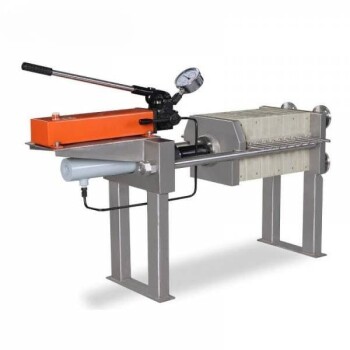
The primary function of a laboratory hydraulic press in this context is the uniaxial compression molding of mixed cathode and solid electrolyte powders. By applying precisely controlled mechanical force, the press consolidates loose powder particles into a dense, unified pellet or layer, eliminating the physical gaps that naturally exist between particles.
Core Takeaway Unlike liquid batteries that naturally wet the electrodes, solid-state batteries rely entirely on mechanical contact for ion movement. The hydraulic press bridges this gap by forcing active materials and solid electrolytes into a tight solid-solid interface, which is the absolute prerequisite for reducing contact resistance and enabling lithium-ion transport.
Overcoming the Interface Barrier
The Challenge of "Dry" Contact
In traditional batteries, liquid electrolytes fill porous electrodes, ensuring ions can move freely. In all-solid-state batteries, you are essentially trying to make two solids interact chemically.
Without sufficient pressure, microscopic voids remain between the cathode and the electrolyte particles. These voids act as insulators, blocking the path of lithium ions and rendering the battery ineffective.
Establishing the Solid-Solid Interface
The hydraulic press addresses this by applying high-intensity pressure to the powder mixture. This forces the solid electrolyte particles to deform and fill the spaces around the active cathode materials.
The result is a tight physical contact area. This maximizes the surface area where the active material touches the electrolyte, creating continuous pathways for ions to travel.
Optimizing Electrochemical Performance
Reducing Contact Resistance
The most critical output of this process is the reduction of interface impedance.
Loose contact creates high resistance, leading to poor voltage performance and heat generation. By eliminating interface voids, the hydraulic press significantly lowers this resistance, allowing current to flow efficiently.
Ensuring Efficient Ion Transport
Lithium-ion transport within a solid matrix depends on physical continuity.
The press densifies the matrix, ensuring that the lithium ions have a direct, uninterrupted "highway" from the cathode particle through the electrolyte. This is essential for the battery to charge and discharge at acceptable rates.
Mechanical Stability and Adhesion
Beyond the powder mixture itself, the press serves a structural role.
It is often used to press the prepared material onto the current collector (such as nickel mesh). This uniform pressure ensures that the electrode layer adheres tightly to the collector, optimizing electron transport paths and maintaining the mechanical integrity of the electrode disc.
Understanding the Trade-offs
Uniaxial vs. Isostatic Pressure
A standard laboratory hydraulic press typically provides uniaxial compression (pressure from one direction).
While effective for standard discs, this can sometimes lead to density gradients where the surface is denser than the center. In scenarios requiring extremely uniform density across complex shapes, researchers may opt for Cold Isostatic Presses (CIP), though the hydraulic press remains the standard for planar electrode assembly.
The Need for Precision
The reference emphasizes "precisely controlled pressure."
This is not simply about applying maximum force. The pressure must be uniform to prevent cracking the delicate solid electrolyte layer while still being high enough to plastically deform the particles for proper bonding.
Making the Right Choice for Your Goal
When utilizing a hydraulic press for solid-state battery assembly, consider your primary objective:
- If your primary focus is electrochemical performance: Prioritize higher pressure settings (within material limits) to maximally eliminate voids and minimize interface impedance.
- If your primary focus is structural integrity: Ensure the pressure is applied uniformly to secure the bond between the catalyst layer and the current collector without damaging the mesh.
- If your primary focus is material research: Utilize the press's precision controls to maintain consistent pressure parameters across different batches, isolating variables effectively.
Ultimately, the hydraulic press transforms a theoretical mixture of powders into a functional, conductive electrochemical system.
Summary Table:
| Feature | Function in Solid-State Battery Assembly |
|---|---|
| Primary Action | Uniaxial compression molding of cathode and electrolyte powders |
| Interface Goal | Eliminating microscopic voids to create tight solid-solid contact |
| Key Outcome | Significantly reduces interface impedance (contact resistance) |
| Ion Transport | Creates continuous pathways for efficient lithium-ion movement |
| Structural Role | Ensures strong adhesion between active material and current collector |
| Pressure Type | Typically uniaxial; Cold Isostatic Pressing (CIP) used for higher uniformity |
Elevate Your Battery Research with KINTEK Precision
Achieving the perfect solid-solid interface is critical for the next generation of energy storage. KINTEK specializes in high-performance laboratory equipment designed specifically for advanced material research.
Our comprehensive range of hydraulic presses—including pellet, hot, and isostatic systems—provides the precise pressure control needed to eliminate interface resistance and ensure the mechanical integrity of your all-solid-state batteries. Beyond pressing, KINTEK supports your entire workflow with:
- High-Temperature Furnaces (Muffle, Vacuum, CVD/PECVD) for material synthesis.
- Crushing and Milling Systems for consistent powder preparation.
- Battery Research Tools and specialized consumables like PTFE products and ceramics.
Ready to optimize your electrode assembly? Contact our technical experts today to find the ideal pressing solution for your lab’s specific requirements.
Related Products
- Laboratory Hydraulic Press Split Electric Lab Pellet Press
- Laboratory Hydraulic Press Lab Pellet Press Machine for Glove Box
- Laboratory Hydraulic Press Lab Pellet Press for Button Battery
- Automatic Laboratory Hydraulic Pellet Press Machine for Lab Use
- Automatic Laboratory Hydraulic Press for XRF & KBR Pellet Press
People Also Ask
- What role does a laboratory hydraulic press play in platinum recovery research? Enhancing Sample Precision
- What are the specific applications of a lab hydraulic press in biochar evaluation? Optimize density and data accuracy.
- What are the roles of a laboratory hydraulic press and stainless steel molds in the preparation of graphite samples?
- What is the role of a laboratory hydraulic press in electrode prep? Maximize Energy Density & Sealing Precision
- Why must a laboratory hydraulic press equipped with cylindrical molds be used when preparing BZY green bodies? High Density