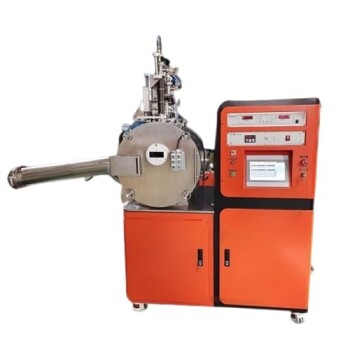
The primary function of a vacuum arc melting furnace is to generate the extreme thermal energy required to melt and fuse refractory elements with exceptionally high melting points, such as Hafnium (Hf), Tantalum (Ta), and Tungsten (W). By utilizing high-energy electric arcs within a controlled environment, this equipment solves the critical challenge of liquefying these robust metals to create Refractory High-Entropy Alloys (RHEAs).
Core Takeaway While standard heating methods struggle with the thermal thresholds of refractory metals, vacuum arc melting excels by using focused electric arcs to achieve fusion. Its true value, however, is in the procedural requirement of repeated melting and flipping, which is essential to eliminate segregation and guarantee a high-performance, homogeneous alloy.
The Mechanics of RHEA Preparation
To understand the role of the vacuum arc melting furnace, one must look beyond simple heating. The equipment is designed to address the specific metallurgical behavior of high-entropy alloys.
Overcoming Thermal Thresholds
The defining characteristic of Refractory High-Entropy Alloys is their composition of elements like Tungsten and Tantalum. These metals possess some of the highest melting points on the periodic table.
Vacuum arc melting utilizes high-energy electric arcs to reach temperatures that conventional resistance or induction furnaces may struggle to maintain efficiently. This intense, focused heat is the only reliable way to fully liquefy these refractory components into a unified state.
Ensuring Atomic-Level Mixing
Merely melting the elements is insufficient for RHEAs; the components must be mixed thoroughly to function as a single alloy.
The process relies on a specific protocol of repeated melting. After the initial melt, the alloy ingot is typically flipped and remelted. This iterative process is critical to ensure atomic-level mixing and to break down any clusters of unmixed material.
Eliminating Component Segregation
A common failure mode in alloy preparation is segregation, where heavier or higher-melting-point elements separate from the rest of the mixture.
Through the mechanism of repeated flipping and melting, the furnace forces the redistribution of elements. This effectively eliminates component segregation, resulting in a chemically uniform ingot that exhibits consistent performance characteristics throughout its structure.
Protection via Inert Atmosphere
High-temperature processing of refractory metals makes them highly susceptible to oxidation and contamination.
To prevent this, the arc melting process is conducted under a protective argon atmosphere. This inert environment shields the molten pool from reactive gases, preserving the purity of the alloy constituents during the intense heating phases.
Understanding the Process Constraints
While effective, vacuum arc melting is not a "set it and forget it" method. Understanding its operational requirements is vital for success.
The Necessity of Iteration
Unlike some induction processes that may utilize electromagnetic stirring for a single-pass mix, the vacuum arc melting workflow described for RHEAs is inherently iterative.
The quality of the final alloy is directly dependent on the number of melt cycles. Skipping the flipping and remelting steps often leads to an inhomogeneous product, regardless of the temperature achieved.
Making the Right Choice for Your Goal
The vacuum arc melting furnace is a specialized tool designed for a specific class of materials. Here is how to align its function with your fabrication objectives:
- If your primary focus is processing Refractory Elements (W, Ta, Hf): Rely on this furnace specifically for its high-energy electric arcs, which are capable of overcoming the extreme melting points of these metals.
- If your primary focus is Material Homogeneity: Mandate a strict protocol of repeated melting and ingot flipping to prevent segregation and ensure atomic-level integration.
Success in preparing RHEAs comes from treating the furnace not just as a heat source, but as an iterative mixer that builds structural integrity through repetition.
Summary Table:
| Feature | Function in RHEA Preparation | Key Benefit |
|---|---|---|
| High-Energy Electric Arc | Generates intense, focused thermal energy | Liquefies elements with extreme melting points (W, Ta, Hf) |
| Inert Argon Atmosphere | Prevents oxidation and contamination | Maintains high purity of the alloy constituents |
| Iterative Melting Process | Involves repeated flipping and remelting | Ensures atomic-level mixing and structural homogeneity |
| Controlled Environment | Eliminates component segregation | Produces chemically uniform ingots with consistent performance |
Elevate Your Material Research with KINTEK
Precision and performance are non-negotiable when working with refractory high-entropy alloys. KINTEK specializes in advanced laboratory equipment, offering industry-leading induction melting and vacuum arc furnaces designed to overcome the highest thermal thresholds.
Whether you are developing cutting-edge RHEAs or require specialized crushing and milling systems, our comprehensive portfolio—from high-temperature reactors to isostatic hydraulic presses—provides the reliability your research demands.
Ready to achieve superior alloy homogeneity? Contact us today to discover how KINTEK’s expert solutions can streamline your laboratory workflows.
References
- Kunjal Patel, Sundeep Mukherjee. Corrosion Behavior of Refractory High-Entropy Alloys in FLiNaK Molten Salts. DOI: 10.3390/met13030450
This article is also based on technical information from Kintek Solution Knowledge Base .
Related Products
- Non Consumable Vacuum Arc Induction Melting Furnace
- Vacuum Induction Melting Spinning System Arc Melting Furnace
- Vacuum Arc Induction Melting Furnace
- Lab-Scale Vacuum Induction Melting Furnace
- Vacuum Heat Treat Furnace and Levitation Induction Melting Furnace
People Also Ask
- What are the advantages of induction melting furnace? Achieve Purity, Efficiency, and Safety
- What is the temperature range of the induction melting furnace? Find the Right Heat for Your Metals
- What is the use of induction melting furnace? Achieve Fast, Clean, and Precise Metal Melting
- How do specialized industrial-grade small melting furnaces address challenges in precision jewelry casting? Expert Guide
- How do vacuum induction or arc melting furnaces facilitate the synthesis of U-Al-C MAX phases? Precision Heat & Purity