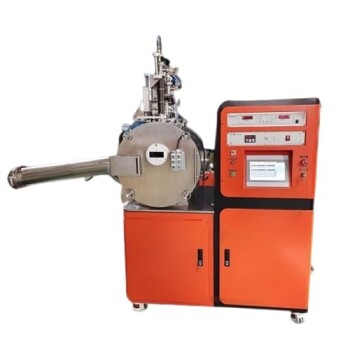
The primary function of a Vacuum Induction Melting (VIM) Furnace in this context is to synthesize homogeneous Copper-Silicon (Cu-Si) pre-alloy ingots by melting pure raw materials in a strictly controlled, oxygen-free environment. By utilizing induction heating, the system achieves two critical goals simultaneously: preventing the oxidation of active silicon and ensuring the thorough fusion of materials via electromagnetic stirring.
The core challenge in preparing Cu-Si alloys is fusing a high-melting-point metal with active silicon without degrading the material. A VIM furnace solves this by combining a protective vacuum atmosphere with intrinsic electromagnetic forces that physically stir the melt, ensuring the final ingot is high-purity, uniform, and ready for powder production.
Preserving Material Integrity via Vacuum
Preventing Silicon Oxidation
Silicon is a chemically active element that reacts readily with oxygen at high temperatures. The VIM furnace operates in a vacuum environment to eliminate atmospheric oxygen during the melting process.
High-Purity Output
By removing oxygen from the equation, the furnace prevents the formation of silicon oxides (slag). This results in high-purity raw materials essential for high-performance downstream applications, such as powder production.
Removal of Impurities
Beyond preventing oxidation, the vacuum environment facilitates the removal of dissolved gases and volatile impurities from the molten pool. This ensures the chemical composition remains precise and free of interstitial contaminants like nitrogen.
Ensuring Uniformity Through Induction Physics
Rapid Heating Mechanism
The furnace utilizes an induction heating mechanism to generate high temperatures quickly. This capability is essential for efficiently melting pure copper and overcoming the thermal requirements of high-melting-point constituents.
Electromagnetic Stirring
Perhaps the most critical mechanical advantage of VIM is electromagnetic stirring. The magnetic fields that generate heat also create strong convective forces within the molten pool.
Compositional Homogeneity
This stirring effect forces the copper and silicon to mix thoroughly. It eliminates segregation and ensures that the silicon is evenly distributed throughout the copper matrix, resulting in a compositionally uniform pre-alloy ingot.
Operational Considerations and Trade-offs
Managing Volatility
While the vacuum is excellent for removing unwanted gases, it presents a trade-off regarding volatile alloying elements. In a high-vacuum state, certain desirable elements with high vapor pressures may evaporate, potentially altering the alloy's target composition if pressure is not carefully regulated.
Batch Consistency
VIM is inherently a batch process. To maintain the "standardized substrate" quality mentioned in research contexts, operators must ensure that vacuum levels and heating profiles are identical across every cycle to prevent batch-to-batch variance.
Optimizing Your Alloy Preparation Strategy
To achieve the best results with Cu-Si pre-alloy preparation, align your process controls with your specific quality metrics:
- If your primary focus is Compositional Uniformity: Maximize the utilization of the electromagnetic stirring effect to ensure the silicon is completely dissolved and evenly distributed within the copper matrix.
- If your primary focus is Chemical Purity: Prioritize the integrity of the vacuum seal and pump-down cycles to strictly prevent silicon oxidation and effectively degas the melt.
The VIM furnace is not just a melting tool; it is a precision instrument designed to stabilize active elements and enforce homogeneity through physics.
Summary Table:
| Feature | Primary Function | Benefit for Cu-Si Preparation |
|---|---|---|
| Vacuum Environment | Eliminates oxygen and atmospheric gases | Prevents silicon oxidation and removes dissolved impurities |
| Induction Heating | Rapid thermal generation | Efficiently melts high-melting-point materials like copper |
| Electromagnetic Stirring | High-intensity convective mixing | Ensures compositional homogeneity and eliminates segregation |
| Process Control | Precise regulation of pressure/heat | Maintains batch consistency and stabilizes volatile elements |
Elevate Your Alloy Production with KINTEK Precision
Unlock superior material integrity for your laboratory or industrial processes with KINTEK’s advanced Vacuum Induction Melting (VIM) systems. Whether you are developing Cu-Si pre-alloys, high-performance battery research tools, or specialized aerospace materials, our furnaces provide the oxygen-free environment and electromagnetic stirring required for perfect homogeneity.
Our laboratory solutions include:
- High-Temperature Furnaces: Muffle, Tube, Vacuum, and CVD/PECVD systems.
- Material Processing: High-pressure reactors, crushing systems, and hydraulic presses.
- Specialized Consumables: High-purity ceramics, crucibles, and PTFE products.
Don't compromise on purity. Let KINTEK’s experts help you select the ideal equipment to stabilize active elements and achieve high-purity results.
Contact KINTEK Today for a Professional Consultation
Related Products
- Lab-Scale Vacuum Induction Melting Furnace
- Vacuum Induction Melting Spinning System Arc Melting Furnace
- Vacuum Heat Treat Furnace and Levitation Induction Melting Furnace
- Vacuum Arc Induction Melting Furnace
- Non Consumable Vacuum Arc Induction Melting Furnace
People Also Ask
- How do vacuum induction or arc melting furnaces facilitate the synthesis of U-Al-C MAX phases? Precision Heat & Purity
- What is the primary function of a vacuum induction melting furnace in Ni-Mo-Cr-Fe master alloy prep? Ensure High Purity
- Why use VIM for rare earth steel? Essential Precision for Melting Reactive Lanthanum and Cerium
- What types of metals are typically processed in a vacuum induction melting furnace? High-Purity Alloys for Critical Applications
- What are the key components inside the vacuum chamber of a vacuum induction melting furnace? A Guide to the Core Melting Assembly