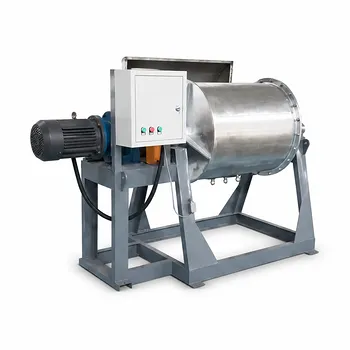
The primary function of low-energy ball milling in this specific context is to mechanically coat 316L stainless steel powders with Y2O3 nanoparticles without damaging the steel particles.
This process focuses on achieving a uniform distribution of the oxide phase onto the surface of the metallic powder. By utilizing low energy, the process avoids the severe deformation associated with traditional mechanical alloying, thereby preserving the spherical morphology and high flowability strictly required for additive manufacturing applications.
Core Insight: While traditional ODS preparation often uses high-energy milling to force oxides inside the metal matrix, low-energy milling is a strategic choice for Additive Manufacturing feedstock. It prioritizes powder flowability over internal alloying, ensuring the powder can actually be processed by 3D printing equipment.
The Mechanics of Low-Energy Mixing
Surface Coating vs. Internal Alloying
In the preparation of 316L-Y2O3 ODS steel for additive manufacturing, the goal is controlled mechanical mixing, not high-energy alloying.
The low-energy process acts as a coating mechanism. It adheres the nano-scale Y2O3 reinforcing phases onto the surface of the micron-sized 316L particles rather than fracturing the steel particles to embed the oxides internally.
Overcoming Electrostatic Agglomeration
Nano-powders like Y2O3 suffer from severe agglomeration due to electrostatic attraction.
Low-energy milling utilizes sufficient mechanical force to break these nano-clusters apart. It disperses the yttria particles individually across the steel surface, ensuring homogeneity without requiring the violent collisions of high-energy milling.
Preserving Material Integrity for Manufacturing
Preventing Work Hardening
High-energy collisions induce significant plastic deformation, known as work hardening, which makes metal powders brittle and irregular.
Low-energy milling prevents this excessive deformation. It ensures the 316L particles retain their original ductility and physical properties, which is critical for the structural integrity of the final printed part.
Maintaining Spherical Morphology
For additive manufacturing technologies (such as Laser Powder Bed Fusion or Direct Energy Deposition), the shape of the powder particle is paramount.
High-energy milling flattens and fractures particles. Low-energy milling maintains the original spherical morphology of the 316L powder, which is the primary driver of how well the powder flows.
Ensuring Superior Flowability
Flowability is the "deep need" driving the selection of this method.
If the powder cannot flow smoothly through standard feeding systems, the manufacturing process fails. By preserving particle shape and avoiding cold-welding, low-energy milling ensures the material is compatible with standard industrial powder feeders.
Understanding the Trade-offs
The Distinction from High-Energy Milling
It is vital to distinguish this process from the preparation of ODS ferritic steels or general mechanical alloying.
Commonly, high-energy ball milling is used to achieve atomic-level forced mixing and solid solutions, embedding oxides within the matrix. While this offers high internal dispersion, it destroys flowability.
The Limitation of Low-Energy Milling
The low-energy approach creates a "core-shell" type structure (steel core, oxide shell) rather than a fully alloyed internal structure.
This means the actual dispersion of oxides into the steel matrix must occur during the subsequent melting and solidification phases of the additive manufacturing process, rather than during the milling stage itself.
Making the Right Choice for Your Goal
The choice between low-energy and high-energy milling depends entirely on your fabrication method.
- If your primary focus is Additive Manufacturing (3D Printing): Use low-energy ball milling. It provides the necessary oxide distribution while strictly preserving the flowability required for powder feeding systems.
- If your primary focus is Press-and-Sinter (PM) or Extrusion: You may require high-energy ball milling. These processes often tolerate poor flowability but benefit from the superior internal dispersion and solid solution formation achieved through high-impact mechanical alloying.
Summary: Use low-energy ball milling when the physical behavior of the powder (flowability) is just as critical as its chemical composition.
Summary Table:
| Feature | Low-Energy Ball Milling | High-Energy Ball Milling |
|---|---|---|
| Primary Goal | Surface coating & distribution | Internal alloying & solid solution |
| Particle Shape | Preserves original spherical morphology | Fractures and flattens particles |
| Flowability | High (Ideal for Additive Manufacturing) | Low (Requires Press-and-Sinter) |
| Oxide Location | Adhered to the particle surface | Embedded within the metal matrix |
| Material Integrity | Prevents work hardening/brittleness | Induces severe plastic deformation |
Elevate Your Additive Manufacturing with KINTEK Precision
Unlock the full potential of ODS steel and advanced alloy development with KINTEK’s premium laboratory equipment. Whether you are optimizing 316L-Y2O3 powders for 3D printing or exploring complex mechanical alloying, our industry-leading crushing and milling systems, rotary furnaces, and high-pressure reactors provide the control you need for superior material integrity.
Why choose KINTEK?
- Advanced Milling Solutions: Achieve perfect surface coating or deep internal dispersion.
- Thermal Expertise: High-temperature furnaces (muffle, vacuum, CVD) for subsequent sintering.
- Comprehensive Support: From hydraulic presses to essential consumables like crucibles and ceramics.
Don't compromise on powder flowability or structural performance. Contact KINTEK today to discover how our specialized tools can streamline your research and production workflows!
References
- Wengang Zhai, Mui Ling Sharon Nai. Effect of Interface Wettability on Additively Manufactured Metal Matrix Composites: A Case Study of 316L-Y2O3 Oxide Dispersion-Strengthened Steel. DOI: 10.3390/met14020170
This article is also based on technical information from Kintek Solution Knowledge Base .
Related Products
- Stainless Steel Laboratory Ball Mill for Dry Powder and Liquid with Ceramic Polyurethane Lining
- High-Energy Omnidirectional Planetary Ball Mill Milling Machine for Laboratory
- Mini Planetary Ball Mill Machine for Laboratory Milling
- High-Energy Omnidirectional Planetary Ball Mill Machine for Laboratory
- High Energy Planetary Ball Mill for Laboratory Horizontal Tank Type Milling Machine
People Also Ask
- How do laboratory ball mills facilitate the mechanochemical synthesis of ZIF-8? Solvent-Free Synthesis Explained
- What is the primary function of a laboratory ball mill in the modification of sulfide-based solid electrolytes with LiPO2F2?
- How does a laboratory ball mill ensure the mixing quality of Mn3Zn0.8Sn0.2N and Ti? Achieve Perfect Homogeneity
- What is the function of a laboratory ball mill in the preparation of AMMCs? Optimize Dispersion & Grain Refinement
- In what way does a laboratory ball mill affect material properties when modifying PHBV/pulp fiber composites?