Knowledge What is the primary function of standard sieving systems? Master Matrix Uniformity for Advanced Composites
Author avatar

Tech Team · Kintek Solution

Updated 3 days ago

What is the primary function of standard sieving systems? Master Matrix Uniformity for Advanced Composites


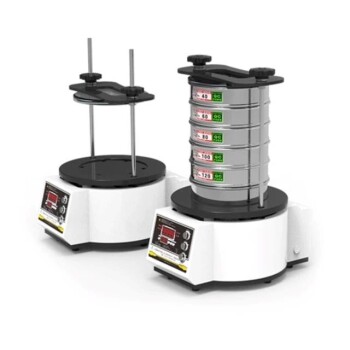
The primary function of standard sieving systems in the pretreatment of (WC + B4C)p/6063Al composites is the strict particle size classification of the 6063Al matrix powder. By grading the alloy powder to specific standards, such as -200 mesh, the system effectively removes oversized particles to ensure a highly uniform matrix base.

Core Takeaway Sieving is not merely a filtration step; it is the foundational process for structural homogeneity. By ensuring the uniformity of the 6063Al matrix powder, you create the necessary conditions for the Tungsten Carbide (WC) and Boron Carbide (B4C) reinforcements to distribute evenly, preventing clustering and ensuring consistent material properties.

Establishing the Foundation for Homogeneity

Precision Classification of Matrix Powder

The immediate role of the sieving system is to process the 6063Al alloy powder.

The goal is to achieve a specific particle size distribution, often strictly controlled to -200 mesh. This step eliminates oversized irregularities that would otherwise disrupt the continuity of the metal matrix.

Facilitating Reinforcement Distribution

While the sieving acts on the aluminum powder, its most critical impact is on the reinforcing phases (WC and B4C).

For a composite material to function correctly, the reinforcing particles must be dispersed evenly throughout the matrix. If the matrix powder consists of irregular or oversized particles, it creates "dead zones" where reinforcements cannot penetrate or, conversely, pockets where they cluster together (agglomerate).

Ensuring Microstructural Consistency

Uniform particle size in the pretreatment phase directly dictates the quality of subsequent processing steps.

By removing outliers early, the system establishes a consistent baseline for mixing and compaction. This uniformity minimizes density gradients during consolidation, laying the groundwork for a final microstructure with predictable mechanical performance.

Understanding the Trade-offs

The Cost of Strict Classification

Implementing strict sieving protocols (e.g., exclusively -200 mesh) inherently reduces the yield of usable raw powder per batch.

However, this material loss is a necessary trade-off for quality. Attempting to widen the acceptable size range to increase yield introduces particle size segregation. This leads to uneven mixing of the WC and B4C reinforcements, which results in weak points within the final composite where stress concentrations can cause premature failure.

The Risk of "Good Enough" Sieving

It is a common pitfall to assume that minor variations in particle size are negligible.

In particle-reinforced composites, however, even small deviations in matrix particle size can alter the packing density. Inconsistent packing leads to residual porosity and lowers the overall density of the billet, compromising the benefits of subsequent treatments like vacuum hot pressing or extrusion.

Making the Right Choice for Your Goal

When configuring your pretreatment protocols for (WC + B4C)p/6063Al composites, prioritize your objectives:

  • If your primary focus is Microstructural Integrity: Enforce strict sieving cutoffs (e.g., -200 mesh) to maximize the even distribution of WC and B4C particles, accepting lower powder yield for higher performance.
  • If your primary focus is Process Consistency: Standardize your sieving duration and mesh maintenance to prevent mesh blinding, ensuring that every batch of 6063Al powder has the exact same flow and packing characteristics.

Ultimately, the uniformity of your matrix powder is the single greatest predictor of how well your reinforcements will perform in the final composite.

Summary Table:

Process Phase Primary Action Impact on Final Composite
Classification Strict -200 mesh grading Removes oversized particles and ensures matrix continuity.
Reinforcement Preventing clustering Creates an ideal environment for even WC and B4C distribution.
Microstructure Homogeneity baseline Minimizes density gradients and improves mechanical performance.
Optimization Yield vs. Quality Balances powder yield against the risk of particle size segregation.

Elevate Your Materials Research with KINTEK Precision

Achieving structural homogeneity in (WC + B4C)p/6063Al composites starts with the right equipment. KINTEK specializes in providing high-performance sieving equipment and laboratory crushing systems designed to meet the strictest particle size standards.

Beyond powder preparation, our comprehensive portfolio supports your entire workflow—from vacuum hot pressing and induction melting furnaces for consolidation to hydraulic pellet presses and high-temperature reactors. Whether you are optimizing matrix uniformity or scaling up production, KINTEK delivers the reliable tools and consumables (including ceramics and crucibles) you need for predictable, high-performance results.

Ready to refine your composite manufacturing process? Contact our technical experts today to find the perfect equipment solution for your laboratory.

Related Products

People Also Ask

Related Products

Laboratory Test Sieves and Sieving Machines

Laboratory Test Sieves and Sieving Machines

Precision lab test sieves & sieving machines for accurate particle analysis. Stainless steel, ISO-compliant, 20μm-125mm range. Request specs now!

Laboratory Test Sieves and Vibratory Sieve Shaker Machine

Laboratory Test Sieves and Vibratory Sieve Shaker Machine

Efficiently process powders, granules, and small blocks with a high-frequency vibration sieve. Control vibration frequency, screen continuously or intermittently, and achieve accurate particle size determination, separation, and classification.

Laboratory Vibratory Sieve Shaker Machine for Dry and Wet Three-Dimensional Sieving

Laboratory Vibratory Sieve Shaker Machine for Dry and Wet Three-Dimensional Sieving

KT-VD200 can be used for sieving tasks of dry and wet samples in the laboratory. The screening quality is 20g-3kg. The product is designed with a unique mechanical structure and an electromagnetic vibrating body with a vibration frequency of 3000 times per minute.

Custom PTFE Teflon Parts Manufacturer for PTFE Mesh F4 Sieve

Custom PTFE Teflon Parts Manufacturer for PTFE Mesh F4 Sieve

PTFE mesh sieve is a specialized test sieve designed for particle analysis in various industries, featuring a non-metallic mesh woven from PTFE filament. This synthetic mesh is ideal for applications where metal contamination is a concern . PTFE sieves are crucial for maintaining the integrity of samples in sensitive environments, ensuring accurate and reliable results in particle size distribution analysis.

Vibratory Sieve Shaker Machine Dry Three-Dimensional Vibrating Sieve

Vibratory Sieve Shaker Machine Dry Three-Dimensional Vibrating Sieve

The KT-V200 product focuses on solving common sieving tasks in the laboratory. It is suitable for sieving 20g-3kg dry samples.

Lab Internal Rubber Mixer Rubber Kneader Machine for Mixing and Kneading

Lab Internal Rubber Mixer Rubber Kneader Machine for Mixing and Kneading

Lab internal rubber mixer is suitable for mixing, kneading and dispersing various chemical raw materials such as plastics, rubber, synthetic rubber, hot melt adhesive and various low-viscosity materials.

Lab Plastic PVC Calender Stretch Film Casting Machine for Film Testing

Lab Plastic PVC Calender Stretch Film Casting Machine for Film Testing

The cast film machine is designed for the molding of polymer cast film products and has multiple processing functions such as casting, extrusion, stretching, and compounding.

Automatic Lab Cold Isostatic Press CIP Machine Cold Isostatic Pressing

Automatic Lab Cold Isostatic Press CIP Machine Cold Isostatic Pressing

Efficiently prepare samples with our Automatic Lab Cold Isostatic Press. Widely used in material research, pharmacy, and electronic industries. Provides greater flexibility and control compared to electric CIPs.

Single Punch Electric Tablet Press Machine TDP Tablet Punching Machine

Single Punch Electric Tablet Press Machine TDP Tablet Punching Machine

The electric tablet punching machine is a laboratory equipment designed for pressing various granular and powdery raw materials into discs and other geometric shapes. It is commonly used in pharmaceutical, healthcare products, food, and other industries for small batch production and processing. The machine is compact, lightweight, and easy to operate, making it suitable for use in clinics, schools, laboratories, and research units.

Automatic Laboratory Hydraulic Pellet Press Machine for Lab Use

Automatic Laboratory Hydraulic Pellet Press Machine for Lab Use

Experience efficient sample preparation with our Automatic Lab Press Machine. Ideal for material research, pharmacy, ceramics, and more. Features a compact size and hydraulic press functionality with heating plates. Available in various sizes.

Rubber Vulcanizer Vulcanizing Machine Plate Vulcanizing Press for Lab

Rubber Vulcanizer Vulcanizing Machine Plate Vulcanizing Press for Lab

The Plate vulcanizing press is a kind of equipment used in the production of rubber products, mainly used for the vulcanization of rubber products. Vulcanization is a key step in rubber processing.

Laboratory Disc Rotary Mixer for Efficient Sample Mixing and Homogenization

Laboratory Disc Rotary Mixer for Efficient Sample Mixing and Homogenization

Efficient Laboratory Disc Rotary Mixer for Precise Sample Mixing, Versatile for Various Applications, DC Motor and Microcomputer Control, Adjustable Speed and Angle.

Electric Split Lab Cold Isostatic Press CIP Machine for Cold Isostatic Pressing

Electric Split Lab Cold Isostatic Press CIP Machine for Cold Isostatic Pressing

Split cold isostatic presses are capable of providing higher pressures, making them suitable for testing applications that require high pressure levels.

Metallographic Specimen Mounting Machine for Laboratory Materials and Analysis

Metallographic Specimen Mounting Machine for Laboratory Materials and Analysis

Precision metallographic mounting machines for labs—automated, versatile, and efficient. Ideal for sample prep in research and quality control. Contact KINTEK today!

Laboratory Sterilizer Lab Autoclave Herbal Powder Sterilization Machine for Plant

Laboratory Sterilizer Lab Autoclave Herbal Powder Sterilization Machine for Plant

The herbal powder sterilization autoclave machine for Chinese medicine uses saturated steam for effective sterilization. It utilizes the heat and penetrative properties of steam, achieves sterilization after heat preservation, and maintains a good drying effect with a dedicated drying system.

Heated Hydraulic Press Machine with Integrated Manual Heated Plates for Lab Use

Heated Hydraulic Press Machine with Integrated Manual Heated Plates for Lab Use

Efficiently process heat-pressing samples with our Integrated Manual Heated Lab Press. With a heating range up to 500°C, it's perfect for various industries.

Automatic Heated Hydraulic Press Machine with Heated Plates for Laboratory Hot Press 25T 30T 50T

Automatic Heated Hydraulic Press Machine with Heated Plates for Laboratory Hot Press 25T 30T 50T

Efficiently prepare your samples with our Automatic Heated Lab Press. With a pressure range up to 50T and precise control, it's perfect for various industries.

Manual High Temperature Heated Hydraulic Press Machine with Heated Plates for Lab

Manual High Temperature Heated Hydraulic Press Machine with Heated Plates for Lab

The High Temperature Hot Press is a machine specifically designed for pressing, sintering and processing materials in a high temperature environment. It is capable of operating in the range of hundreds of degrees Celsius to thousands of degrees Celsius for a variety of high temperature process requirements.

Lab Blown Film Extrusion Three Layer Co-Extrusion Film Blowing Machine

Lab Blown Film Extrusion Three Layer Co-Extrusion Film Blowing Machine

Lab blown film extrusion is mainly used to detect the feasibility of film blowing of polymer materials and the colloid condition in the materials, as well as the dispersion of colored dispersions, controlled mixtures, and extrudates;

Automatic High Temperature Heated Hydraulic Press Machine with Heated Plates for Lab

Automatic High Temperature Heated Hydraulic Press Machine with Heated Plates for Lab

The High Temperature Hot Press is a machine specifically designed for pressing, sintering and processing materials in a high temperature environment. It is capable of operating in the range of hundreds of degrees Celsius to thousands of degrees Celsius for a variety of high temperature process requirements.


Leave Your Message