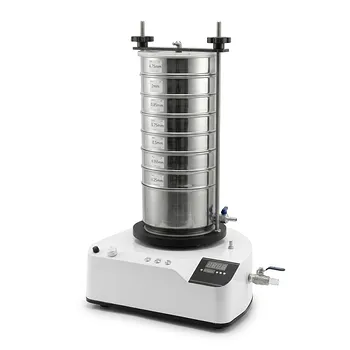
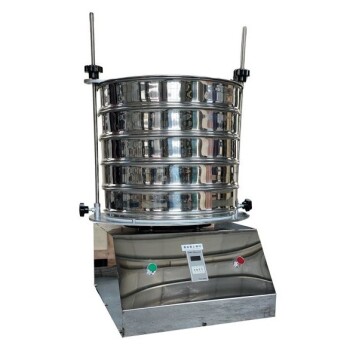
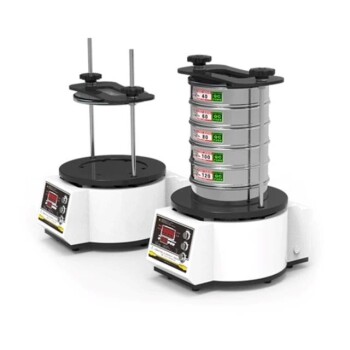
The primary objective of using a 325-mesh sieving system is to strictly regulate the maximum particle size of Mg3Sb2 powder, ensuring that every particle entering the next stage of processing is smaller than 45 microns (μm). This mechanical filtration is not merely about sorting; it is the critical control point that establishes the necessary physical conditions for successful material consolidation.
Core Takeaway While the immediate function of the sieve is filtration, its strategic purpose is to prepare the material for the sintering process. By guaranteeing a particle size under 45 μm, the system creates the uniformity required for high-density packing, minimized porosity, and a homogeneous final microstructure.
The Role of Particle Size in Material Quality
Regulating the Upper Limit
The 325-mesh designation refers to a specific screen size that acts as a strict "go/no-go" gauge for the powder.
Any particle larger than 45 μm is mechanically prevented from passing through. This ensures that no large agglomerates or inconsistent chunks contaminate the powder batch.
Achieving Physical Uniformity
Uniformity is the foundation of material performance.
The sieving process ensures that the raw material is not a random mix of sizes, but a controlled, consistent input. This step transforms raw crushed material into a standardized ingredient ready for engineering applications.
Why Sintering Requires Fine Powders
High-Density Packing
The ultimate goal of processing Mg3Sb2 is usually to create a solid, dense component via sintering.
Fine particles (under 45 μm) pack together much more efficiently than coarse or irregular particles. This tight packing is the physical prerequisite for achieving a high-density final product.
Minimizing Porosity
Porosity—empty spaces within the material—is generally detrimental to the mechanical and thermal properties of the final product.
By removing large particles that create gaps, the sieving system ensures that the particles can sit closer together. This leads to a minimized porosity in the final microstructure, resulting in a stronger, more reliable material.
Operational Challenges and Trade-offs
The Challenge of Adhesion
While fine powders are necessary for density, they introduce processing difficulties.
Very fine samples often have a tendency to adhere or clump together due to surface forces. This can make them difficult to sieve effectively, potentially blocking the mesh openings.
Managing Throughput
To overcome adhesion, operators may need to utilize sieving aids or mechanical agitation.
While these aids make the sample sievable and ensure the "perfect product" mentioned in quality control standards, they add a layer of complexity to the processing workflow. Balancing the need for extreme fineness with the practical ability to process the powder is a key operational trade-off.
Optimizing Your Powder Processing Strategy
To ensure your Mg3Sb2 processing yields the best possible results, consider your specific end-goals:
- If your primary focus is Maximum Density: Prioritize the integrity of the mesh to ensure zero particles larger than 45 μm contaminate the mix, as these create voids.
- If your primary focus is Process Efficiency: Monitor the sieve for clogging caused by particle adhesion and introduce sieving aids if the throughput drops.
Strict control over particle size is the single most effective way to guarantee a homogeneous, high-performance microstructure in your final sintered product.
Summary Table:
| Feature | Specification/Requirement | Impact on Processing |
|---|---|---|
| Sieve Mesh Size | 325 Mesh | Filters all particles to < 45 microns (μm) |
| Particle Consistency | High Uniformity | Ensures standardized input for sintering |
| Packing Density | High-Density Packing | Critical for reaching theoretical material density |
| Final Microstructure | Minimal Porosity | Results in superior mechanical and thermal properties |
| Operational Challenge | Particle Adhesion | Requires mechanical agitation for throughput |
Elevate Your Material Research with KINTEK Precision
Achieving the perfect 45 μm threshold is just the beginning of high-performance material synthesis. KINTEK specializes in advanced laboratory equipment designed to meet the rigorous demands of material science. From high-precision sieving equipment and crushing and milling systems for powder preparation to high-temperature furnaces and hydraulic presses for final consolidation, we provide the tools you need for zero-defect results.
Whether you are processing Mg3Sb2 for thermoelectrics or developing new battery materials, our comprehensive portfolio of PTFE consumables, ceramics, and crucibles ensures contamination-free workflows. Contact KINTEK today to discover how our expertise in laboratory solutions can optimize your sintering outcomes and enhance your lab's efficiency!
Related Products
- Three-dimensional electromagnetic sieving instrument
- Custom PTFE Teflon Parts Manufacturer for PTFE Mesh F4 Sieve
- Laboratory Vibratory Sieve Shaker Machine for Dry and Wet Three-Dimensional Sieving
- Laboratory Test Sieves and Sieving Machines
- Laboratory Wet Three-Dimensional Vibratory Sieve Shaker Machine
People Also Ask
- Why is sieving equipment essential for the classification of processed bio-activated carbon? Optimize Performance
- What are the limitations of sieving? Understanding the Constraints of Particle Size Analysis
- What are advantages and disadvantages of sieving method? A Guide to Reliable & Cost-Effective Particle Sizing
- How is sieving important? The Critical Role of Particle Size Analysis in Quality Control
- What is sieving and how does it work? A Guide to Accurate Particle Size Analysis