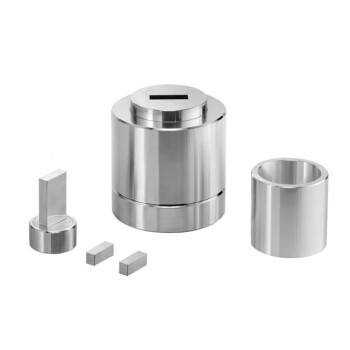
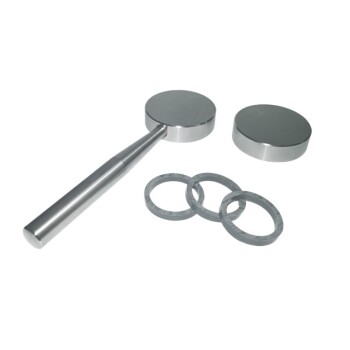
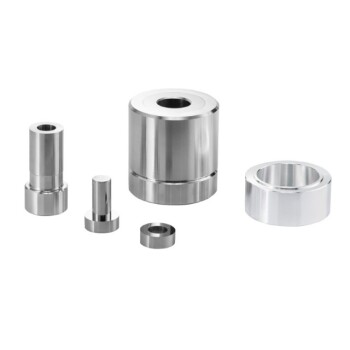
The primary function of a laboratory hydraulic press in this context is to transform synthesized Ruddlesden–Popper perovskite oxide (RPPO) powders into highly dense, cohesive pellets. This mechanical densification is a prerequisite for valid testing because it eliminates the physical voids that naturally exist in loose powder.
By compressing the material into a solid form, the press ensures optimal physical contact between the electrolyte grains and the testing electrodes. Without this step, the Electrochemical Impedance Spectroscopy (EIS) data would measure the resistance of air gaps and poor contact points rather than the actual ionic conductivity of the material.
Core Takeaway The hydraulic press eliminates inter-particle porosity and minimizes grain boundary resistance through high-pressure densification. This ensures that subsequent impedance measurements reflect the intrinsic material properties of the RPPO electrolyte, rather than artifacts caused by voids or poor electrode interfaces.
The Mechanics of Data Integrity
To understand why this step is non-negotiable, one must look beyond the simple act of "squishing" powder. The hydraulic press serves three specific technical needs regarding the microstructure of the sample.
Minimizing Inter-particle Porosity
Synthesized RPPO initially exists as a loose powder. In this state, the vast majority of the volume is occupied by air, which is an electrical insulator.
A hydraulic press applies significant force (often between 300 and 400 MPa) to mechanically force particles together. This densification process drastically reduces the void volume, creating a continuous path for ions to travel.
Reducing Grain Boundary Resistance
Even when particles touch, the interface between them—the grain boundary—can act as a barrier to ionic transport.
High-pressure compression reduces the distance between grains. By forcing particles into intimate contact, the press minimizes grain boundary resistance. This ensures that the impedance spectrum captures the movement of ions through the bulk material and across grain boundaries, rather than stalling at physical gaps.
Ensuring Electrode-Electrolyte Contact
EIS testing relies on the application of an electrical signal through blocking electrodes.
If the sample surface is porous or rough, the contact area with the electrode is significantly reduced. The press molds the powder into a pellet with a smooth, uniform surface. This guarantees tight physical contact with the electrodes, preventing contact resistance from overwhelming the measurement of the electrolyte's performance.
Critical Considerations and Trade-offs
While the hydraulic press is essential, the pressing parameters must be carefully managed to avoid introducing new variables into your data.
Density vs. Mechanical Integrity
Applying higher pressure generally yields better density, which is desirable for conductivity.
However, excessive pressure or rapid release of pressure can introduce micro-cracks or lamination within the pellet. These structural defects can interrupt ionic pathways just as voids do, leading to noisy or inconsistent EIS data.
Green Body vs. Sintered Product
It is important to distinguish between the "green pellet" formed by the press and the final sintered product.
The press provides mechanical densification. However, for many oxide electrolytes, this is often a precursor to high-temperature sintering. Sintering converts the mechanical contact achieved by the press into chemical bonding. The press sets the stage by creating the initial packing density required for successful sintering and grain growth.
Making the Right Choice for Your Goal
To ensure your EIS data is both accurate and reproducible, apply the following principles to your pressing protocols:
- If your primary focus is Intrinsic Conductivity: Apply sufficient pressure (e.g., 300–400 MPa) to maximize density, ensuring that the measured resistance is dominated by the crystal lattice and grain boundaries, not air voids.
- If your primary focus is Reproducibility: Standardize the specific pressure, dwell time, and pellet geometry across all samples to eliminate variations in porosity as a confounding variable in your comparative analysis.
The hydraulic press acts as the critical bridge between raw synthesis and reliable characterization, ensuring that your data represents the chemistry of your material rather than the geometry of its packing.
Summary Table:
| Feature | Role in EIS Preparation | Impact on Data Quality |
|---|---|---|
| Mechanical Densification | Eliminates voids and inter-particle porosity | Ensures continuous ionic pathways |
| Interface Optimization | Minimizes grain boundary resistance | Isolates intrinsic material resistance |
| Surface Uniformity | Guarantees tight electrode-electrolyte contact | Prevents contact resistance artifacts |
| Pressure Standardization | Maintains consistent pellet density | Enables reproducible comparative analysis |
Elevate Your Material Research with KINTEK Precision
Don't let air gaps and poor contact compromise your EIS data integrity. KINTEK specializes in high-performance laboratory equipment, providing the advanced hydraulic presses (pellet, hot, and isostatic) required to achieve the high-pressure densification (300-400 MPa) necessary for Ruddlesden–Popper perovskite research.
From pellet preparation and crushing systems to high-temperature furnaces and sintering solutions, KINTEK offers the complete workflow for solid electrolyte characterization. Our precision tools ensure your measurements reflect true material properties, not experimental artifacts.
Ready to optimize your pellet densification process?
Contact our technical experts today to find the perfect pressing solution for your lab.
Related Products
- Automatic Laboratory Hydraulic Press for XRF & KBR Pellet Press
- Automatic Laboratory Hydraulic Pellet Press Machine for Lab Use
- Laboratory Manual Hydraulic Pellet Press for Lab Use
- Laboratory Hydraulic Pellet Press for XRF KBR FTIR Lab Applications
- Laboratory Manual Hydraulic Pellet Press for Lab Use
People Also Ask
- What is the significance of applying 200 MPa of pressure with a laboratory hydraulic pellet press for composite ceramics?
- What is the role of a laboratory hydraulic pellet press and stainless steel molds in the fabrication of RuO2/NbC anodes?
- What is the necessity of using a laboratory hydraulic pellet press in the preparation of biomass fuel pellets? Guide
- How does a laboratory hydraulic pellet press contribute to SiCw/2024 aluminum composite preforms? Optimize Densification
- What role does a laboratory hydraulic pellet press play in fly ash utilization? Enhancing Adsorption and Flow Control