Knowledge What is the process of making diamonds called? Discover HPHT & CVD Lab-Grown Methods
Author avatar

Tech Team · Kintek Solution

Updated 6 days ago

What is the process of making diamonds called? Discover HPHT & CVD Lab-Grown Methods


There is no single process for making diamonds. Instead, two primary industrial methods are used to create lab-grown diamonds: High Pressure, High Temperature (HPHT) and Chemical Vapor Deposition (CVD). Both processes result in diamonds that are chemically and physically identical to those mined from the earth.

The core distinction lies in their approach: HPHT mimics the intense, crushing force of nature that forms diamonds deep within the Earth, while CVD systematically builds a diamond layer by layer from a carbon-rich gas.
What is the process of making diamonds called? Discover HPHT & CVD Lab-Grown Methods

Method 1: High Pressure, High Temperature (HPHT) – Replicating Nature

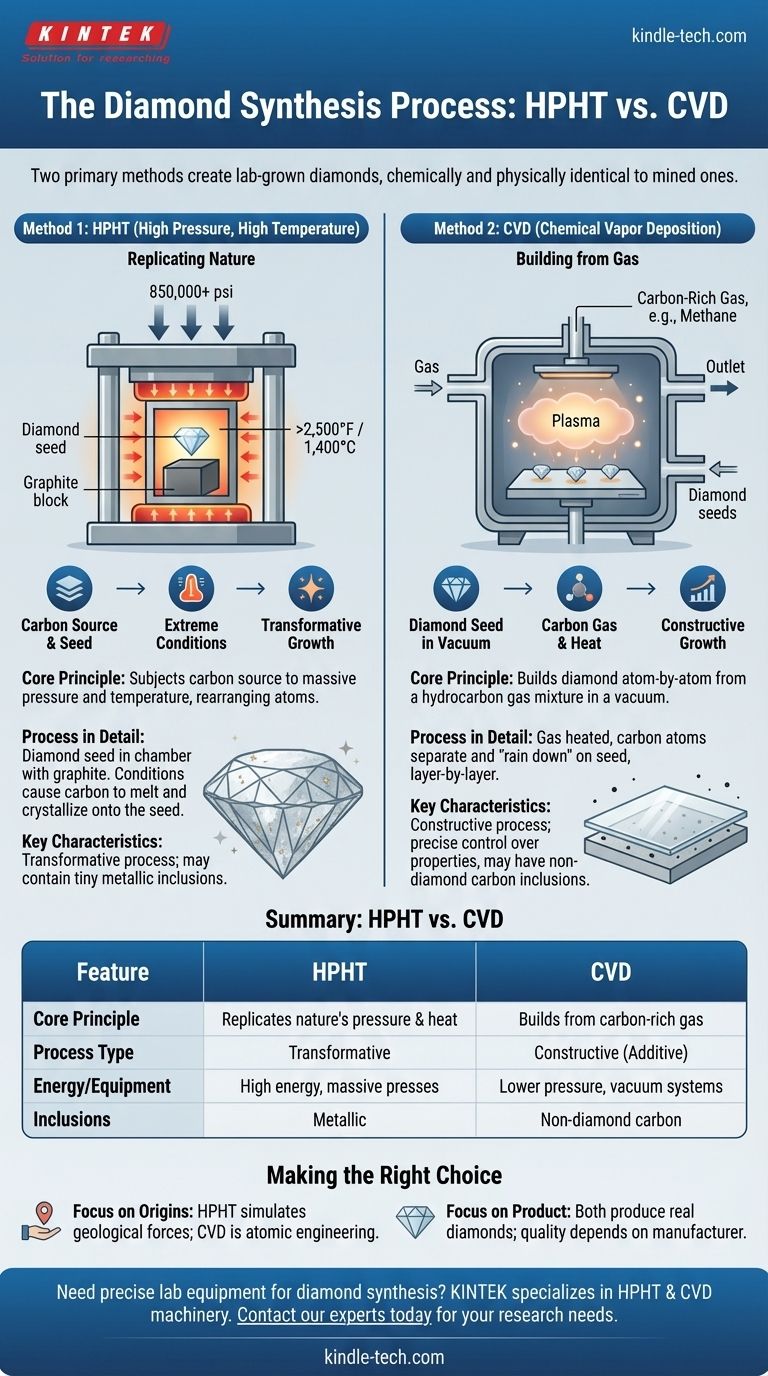
The HPHT method is the original process for creating diamonds and is engineered to replicate the natural conditions found in the Earth's mantle.

The Core Principle

This process subjects a carbon source to enormous pressure and extremely high temperatures, forcing the carbon atoms to rearrange into the crystal lattice structure of a diamond.

The Process in Detail

A small, natural diamond fragment, known as a diamond seed, is placed in a chamber with a pure carbon source, like graphite.

The chamber is then subjected to pressures exceeding 850,000 pounds per square inch and temperatures over 2,500° F (1,400° C).

Under these extreme conditions, the carbon source melts and dissolves, then crystallizes onto the diamond seed, growing into a larger, rough diamond.

Method 2: Chemical Vapor Deposition (CVD) – Building from Gas

The CVD method is a more recent innovation that grows diamonds in a completely different environment, moving away from brute force and toward atomic precision.

The Core Principle

CVD involves growing a diamond from a hydrocarbon gas mixture. It is fundamentally an additive process, building the diamond one atomic layer at a time.

The Process in Detail

A diamond seed is placed inside a sealed vacuum chamber. The chamber is then filled with a mixture of carbon-rich gases, such as methane.

This gas is heated to a high temperature, causing the carbon atoms to separate from their molecules. These free carbon atoms then "rain down" and bond to the diamond seed, slowly building up the crystal structure.

Key Advantages of CVD

The CVD process is noted for its flexibility. It allows for precise control over the chemical impurities and ultimate properties of the diamond, and it can be used to grow diamond films over large surface areas for industrial applications.

Understanding the Key Differences and Trade-offs

While both HPHT and CVD produce real diamonds, the processes themselves have distinct characteristics and implications for the final product.

Mimicking Nature vs. Atomic Construction

HPHT is a transformative process; it transforms one form of carbon (graphite) into another (diamond). CVD is a constructive process; it builds a diamond from individual atoms supplied by a gas.

Energy and Equipment

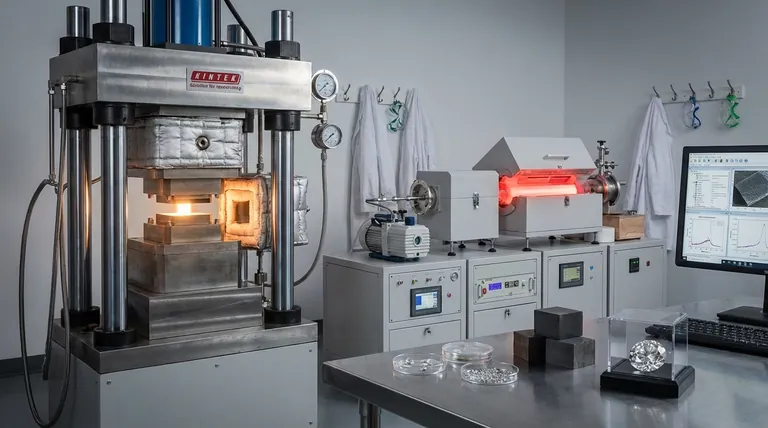
The HPHT method requires massive, complex presses capable of generating immense force, making it a highly energy-intensive process. CVD operates at much lower pressures, though it requires sophisticated vacuum and gas control systems.

Growth Patterns and Inclusions

Due to the different growth environments, HPHT and CVD diamonds can sometimes be distinguished by their growth patterns when examined by gemologists. HPHT diamonds may contain tiny metallic inclusions from the machinery, while CVD diamonds are more likely to have non-diamond carbon inclusions.

Making the Right Choice for Your Goal

Understanding these methods is less about choosing one over the other and more about appreciating the technology behind modern diamonds.

  • If your primary focus is on the origins: Recognize that HPHT most closely simulates the geological forces of nature, while CVD represents a triumph of atomic-scale engineering.
  • If your primary focus is on the final product: Know that both methods produce physically and chemically real diamonds, with the final quality depending entirely on the skill and precision of the manufacturer.

Ultimately, both HPHT and CVD are sophisticated engineering achievements that produce diamonds identical to their natural counterparts.

Summary Table:

Process Core Principle Key Characteristics
HPHT Replicates natural conditions with extreme heat and pressure. Transformative process; may contain metallic inclusions.
CVD Builds diamond layer-by-layer from a carbon-rich gas. Constructive process; offers precise control over properties.

Need precise, high-quality lab equipment for your diamond synthesis or material science research? KINTEK specializes in the advanced machinery and consumables required for both HPHT and CVD processes. Our expertise ensures you have the reliable tools needed for successful outcomes. Contact our experts today to discuss your specific laboratory requirements!

Visual Guide
What is the process of making diamonds called? Discover HPHT & CVD Lab-Grown Methods Visual Guide

Related Products

People Also Ask

Related Products

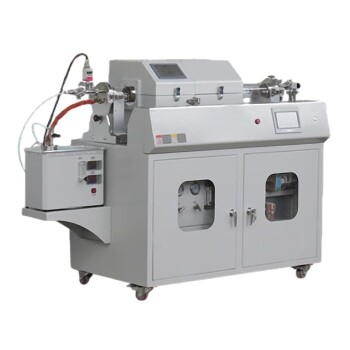
Chemical Vapor Deposition CVD Equipment System Chamber Slide PECVD Tube Furnace with Liquid Gasifier PECVD Machine

Chemical Vapor Deposition CVD Equipment System Chamber Slide PECVD Tube Furnace with Liquid Gasifier PECVD Machine

KT-PE12 Slide PECVD System: Wide power range, programmable temp control, fast heating/cooling with sliding system, MFC mass flow control & vacuum pump.

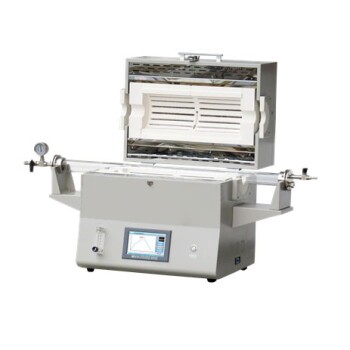
Customer Made Versatile CVD Tube Furnace Chemical Vapor Deposition Chamber System Equipment

Customer Made Versatile CVD Tube Furnace Chemical Vapor Deposition Chamber System Equipment

Get your exclusive CVD furnace with KT-CTF16 Customer Made Versatile Furnace. Customizable sliding, rotating, and tilting functions for precise reactions. Order now!

RF PECVD System Radio Frequency Plasma-Enhanced Chemical Vapor Deposition RF PECVD

RF PECVD System Radio Frequency Plasma-Enhanced Chemical Vapor Deposition RF PECVD

RF-PECVD is an acronym for "Radio Frequency Plasma-Enhanced Chemical Vapor Deposition." It deposits DLC (Diamond-like carbon film) on germanium and silicon substrates. It is utilized in the 3-12um infrared wavelength range.

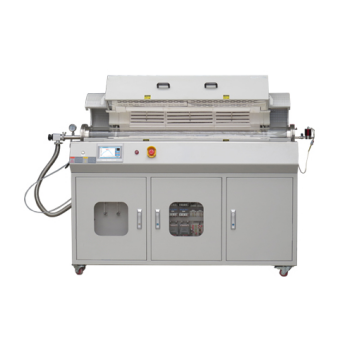
Split Chamber CVD Tube Furnace with Vacuum Station Chemical Vapor Deposition System Equipment Machine

Split Chamber CVD Tube Furnace with Vacuum Station Chemical Vapor Deposition System Equipment Machine

Efficient split chamber CVD furnace with vacuum station for intuitive sample checking and quick cooling. Up to 1200℃ max temperature with accurate MFC mass flowmeter control.

1200℃ Split Tube Furnace with Quartz Tube Laboratory Tubular Furnace

1200℃ Split Tube Furnace with Quartz Tube Laboratory Tubular Furnace

KT-TF12 split tube furnace: high-purity insulation, embedded heating wire coils, and max. 1200C. Widely used for new materials and chemical vapour deposition.

1400℃ Laboratory Quartz Tube Furnace with Alumina Tube Tubular Furnace

1400℃ Laboratory Quartz Tube Furnace with Alumina Tube Tubular Furnace

Looking for a tube furnace for high-temperature applications? Our 1400℃ Tube Furnace with Alumina Tube is perfect for research and industrial use.

1700℃ Laboratory Quartz Tube Furnace with Alumina Tube Tubular Furnace

1700℃ Laboratory Quartz Tube Furnace with Alumina Tube Tubular Furnace

Looking for a high-temperature tube furnace? Check out our 1700℃ Tube Furnace with Alumina Tube. Perfect for research and industrial applications up to 1700C.

High Temperature Muffle Oven Furnace for Laboratory Debinding and Pre Sintering

High Temperature Muffle Oven Furnace for Laboratory Debinding and Pre Sintering

KT-MD High temperature debinding and pre-sintering furnace for ceramic materials with various molding processes. Ideal for electronic components such as MLCC and NFC.

Laboratory Muffle Oven Furnace Bottom Lifting Muffle Furnace

Laboratory Muffle Oven Furnace Bottom Lifting Muffle Furnace

Efficiently produce batches with excellent temperature uniformity using our Bottom Lifting Furnace. Features two electric lifting stages and advanced temperature control up to 1600℃.

1800℃ Muffle Oven Furnace for Laboratory

1800℃ Muffle Oven Furnace for Laboratory

KT-18 muffle furnace with Japan Al2O3 polycrystalline fibe and Silicon Molybdenum heating element, up to 1900℃, PID temperature control and 7" smart touch screen. Compact design, low heat loss, and high energy efficiency. Safety interlock system and versatile functions.

1700℃ Controlled Atmosphere Furnace Nitrogen Inert Atmosphere Furnace

1700℃ Controlled Atmosphere Furnace Nitrogen Inert Atmosphere Furnace

KT-17A Controlled atmosphere furnace: 1700℃ heating, vacuum sealing technology, PID temperature control, and versatile TFT smart touch screen controller for laboratory and industrial use.

1400℃ Controlled Atmosphere Furnace with Nitrogen and Inert Atmosphere

1400℃ Controlled Atmosphere Furnace with Nitrogen and Inert Atmosphere

Achieve precise heat treatment with KT-14A controlled atmosphere furnace. Vacuum sealed with a smart controller, it's ideal for lab and industrial use up to 1400℃.

1700℃ Muffle Oven Furnace for Laboratory

1700℃ Muffle Oven Furnace for Laboratory

Get superior heat control with our 1700℃ Muffle Furnace. Equipped with intelligent temperature microprocessor, TFT touch screen controller & advanced insulation materials for precise heating up to 1700C. Order now!

Laboratory Quartz Tube Furnace Tubular RTP Heating Furnace

Laboratory Quartz Tube Furnace Tubular RTP Heating Furnace

Get lightning-fast heating with our RTP Rapid Heating Tube Furnace. Designed for precise, high-speed heating and cooling with convenient sliding rail and TFT touch screen controller. Order now for ideal thermal processing!

1400℃ Muffle Oven Furnace for Laboratory

1400℃ Muffle Oven Furnace for Laboratory

Get precise high-temperature control up to 1500℃ with KT-14M Muffle furnace. Equipped with a smart touch screen controller and advanced insulation materials.

Vertical Laboratory Quartz Tube Furnace Tubular Furnace

Vertical Laboratory Quartz Tube Furnace Tubular Furnace

Elevate your experiments with our Vertical Tube Furnace. Versatile design allows for operation under various environments and heat treatment applications. Order now for precise results!

Vacuum Heat Treat Sintering Brazing Furnace

Vacuum Heat Treat Sintering Brazing Furnace

A vacuum brazing furnace is a type of industrial furnace used for brazing, a metalworking process that joins two pieces of metal using a filler metal that melts at a lower temperature than the base metals. Vacuum brazing furnaces are typically used for high-quality applications where a strong, clean joint is required.

Rotary Tube Furnace Split Multi Heating Zone Rotating Tube Furnace

Rotary Tube Furnace Split Multi Heating Zone Rotating Tube Furnace

Multi zone rotary furnace for high-precision temperature control with 2-8 independent heating zones. Ideal for lithium ion battery electrode materials and high-temperature reactions. Can work under vacuum and controlled atmosphere.

1200℃ Controlled Atmosphere Furnace Nitrogen Inert Atmosphere Furnace

1200℃ Controlled Atmosphere Furnace Nitrogen Inert Atmosphere Furnace

Discover our KT-12A Pro Controlled atmosphere furnace - high precision, heavy duty vacuum chamber, versatile smart touch screen controller, and excellent temperature uniformity up to 1200C. Ideal for both laboratory and industrial application.

Vacuum Sealed Continuous Working Rotary Tube Furnace Rotating Tube Furnace

Vacuum Sealed Continuous Working Rotary Tube Furnace Rotating Tube Furnace

Experience efficient material processing with our vacuum-sealed rotary tube furnace. Perfect for experiments or industrial production, equipped with optional features for controlled feeding and optimized results. Order now.


Leave Your Message