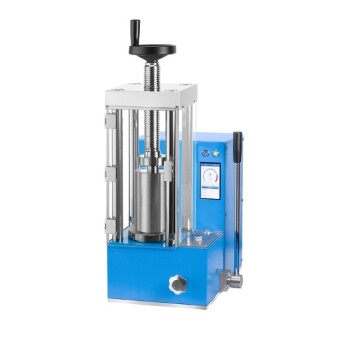
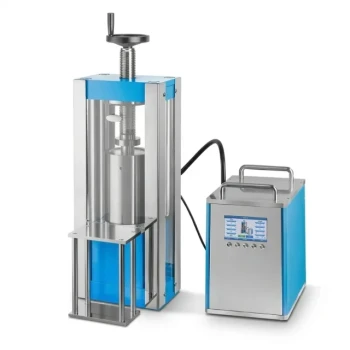
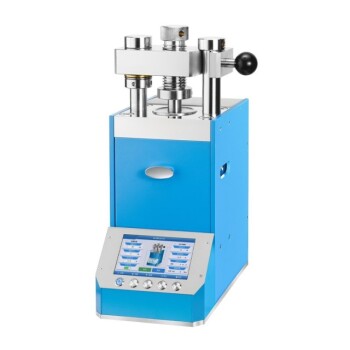
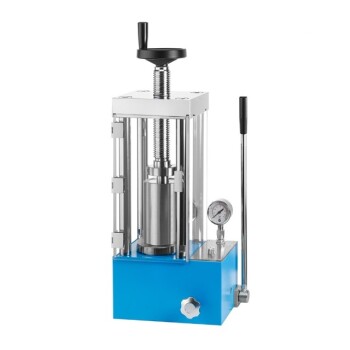
The primary purpose of using a laboratory hydraulic press for diamond and aluminum powder mixtures is to transform loose, aerated particles into a cohesive, high-density solid known as a "green compact." This cold pressing step acts as a critical bridge between raw material preparation and the final sintering process, ensuring the mixture has the necessary structural integrity and density to survive subsequent manufacturing stages.
Core Takeaway: Cold pressing is not merely about shaping; it is a density-management strategy. By mechanically expelling air and forcing particle rearrangement prior to heating, you minimize volume shrinkage and ensure internal uniformity during the critical hot-pressing phase.
Establishing the Green Compact
The immediate goal of the hydraulic press is to create a "green compact"—a formed object that holds together without the aid of heat or chemical bonding.
Increasing Initial Packing Density
Loose diamond and aluminum powders naturally contain significant void space. The hydraulic press applies mechanical force to push these grains into closer contact.
This process forces the particles to flow and rearrange, drastically reducing the gaps between them. The result is a significant increase in the initial packing density of the material.
Creating Specific Geometry and Strength
The press shapes the loose powder into a specific form (typically a pellet or cylinder) with defined dimensions.
Crucially, this imparts "green strength" to the material. This strength ensures the compact acts as a solid object that does not crumble or fall apart once the load is removed.
Facilitating Handling and Logistics
Without cold pressing, transferring loose powder into a hot-pressing mold is messy and prone to error.
The compacted green body is stable enough to be handled, stored, or loaded into hot-pressing molds without losing its shape or integrity.
Optimizing the Sintering Process
While the surface need is shaping, the deep need addressed by the hydraulic press is the optimization of the subsequent vacuum hot pressing or sintering steps.
Expelling Trapped Air
Air trapped between powder particles acts as a defect in the final composite. The initial pressure from the hydraulic press expels the majority of this air from the gaps between the powders.
Removing this air early is essential for preventing defects and ensuring a dense, high-quality final product.
Reducing Volume Shrinkage
If you load loose powder directly into a hot press, the material will undergo massive volume reduction as it heats and sinters.
By cold pressing first, you achieve initial densification. This significantly reduces the amount of volume shrinkage that occurs during the hot pressing phase, making the final dimensions more predictable.
Ensuring Internal Uniformity
The mechanical rearrangement of particles during cold pressing promotes a homogeneous distribution of diamond and aluminum.
This step is vital for ensuring the internal structure of the final diamond/aluminum composite is uniform, avoiding areas of segregated material or inconsistent density.
Understanding the Trade-offs
While necessary, the cold pressing process relies on mechanical force rather than thermal bonding, which introduces specific limitations you must manage.
The Limits of Green Strength
The compact created is held together by mechanical interlocking and friction, not chemical bonds. While it is stable enough for handling, it remains relatively fragile compared to the final sintered product and must still be treated with care.
Density vs. Flow
The press relies on the powder's ability to flow and rearrange. Once the available volume is reduced, particles deform elastically and plastically.
If the pressure is applied unevenly, or if the powder does not flow well, you may achieve a compact that looks solid on the outside but has inconsistent density gradients internally.
Making the Right Choice for Your Goal
When integrating a laboratory hydraulic press into your workflow, consider your primary objective:
- If your primary focus is process efficiency: Use the press to maximize the "green strength" of the compact, ensuring it is robust enough for rapid handling and storage without breakage.
- If your primary focus is material quality: Prioritize the maximization of initial packing density to expel the maximum amount of air, ensuring the highest possible uniformity in the final composite.
The hydraulic press is the foundational tool that turns a volatile mixture into a manageable, engineering-grade precursor.
Summary Table:
| Feature | Benefit of Cold Pressing |
|---|---|
| Particle Packing | Mechanical rearrangement increases initial density and removes void space. |
| Structural Integrity | Creates 'green strength' for stable handling without heat or chemical bonding. |
| Sintering Prep | Expels trapped air to prevent defects and minimize volume shrinkage during hot pressing. |
| Internal Quality | Ensures a homogeneous distribution of diamond and aluminum for uniform final composites. |
Transform Your Powder Research with KINTEK
Precision material engineering starts with the right equipment. KINTEK specializes in advanced laboratory solutions tailored for high-performance material synthesis. Whether you are creating green compacts for diamond-aluminum composites or performing high-pressure material testing, our comprehensive range of laboratory hydraulic presses (pellet, hot, isostatic), crushing and milling systems, and high-temperature furnaces provides the reliability your research demands.
Why partner with KINTEK?
- Versatility: From atmosphere-controlled sintering to precision sample preparation.
- Quality: Durable consumables including PTFE products, ceramics, and crucibles.
- Expertise: Specialized tools for battery research, cooling solutions, and high-pressure reactors.
Contact our laboratory specialists today to find the perfect hydraulic press and consumables for your specific application and ensure your materials reach their peak density and performance.
Related Products
- Electric Lab Cold Isostatic Press CIP Machine for Cold Isostatic Pressing
- 30T 40T Split Automatic Heated Hydraulic Press Machine with Heated Plates for Laboratory Hot Press
- Electric Split Lab Cold Isostatic Press CIP Machine for Cold Isostatic Pressing
- Automatic Lab Cold Isostatic Press CIP Machine Cold Isostatic Pressing
- Laboratory Hydraulic Press Lab Pellet Press Machine for Glove Box
People Also Ask
- What role does cold isostatic pressing play in the formation of feed rods for single crystal growth? Ensure Stability.
- What is isostatic pressing method for ceramics? Achieve Uniform Density for Complex Parts
- In what ways does Cold Isostatic Pressing (CIP) enhance LiFePO4 battery performance? Boost Density and Conductivity
- How does Cold Isostatic Pressing (CIP) benefit SiC ceramic reactors? Achieve Flawless Material Integrity
- Why is a cold isostatic press advantageous for Argyrodite sulfide solid-state batteries? Achieve Optimal Densification