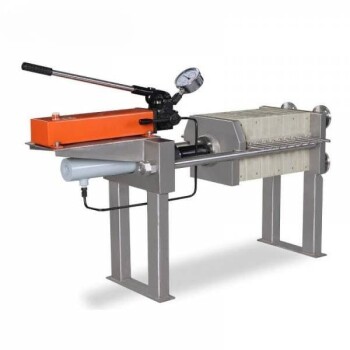
The primary purpose of a laboratory hydraulic press in the fabrication of LATP (Lithium Aluminum Titanium Phosphate) sheets is to apply high-intensity pressure to compress calcined powder into a solid, dense form known as a "green body." This step transforms loose, ball-milled powder into a cohesive circular pellet, establishing the structural foundation required for the material to function as a solid electrolyte.
The hydraulic press serves a critical densification role: it mechanically minimizes the voids (porosity) between powder particles before thermal processing. By creating a tightly packed green body, the press ensures the subsequent sintering stage yields a ceramic with the high density necessary for superior ionic conductivity.
The Mechanics of Densification
Creating the "Green Body"
The immediate output of the hydraulic press is a green body. This is a compacted pellet that has not yet been fired but possesses a defined shape and volume.
The press uses specialized dies to apply uniform axial pressure to the LATP powder. This forces the loose particles to rearrange and pack tightly together, effectively interlocking them into a solid mass.
Reducing Porosity
The single biggest enemy of a solid electrolyte is porosity. Air gaps between particles act as barriers to lithium-ion movement, drastically lowering conductivity.
By applying pressures that can range significantly (e.g., from 10 MPa up to 300 MPa depending on the specific protocol), the hydraulic press physically squeezes air out of the powder mixture. This reduction in inter-particle porosity is vital for the material's final electrochemical performance.
Establishing Initial Density
The density achieved during this pressing stage is called green density.
The primary reference confirms that high green density is a prerequisite for high sintered density. If the particles are not pressed close enough together initially, they cannot fuse properly during the high-temperature heating stage.
Preparing for Sintering and Handling
Enabling the Sintering Process
Sintering is the process where particles fuse into a solid ceramic at high temperatures. This process relies on atomic diffusion between particles.
The hydraulic press ensures intimate contact between the LATP particles. Without this pre-compression, the diffusion distance between particles would be too great, resulting in a weak, porous ceramic rather than a dense, conductive electrolyte.
Ensuring Mechanical Strength
Beyond electrochemical needs, there is a practical physical requirement: structural integrity.
The press compacts the powder with enough force to give the pellet sufficient mechanical strength to be handled. This allows the delicate green body to be removed from the mold and transported to a furnace without crumbling, delaminating, or losing its shape.
Understanding the Trade-offs
The Risk of Insufficient Pressure
If the pressure applied is too low, the green body will retain too much air. This leads to a low-density final product with poor ionic conductivity and weak mechanical structure that may crumble during handling.
The Limits of Pressure
While high pressure is generally beneficial for density, the application must be precisely controlled. Inconsistent pressure application can lead to density gradients within the pellet, which may cause warping or cracking during the sintering phase.
Making the Right Choice for Your Goal
To maximize the effectiveness of the hydraulic press in your LATP formation process, consider these targeted approaches:
- If your primary focus is maximum ionic conductivity: Aim for higher pressure ranges (e.g., up to 300 MPa) to maximize the initial packing density and minimize the distance lithium ions must travel.
- If your primary focus is process stability: Ensure your dies are perfectly aligned to apply uniform axial pressure, preventing delamination and ensuring the green body survives the transfer to the sintering furnace.
- If your primary focus is reproducible results: Standardize the specific pressure (e.g., 10 MPa vs 300 MPa) and dwell time, as variations in "green density" will directly alter the final ceramic properties.
The laboratory hydraulic press is not merely a shaping tool; it is the critical density-determining step that dictates the ultimate performance of the solid electrolyte.
Summary Table:
| Stage | Function of Hydraulic Press | Impact on LATP Performance |
|---|---|---|
| Powder Compaction | Transforms loose powder into a cohesive 'green body' | Establishes the structural foundation of the electrolyte |
| Densification | Mechanically reduces inter-particle porosity | Maximizes ionic conductivity by removing air barriers |
| Pre-Sintering | Ensures intimate contact between particles | Facilitates atomic diffusion and fusion during heat treatment |
| Handling | Increases mechanical strength of the pellet | Allows damage-free transport from the die to the furnace |
Precision Compaction for Superior Solid-State Battery Research
Maximize the ionic conductivity of your LATP ceramic sheets with KINTEK’s high-precision laboratory hydraulic presses. Whether you require manual pellet presses for rapid prototyping or automated isostatic systems for uniform density, KINTEK provides the specialized tooling and pressure control necessary to eliminate porosity and ensure consistent green body quality.
Our laboratory solutions for battery research include:
- Hydraulic Presses: Pellet, hot, and isostatic presses for superior densification.
- Materials Processing: High-performance crushing, milling, and sieving systems.
- Thermal Treatment: Muffle, vacuum, and atmosphere furnaces for precise sintering.
- Battery Consumables: PTFE products, ceramics, and high-purity crucibles.
Contact KINTEK today to optimize your electrolyte fabrication workflow!
Related Products
- Laboratory Hydraulic Press Lab Pellet Press Machine for Glove Box
- Laboratory Hydraulic Press Split Electric Lab Pellet Press
- Laboratory Hydraulic Press Lab Pellet Press for Button Battery
- Automatic Laboratory Hydraulic Press for XRF & KBR Pellet Press
- Automatic Laboratory Hydraulic Pellet Press Machine for Lab Use
People Also Ask
- What is the function of a laboratory hydraulic press in W-Cu composites? Control Porosity and Material Ratio
- What is the role of a laboratory hydraulic press in the initial stages of Li6PS5Cl preparation? Key to Green Pellets
- What role does a laboratory hydraulic press play in triboelectric testing? Achieve Precision Alloy Sample Prep
- How can a laboratory hydraulic press be applied to chitosan for wastewater treatment? Optimize Pores & Strength
- How do a precision laboratory hydraulic press and specialized molds contribute to the fabrication of spherical ceramic samples? Achieving High-Density Material Precision