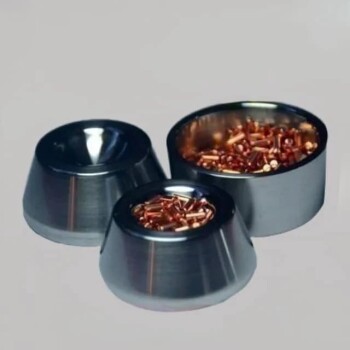
In the context of testing calcined boron mud clinker, the crucible serves as a high-precision containment vessel designed to withstand rigorous experimental conditions. It holds specific quantities of the clinker throughout the hydration, drying, and weighing phases, providing a chemically stable environment that resists high temperatures. Its role is fundamental to the testing process, ensuring that the sample can be subjected to thermal cycling without the container itself interfering with the results.
The crucible is not merely a holder; it is an instrument of isolation. By maintaining absolute mass stability during repeated heating and cooling cycles, it ensures that any measured weight change is exclusively due to the hydration activity of the clinker, safeguarding data accuracy.
The Functional Role in Testing
Containing the Specimen
The primary logistical function of the crucible is to securely hold specific quantities of calcined clinker.
It acts as the constant vessel during the actual hydration experiments. This ensures that the sample is kept intact and free from external contaminants throughout the process.
Enduring Thermal Stress
The testing process involves significant temperature fluctuations.
The crucible is specifically selected to be high-temperature resistant. It must endure the heat of drying and calcination without degrading or warping.
Chemical Stability
Beyond heat, the crucible must be chemically stable.
It must not react with the calcined boron mud clinker or the hydration fluids. This inertness prevents chemical interference that could skew the analysis of the material's activity.
Ensuring Data Integrity
Facilitating Accurate Weighing
The crucible is integral to the quantitative analysis phase.
It is used during the subsequent drying and weighing steps. Because the clinker is weighed while inside the crucible, the container's weight becomes part of the baseline measurement.
Withstanding Thermal Cycling
The most critical technical requirement is the ability to withstand repeated thermal cycling.
The crucible undergoes heating and cooling multiple times. During these cycles, the crucible itself must not change in mass.
Guaranteeing Calculation Accuracy
The ultimate goal of the test is to calculate activity levels based on mass changes in the sample.
If the crucible were to gain or lose weight (due to oxidation or material loss), the final data would be corrupted. Therefore, the crucible's mass stability is the control variable that ensures the accuracy of the data.
Critical Considerations for Accuracy
The Risk of Mass Variation
A common pitfall in hydration testing is using a crucible that cannot maintain constant mass.
If a crucible degrades or reacts during thermal cycling, its weight changes. This change is indistinguishable from the weight change of the sample, rendering the calculated activity levels incorrect.
Material Suitability
Not all containers qualify as crucibles for this specific test.
Standard glassware or low-grade ceramics may crack or react under the specific conditions required for calcined boron mud. Only materials verified for high thermal and chemical resistance should be employed to avoid experimental failure.
Ensuring Reliable Test Results
To maximize the accuracy of your hydration activity testing, consider the following principles:
- If your primary focus is Data Precision: Ensure the crucible material is verified to undergo repeated thermal cycling with zero mass alteration.
- If your primary focus is Process Safety: Select a crucible with high thermal shock resistance to prevent cracking during rapid temperature changes.
By treating the crucible as a precision instrument rather than simple glassware, you guarantee the integrity of your hydration activity analysis.
Summary Table:
| Feature | Role in Hydration Activity Testing |
|---|---|
| Containment | Securely holds samples through hydration, drying, and weighing phases. |
| Thermal Stability | Withstands repeated thermal cycling without mass alteration or degradation. |
| Chemical Inertness | Prevents reactions between the container and boron mud clinker/fluids. |
| Data Integrity | Acts as a constant baseline to ensure measured weight changes reflect sample activity. |
| Durability | High thermal shock resistance prevents cracking during rapid temperature changes. |
Elevate Your Material Analysis with KINTEK Precision
Accuracy in hydration testing starts with the quality of your equipment. KINTEK specializes in premium laboratory solutions, providing the high-temperature crucibles, ceramics, and muffle furnaces essential for calcined boron mud clinker research.
Our extensive portfolio—from crushing and milling systems to high-pressure reactors and dental furnaces—is designed to meet the rigorous demands of material science. Don't let container degradation compromise your data. Contact us today to find the perfect lab consumables for your research!
Related Products
- Boron Nitride (BN) Crucible for Phosphorous Powder Sintered
- Electron Beam Evaporation Coating Conductive Boron Nitride Crucible BN Crucible
- Engineering Advanced Fine Alumina Al2O3 Ceramic Crucible for Laboratory Muffle Furnace
- Engineering Advanced Fine Ceramics Alumina Al2O3 Crucible With Lid Cylindrical Laboratory Crucible
- Ceramic Evaporation Boat Set Alumina Crucible for Laboratory Use
People Also Ask
- Why use Boron Nitride (BN) crucibles in metal infiltration? Ensure sample purity and non-wetting performance.
- Why are Boron Nitride (BN) or Alumina crucibles preferred for Na-flux GaN growth? Optimize Your Crystal Yield
- What is the necessity of using a ceramic crucible as a carrier during BN synthesis? Ensure High-Purity Results
- How much heat can a ceramic crucible take? Find the Right Crucible for Your High-Temp Process
- What is the necessity of using ceramic crucibles in TGA for TClPhMA? Ensure Accurate Thermal Data Integrity