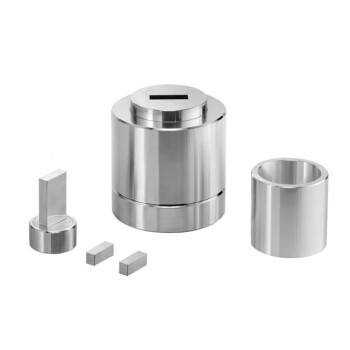
The primary role of a laboratory hydraulic press is to transform loose, ball-milled LiTa2PO8 (LTPO) powder into a solid, cohesive unit known as a "green pellet." This mechanical compression creates a defined shape, typically with a specific diameter such as 10mm, and imparts sufficient mechanical strength to withstand handling prior to the thermal processing stage.
By significantly increasing the contact area between powder particles, the press establishes the necessary initial packing density. This pre-densification is the decisive factor in minimizing shrinkage and preventing deformation during subsequent pressureless sintering.
Establishing the Green Body
Transforming Powder to Solid
The initial state of LTPO is a ball-milled powder, which lacks structural integrity. The hydraulic press applies force to consolidate this loose material.
This process creates a green pellet, a compacted form that holds its shape but has not yet been fired.
Ensuring Mechanical Stability
A critical function of the press is to provide sufficient mechanical strength.
Without this compression, the material would be too fragile to transfer from the mold to the box furnace. The pellet must remain intact during this transition to ensure a consistent sintering outcome.
Optimizing Sintering Conditions
Maximizing Particle Contact
The hydraulic press forces individual powder particles into close proximity.
This increased contact area is a prerequisite for effective sintering. It reduces the distance atoms must diffuse, facilitating the chemical bonds that form during the high-temperature phase.
Minimizing Structural Defects
One of the main challenges in conventional sintering (CS) is the dimensional change of the material.
By achieving a high initial packing density through hydraulic compression, you effectively reduce the amount of free space (porosity) in the material before heating begins.
This pre-reduction of void space is essential for minimizing shrinkage and avoiding deformation or warping as the ceramic hardens in the furnace.
Understanding the Operational Trade-offs
The Precision of Pressure
While pressure is necessary, it must be applied with controlled precision.
Insufficient pressure results in a "soft" green pellet with low density, leading to excessive shrinkage and potential cracking during sintering.
Homogeneity vs. Gradients
The goal is uniform axial pressure.
If the pressure is not applied evenly, the green pellet may develop density gradients. These inconsistencies can cause the final ceramic to warp or sinter unevenly, compromising the structural integrity of the LTPO pellet.
Making the Right Choice for Your Goal
To maximize the effectiveness of your LTPO preparation, align your pressing strategy with your specific processing needs:
- If your primary focus is handling and workflow: Ensure the hydraulic press applies enough force to achieve sufficient mechanical strength, preventing pellet breakage during transfer to the furnace.
- If your primary focus is dimensional accuracy: Prioritize maximizing the initial packing density to minimize porosity, which directly reduces the rate of shrinkage and deformation during the heating cycle.
Precise hydraulic compression is not merely a shaping step; it is the structural foundation that dictates the final density and fidelity of the sintered ceramic.
Summary Table:
| Process Stage | Role of Hydraulic Press | Key Outcome for LTPO |
|---|---|---|
| Pre-Sintering | Powder Consolidation | Formation of a 10mm "green pellet" |
| Handling | Mechanical Compression | Sufficient strength for furnace transfer |
| Densification | Maximizing Contact Area | Enhanced atomic diffusion during heating |
| Structural Integrity | Porosity Reduction | Minimized shrinkage and prevented deformation |
Elevate Your Advanced Ceramic Research with KINTEK
Precision in pellet preparation is the foundation of high-performance solid-state electrolytes. KINTEK provides industry-leading laboratory hydraulic presses (pellet, hot, and isostatic) designed to deliver the uniform axial pressure required for defect-free LiTa2PO8 (LTPO) ceramics.
Our comprehensive laboratory solutions include:
- High-Temperature Box & Tube Furnaces for conventional sintering.
- Precision Crushing & Ball Milling Systems for optimized powder preparation.
- Specialized Consumables, including high-purity crucibles and ceramics.
Whether you are focusing on battery research or advanced material synthesis, our technical experts are ready to help you achieve superior packing density and structural fidelity. Contact KINTEK today to optimize your laboratory workflow!
Related Products
- Automatic Laboratory Hydraulic Pellet Press Machine for Lab Use
- Laboratory Manual Hydraulic Pellet Press for Lab Use
- Laboratory Hydraulic Press Lab Pellet Press Machine for Glove Box
- kbr pellet press 2t
- Laboratory Manual Hydraulic Pellet Press for Lab Use
People Also Ask
- What is the role of a laboratory hydraulic pellet press and stainless steel molds in the fabrication of RuO2/NbC anodes?
- What role does a laboratory pellet press play in the enhancement of biomass energy products? Optimize Fuel Efficiency
- What is the purpose of using a laboratory pellet press when evaluating the electronic conductivity of carbon powders? Guide
- How does a laboratory hydraulic pellet press contribute to SiCw/2024 aluminum composite preforms? Optimize Densification
- What is the significance of applying 200 MPa of pressure with a laboratory hydraulic pellet press for composite ceramics?