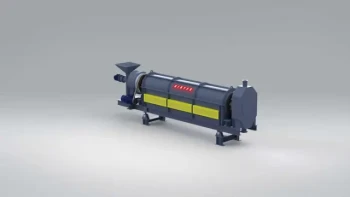
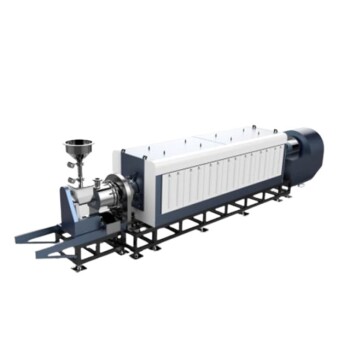
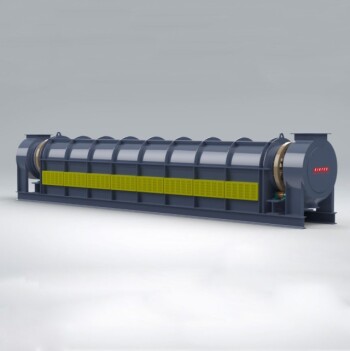
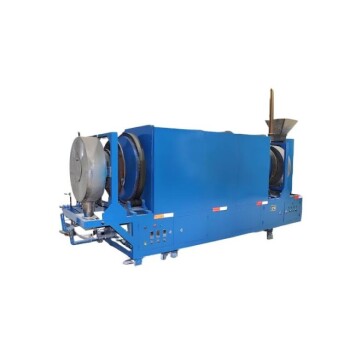
The primary role of a Rotary Furnace in combined pyro-hydrometallurgical recycling is to facilitate the high-temperature decomposition of nickel-based superalloy scrap within alkaline salt melts. By acting as a dynamic reaction vessel that introduces oxygen-rich air, it ensures the scrap is chemically altered to allow for metal recovery in later stages.
Nickel-based superalloys are engineered to resist heat and corrosion, making them inherently difficult to recycle. The Rotary Furnace serves as the critical "unlocking" mechanism, using mechanical rotation and chemical oxidation to convert resistant metals into soluble salts that can be processed by water.
The Mechanism of Action
Utilizing Salt Melts
The process relies on immersing the superalloy scrap in a bath of alkaline salts. Common agents used in this high-temperature environment include sodium hydroxide or sodium sulfate.
Mechanical Stirring
The "rotary" aspect of the furnace is functional, not just structural. The rotation provides constant stirring action, which is essential for maintaining a homogenous mixture of scrap and molten salt.
Introduction of Oxygen
To drive the decomposition, oxygen-rich air is introduced into the furnace chamber. This oxidizer reacts with the alloy components in the presence of the molten salts.
Chemical Transformation Goals
Targeting Refractory Metals
The specific target of this process is the conversion of refractory metals contained within the superalloy. Elements such as chromium and tungsten—which are typically highly resistant to chemical attack—are the primary focus.
Creating Soluble Compounds
Through the reaction with the alkaline salts and oxygen, these refractory metals are converted into new chemical forms. They transform into salts that are soluble in water.
Preparing for Hydrometallurgy
The ultimate goal of the Rotary Furnace is preparation. By converting the metals into soluble salts, the material is primed for the subsequent "water leaching" stage, where the metals can be easily dissolved and recovered.
Critical Process Requirements
Ensuring Thorough Reaction
The efficiency of the downstream water leaching depends entirely on the success of this pyro-metallurgical step. If the reaction in the furnace is incomplete, the metals will remain in their refractory state and will not dissolve in water later.
The Necessity of Agitation
Static furnaces are generally insufficient for this specific application. The stirring action provided by the rotating chamber is required to expose the scrap surface continuously to the oxygen and salt melt, preventing passivation layers from blocking the reaction.
Making the Right Choice for Your Goal
To maximize the efficiency of your recycling circuit, consider the following regarding the Rotary Furnace's function:
- If your primary focus is process speed: Ensure the furnace rotation speed provides aggressive agitation to accelerate the reaction between the scrap and the oxygen-rich environment.
- If your primary focus is recovery yield: Prioritize the precise control of the salt melt composition (sodium hydroxide/sulfate) to ensure complete conversion of valuable chromium and tungsten into soluble forms.
The Rotary Furnace is not merely a heater; it is a chemical reactor that bridges the gap between solid, resistant scrap and liquid-based metal recovery.
Summary Table:
| Feature | Role in Pyro-Hydrometallurgical Recycling |
|---|---|
| Core Function | High-temperature decomposition of superalloy scrap in alkaline salt melts |
| Reaction Media | Alkaline salts (e.g., sodium hydroxide or sodium sulfate) |
| Agitation Method | Mechanical rotation for continuous stirring and surface exposure |
| Key Reactant | Introduction of oxygen-rich air to drive chemical oxidation |
| Primary Goal | Converting refractory metals (Cr, W) into water-soluble salts |
| Downstream Impact | Prepares material for efficient water leaching and metal recovery |
Maximize Your Material Recovery with KINTEK Advanced Furnace Solutions
Are you looking to optimize your recycling efficiency for nickel-based superalloys? KINTEK provides industry-leading rotary and high-temperature furnaces designed to handle complex chemical transformations with precision and durability. Our specialized equipment ensures uniform agitation and superior temperature control, critical for converting resistant scrap into high-yield soluble salts.
From high-temperature high-pressure reactors to precision crushing and milling systems, KINTEK offers the comprehensive lab and industrial tools needed to refine your recycling process. Our expertise in laboratory consumables, ceramics, and induction melting makes us the preferred partner for demanding metallurgical applications.
Ready to upgrade your recovery yields?
Contact KINTEK Experts Today to discover how our tailored equipment solutions can transform your lab and production capabilities.
References
- Alexandra Kollová, Katarína Pauerová. Superalloys - Characterization, Usage and Recycling. DOI: 10.21062/mft.2022.070
This article is also based on technical information from Kintek Solution Knowledge Base .
Related Products
- Rotary Tube Furnace Split Multi Heating Zone Rotating Tube Furnace
- Laboratory Vacuum Tilt Rotary Tube Furnace Rotating Tube Furnace
- Vacuum Sealed Continuous Working Rotary Tube Furnace Rotating Tube Furnace
- Electric Rotary Kiln Small Rotary Furnace for Activated Carbon Regeneration
- Electric Rotary Kiln Small Rotary Furnace Biomass Pyrolysis Plant
People Also Ask
- What are the advantages of using a rotary tube furnace for MoVOx catalysts? Elevate Uniformity and Crystallinity
- What are the process advantages of using a rotary tube furnace for WS2 powder? Achieve Superior Material Crystallinity
- Why is a rotary tube furnace preferred over a fixed tube furnace for the carbonization of asphaltenes? Superior Quality
- Why is a rotary tube furnace recommended for the calcination stage of potassium vanadium oxide catalysts? Optimize Purity
- What is a rotary tube furnace? Achieve Superior Uniformity for Powders and Granules