Knowledge What is the role of a vacuum hot-pressing furnace in the preparation of TiAl/Ti6Al4V? Master High-Strength Bonding
Author avatar

Tech Team · Kintek Solution

Updated 3 days ago

What is the role of a vacuum hot-pressing furnace in the preparation of TiAl/Ti6Al4V? Master High-Strength Bonding


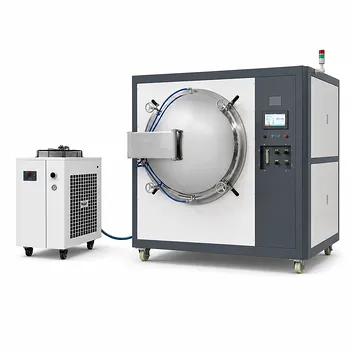
The vacuum hot-pressing furnace functions as the critical enabling technology for fabricating TiAl/Ti6Al4V layered composites by establishing a precise, synergistic environment. It subjects the materials to a specific combination of high temperature (1000°C), high mechanical pressure (30 MPa), and high vacuum (1×10⁻² Pa) to overcome the inherent reactivity and bonding challenges of titanium alloys.

Core Takeaway The furnace does not merely heat the material; it synchronizes thermal energy and mechanical force within an oxygen-free void. This tri-factor approach is the only way to facilitate sufficient atomic diffusion between layers while simultaneously preventing the catastrophic oxidation that would occur with titanium and aluminum at these temperatures.

The Mechanism of Interfacial Bonding

Preventing Material Degradation

Titanium and aluminum are highly reactive metals, particularly at elevated temperatures. If exposed to air during heating, they would instantly form stable oxides that inhibit bonding.

High vacuum (1×10⁻² Pa) is the primary defense mechanism. By removing oxygen and other active gases, the furnace ensures the metal surfaces remain chemically clean, preserving the purity of the TiAl and Ti6Al4V layers throughout the thermal cycle.

Promoting Atomic Diffusion

Clean surfaces alone are insufficient for bonding; the atoms must migrate across the interface to create a metallurgical join.

The furnace applies high temperature (1000°C) to increase the kinetic energy of the atoms, making them mobile. Simultaneously, high pressure (30 MPa) forces the layers into intimate contact, reducing the diffusion distance and physically driving the atoms to intermix.

Ensuring Microstructural Integrity

The ultimate goal is a dense, void-free composite. The applied pressure acts as a densification driving force.

This mechanical load promotes plastic flow in the materials, effectively closing gaps and preventing the formation of cracks or pores at the interface. The result is a robust metallurgical bond rather than a weak mechanical adhesion.

Critical Functions of Process Parameters

Breaking Surface Oxide Films

Even in a vacuum, pre-existing oxide films on the metal foils can act as barriers.

The continuous uniaxial pressure helps to physically fracture these brittle surface layers. This exposes fresh, reactive metal underneath, allowing for direct solid-solid reactions and ensuring the continuity of the matrix.

Eliminating Porosity

Diffusion processes can sometimes create voids (known as Kirkendall pores) due to unequal diffusion rates between different elements.

The external pressure provided by the hot-pressing furnace counteracts this phenomenon. It collapses these voids as they form, ensuring the final component achieves near-full density.

Understanding the Trade-offs

Process Constraints

While effective, vacuum hot pressing is inherently a batch process constrained by the size of the furnace chamber. It is difficult to scale for continuous, high-volume manufacturing compared to other methods like rolling.

Parameter Sensitivity

The success of the bond relies on a delicate balance. If the temperature is too low or pressure insufficient, diffusion will be incomplete, leading to delamination.

Conversely, excessive temperatures or prolonged hold times can lead to uncontrolled reactions or grain growth, potentially degrading the mechanical properties of the individual layers.

Making the Right Choice for Your Goal

To maximize the effectiveness of the vacuum hot-pressing process for your specific application, prioritize the following parameters:

  • If your primary focus is Interface Purity: Prioritize the vacuum level capabilities of the furnace to prevent oxidation and gas contamination, which are the main causes of bond failure in titanium alloys.
  • If your primary focus is Structural Density: Focus on the furnace's hydraulic pressure capacity to ensure sufficient force is available to close internal voids and overcome the yield strength of the material at temperature.

The vacuum hot-pressing furnace transforms a stack of loose foils into a unified structural composite by substituting atmospheric chaos with a controlled, high-energy vacuum environment.

Summary Table:

Parameter Process Role Impact on TiAl/Ti6Al4V Composites
Vacuum (1×10⁻² Pa) Atmosphere Control Prevents oxidation and ensures chemically clean interfaces for bonding.
Temperature (1000°C) Thermal Activation Increases atomic kinetic energy to facilitate metallurgical diffusion.
Pressure (30 MPa) Mechanical Load Promotes plastic flow, closes Kirkendall pores, and fractures surface oxides.
Holding Time Diffusion Duration Balances interfacial bond strength against undesirable grain growth.

Elevate your material research with KINTEK’s precision engineering. Whether you are developing advanced TiAl/Ti6Al4V layered composites or specialized aerospace alloys, our high-performance vacuum hot-pressing furnaces and high-temperature systems provide the exact thermal and mechanical control required for defect-free results. KINTEK specializes in laboratory equipment including vacuum, CVD, and induction melting furnaces, as well as hydraulic presses and high-pressure reactors. Contact our technical team today to find the perfect solution for your high-temperature, high-pressure material processing needs!

Related Products

People Also Ask

Related Products

Vacuum Hot Press Furnace Machine Heated Vacuum Press

Vacuum Hot Press Furnace Machine Heated Vacuum Press

Discover the advantages of Vacuum Hot Press Furnace! Manufacture dense refractory metals & compounds, ceramics, and composites under high temp and pressure.

Vacuum Hot Press Furnace Heated Vacuum Press Machine Tube Furnace

Vacuum Hot Press Furnace Heated Vacuum Press Machine Tube Furnace

Reduce forming pressure & shorten sintering time with Vacuum Tube Hot Press Furnace for high-density, fine-grain materials. Ideal for refractory metals.

600T Vacuum Induction Hot Press Furnace for Heat Treat and Sintering

600T Vacuum Induction Hot Press Furnace for Heat Treat and Sintering

Discover the 600T Vacuum Induction Hot Press Furnace, designed for high-temperature sintering experiments in vacuum or protected atmospheres. Its precise temperature and pressure control, adjustable working pressure, and advanced safety features make it ideal for nonmetal materials, carbon composites, ceramics, and metal powders.

Vacuum Heat Treat Furnace with Ceramic Fiber Liner

Vacuum Heat Treat Furnace with Ceramic Fiber Liner

Vacuum furnace with polycrystalline ceramic fiber insulation liner for excellent heat insulation and uniform temperature field. Choose from 1200℃ or 1700℃ max. working temperature with high vacuum performance and precise temperature control.

High Pressure Laboratory Vacuum Tube Furnace Quartz Tubular Furnace

High Pressure Laboratory Vacuum Tube Furnace Quartz Tubular Furnace

KT-PTF High Pressure Tube Furnace: Compact split tube furnace with strong positive pressure resistance. Working temp up to 1100°C and pressure up to 15Mpa. Also works under controller atmosphere or high vacuum.

Vacuum Heat Treat and Molybdenum Wire Sintering Furnace for Vacuum Sintering

Vacuum Heat Treat and Molybdenum Wire Sintering Furnace for Vacuum Sintering

A vacuum molybdenum wire sintering furnace is a vertical or bedroom structure, which is suitable for withdrawal, brazing, sintering and degassing of metal materials under high vacuum and high temperature conditions. It is also suitable for dehydroxylation treatment of quartz materials.

2200 ℃ Tungsten Vacuum Heat Treat and Sintering Furnace

2200 ℃ Tungsten Vacuum Heat Treat and Sintering Furnace

Experience the ultimate refractory metal furnace with our Tungsten vacuum furnace. Capable of reaching 2200℃, perfect for sintering advanced ceramics and refractory metals. Order now for high-quality results.

Vacuum Heat Treat Sintering Brazing Furnace

Vacuum Heat Treat Sintering Brazing Furnace

A vacuum brazing furnace is a type of industrial furnace used for brazing, a metalworking process that joins two pieces of metal using a filler metal that melts at a lower temperature than the base metals. Vacuum brazing furnaces are typically used for high-quality applications where a strong, clean joint is required.

Molybdenum Vacuum Heat Treat Furnace

Molybdenum Vacuum Heat Treat Furnace

Discover the benefits of a high-configuration molybdenum vacuum furnace with heat shield insulation. Ideal for high-purity, vacuum environments like sapphire crystal growth and heat treatment.

2200 ℃ Graphite Vacuum Heat Treat Furnace

2200 ℃ Graphite Vacuum Heat Treat Furnace

Discover the power of the KT-VG Graphite Vacuum Furnace - with a maximum working temperature of 2200℃, it's perfect for vacuum sintering of various materials. Learn more now.

Mesh belt controlled atmosphere furnace

Mesh belt controlled atmosphere furnace

Discover our KT-MB mesh belt sintering furnace - perfect for high-temperature sintering of electronic components & glass insulators. Available for open air or controlled atmosphere environments.

Ultra-High Temperature Graphite Vacuum Graphitization Furnace

Ultra-High Temperature Graphite Vacuum Graphitization Furnace

The ultra-high temperature graphitization furnace utilizes medium frequency induction heating in a vacuum or inert gas environment. The induction coil generates an alternating magnetic field, inducing eddy currents in the graphite crucible, which heats up and radiates heat to the workpiece, bringing it to the desired temperature. This furnace is primarily used for graphitization and sintering of carbon materials, carbon fiber materials, and other composite materials.

1800℃ Muffle Oven Furnace for Laboratory

1800℃ Muffle Oven Furnace for Laboratory

KT-18 muffle furnace with Japan Al2O3 polycrystalline fibe and Silicon Molybdenum heating element, up to 1900℃, PID temperature control and 7" smart touch screen. Compact design, low heat loss, and high energy efficiency. Safety interlock system and versatile functions.

1700℃ Muffle Oven Furnace for Laboratory

1700℃ Muffle Oven Furnace for Laboratory

Get superior heat control with our 1700℃ Muffle Furnace. Equipped with intelligent temperature microprocessor, TFT touch screen controller & advanced insulation materials for precise heating up to 1700C. Order now!

Laboratory Rapid Thermal Processing (RTP) Quartz Tube Furnace

Laboratory Rapid Thermal Processing (RTP) Quartz Tube Furnace

Get lightning-fast heating with our RTP Rapid Heating Tube Furnace. Designed for precise, high-speed heating and cooling with convenient sliding rail and TFT touch screen controller. Order now for ideal thermal processing!

Vacuum Heat Treat and Sintering Furnace with 9MPa Air Pressure

Vacuum Heat Treat and Sintering Furnace with 9MPa Air Pressure

The air pressure sintering furnace is a high-tech equipment commonly used for the sintering of advanced ceramic materials. It combines vacuum sintering and pressure sintering techniques to achieve high-density and high-strength ceramics.

Graphite Vacuum Furnace Bottom Discharge Graphitization Furnace for Carbon Materials

Graphite Vacuum Furnace Bottom Discharge Graphitization Furnace for Carbon Materials

Bottom-out graphitization furnace for carbon materials, ultra-high temperature furnace up to 3100°C, suitable for graphitization and sintering of carbon rods and carbon blocks. Vertical design, bottom discharging, convenient feeding and discharging, high temperature uniformity, low energy consumption, good stability, hydraulic lifting system, convenient loading and unloading.

Vacuum Dental Porcelain Sintering Furnace

Vacuum Dental Porcelain Sintering Furnace

Get precise and reliable results with KinTek's Vacuum Porcelain Furnace. Suitable for all porcelain powders, it features hyperbolic ceramic furnace function, voice prompt, and automatic temperature calibration.

Horizontal High Temperature Graphite Vacuum Graphitization Furnace

Horizontal High Temperature Graphite Vacuum Graphitization Furnace

Horizontal Graphitization Furnace: This type of furnace is designed with the heating elements placed horizontally, allowing for uniform heating of the sample. It's well-suited for graphitizing large or bulky samples that require precise temperature control and uniformity.

Dental Porcelain Zirconia Sintering Ceramic Vacuum Press Furnace

Dental Porcelain Zirconia Sintering Ceramic Vacuum Press Furnace

Get precise dental results with Dental Vacuum Press Furnace. Automatic temperature calibration, low noise tray, and touch screen operation. Order now!


Leave Your Message