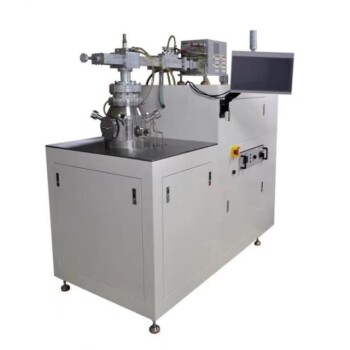
The pivotal role of a vertical Chemical Vapor Deposition (CVD) reactor in this context is to directly synthesize and continuously spin the Carbon Nanotube Fiber (CNTf) backbone. This equipment does not merely deposit material; it creates the highly conductive, mechanically tough, and porous structural foundation upon which the metal oxide is subsequently anchored to form the hybrid electrode.
Core Takeaway: The vertical CVD reactor is the architect of the electrode's skeleton. By precisely controlling reaction conditions to produce long, multi-walled nanotube bundles, it establishes the essential electrical and mechanical framework required for a high-performance Metal Oxide/CNTf hybrid.
Establishing the Structural Foundation
The vertical CVD reactor is distinct because it combines synthesis and fiber assembly into a single, continuous step. Its primary function is to generate the "host" material that defines the electrode's physical properties.
Direct Synthesis and Continuous Spinning
Unlike batch processes, the vertical reactor facilitates the continuous spinning of carbon nanotubes. This allows for the creation of fibers that are macroscopic in length (reaching the millimeter scale) while maintaining nanoscale precision. The continuous nature of this process ensures structural integrity and uniformity throughout the fiber length.
Precision Control of Nanostructure
The reactor allows for the precise adjustment of reaction conditions to dictate the geometry of the nanotubes. Specifically, it produces carbon nanotube bundles containing 3 to 5 walls with an average diameter of less than 7 nanometers. This specific geometry strikes a balance between surface area and structural stability.
Achieving High Graphitization
A key output of this reactor is a fiber characterized by a high degree of graphitization. High graphitization is critical because it directly correlates to superior electrical conductivity. Without this conductive pathway, the hybrid electrode would suffer from poor charge transport.
Enabling Hybrid Electrode Performance
The vertical CVD reactor prepares the CNTf to serve as more than just a wire; it acts as a functional scaffold for the metal oxide.
Creating a Porous Framework
The reactor generates a porous framework rather than a solid, impermeable rod. This porosity is essential for the subsequent loading of metal oxides, allowing them to infiltrate the structure. A porous structure ensures a high surface area for electrochemical reactions in the final hybrid device.
Ensuring Mechanical Toughness
The fibers produced are mechanically tough, providing durability to the final electrode. This toughness prevents the electrode from degrading during the stress of fabrication or operation. It allows the hybrid material to remain flexible and robust, even after the addition of brittle metal oxides.
Understanding the Trade-offs
While the vertical CVD reactor is powerful, it introduces specific constraints and challenges that must be managed.
High Thermal Requirements
CVD is generally a medium-to-high temperature process, often operating between 500°C and 1100°C. This requires robust thermal management and limits the types of substrates or co-materials that can be present during the fiber synthesis phase. Materials with low melting points cannot be introduced until after the CVD process is complete.
Parameter Sensitivity
The quality of the fiber is heavily dependent on the precise regulation of gas flow and temperature. Slight deviations in the reaction environment can alter the number of walls or the diameter of the nanotubes, impacting conductivity. Reproducibility requires rigorous maintenance of the reaction chamber and precursor gas ratios.
Making the Right Choice for Your Goal
When integrating a vertical CVD reactor into your fabrication line, focus on the specific property you need to maximize for your hybrid electrode.
- If your primary focus is Electrical Conductivity: Prioritize high reaction temperatures and precise catalyst control to maximize the degree of graphitization and minimize defects in the nanotube walls.
- If your primary focus is Active Material Loading: Adjust the spinning parameters to maximize the spacing and porosity of the bundles, ensuring the metal oxide can penetrate deep into the fiber framework.
The vertical CVD reactor is the critical first step that defines the upper limits of your hybrid electrode's potential.
Summary Table:
| Feature | Function in MOx/CNTf Synthesis | Impact on Electrode |
|---|---|---|
| Continuous Spinning | Direct synthesis of macroscopic fibers | Ensures structural integrity & uniformity |
| Wall Control | Produces 3-5 walls (<7nm diameter) | Balances surface area & stability |
| Graphitization | High-temperature thermal processing | Maximizes electrical conductivity |
| Porosity | Creates a porous nanotube framework | Enables deep metal oxide infiltration |
| Mechanical Control | Alignment of multi-walled bundles | Provides toughness & flexible durability |
Elevate Your Material Research with KINTEK Precision
Unlock the full potential of your hybrid electrode fabrication with KINTEK’s advanced vertical CVD systems. As specialists in high-performance laboratory equipment, we provide the precise thermal and gas control necessary to synthesize high-graphitization CNT fibers and complex metal oxide architectures.
From CVD, PECVD, and MPCVD reactors to our comprehensive range of high-temperature furnaces, hydraulic presses, and specialized electrolytic cells, KINTEK delivers the tools researchers need for cutting-edge energy storage and battery research.
Ready to optimize your synthesis process? Contact our technical experts today to find the perfect solution for your lab’s unique requirements.
References
- Cleis Santos, Juan J. Vilatela. Interconnected metal oxide CNT fibre hybrid networks for current collector-free asymmetric capacitive deionization. DOI: 10.1039/c8ta01128a
This article is also based on technical information from Kintek Solution Knowledge Base .
Related Products
- Customer Made Versatile CVD Tube Furnace Chemical Vapor Deposition Chamber System Equipment
- Cylindrical Resonator MPCVD Machine System Reactor for Microwave Plasma Chemical Vapor Deposition and Lab Diamond Growth
- Split Chamber CVD Tube Furnace with Vacuum Station Chemical Vapor Deposition System Equipment Machine
- Microwave Plasma Chemical Vapor Deposition MPCVD Machine System Reactor for Lab and Diamond Growth
- 915MHz MPCVD Diamond Machine Microwave Plasma Chemical Vapor Deposition System Reactor
People Also Ask
- What is a CVD tube furnace? A Complete Guide to Thin-Film Deposition
- What is the function of a high-temperature CVD tube furnace in 3D graphene foam prep? Master 3D Nanomaterial Growth
- What are the technical advantages of using a CVD tube furnace? Optimize Silicon-Carbon Battery Anodes
- How does a CVD tube furnace inhibit the sintering of silver supports? Boost Membrane Durability and Performance
- What is the function of a tube furnace in CVD SiC synthesis? Achieving Ultra-Pure Silicon Carbide Powders