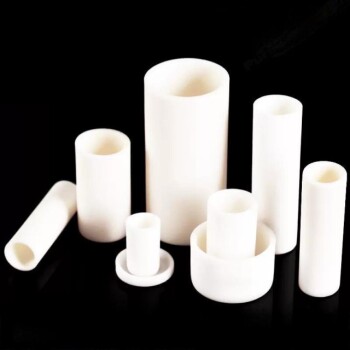
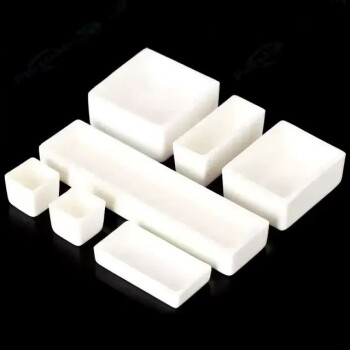
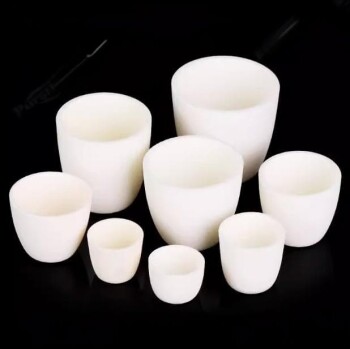
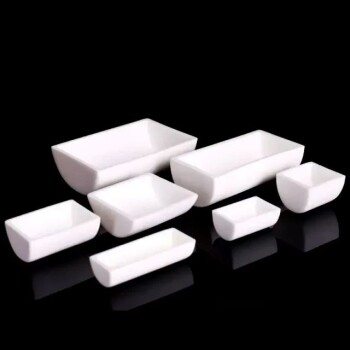
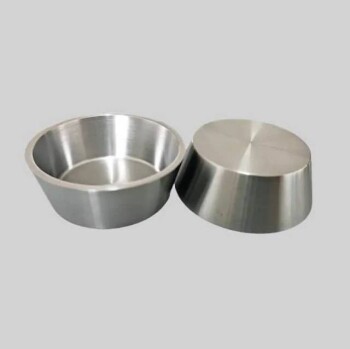
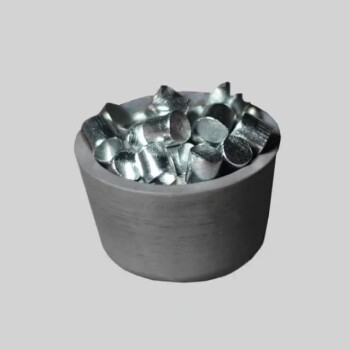
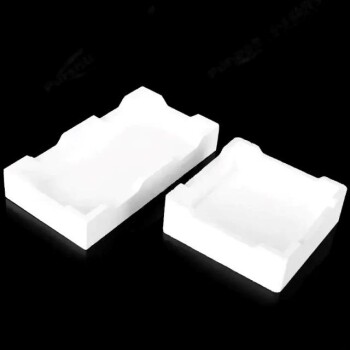
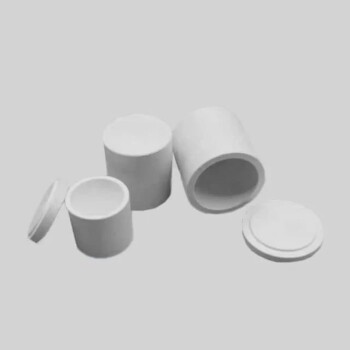
An alumina crucible functions as a chemically inert, thermally stable containment vessel designed to protect the purity of Lithium Lanthanum Zirconate (LLZ) precursors during solid-phase reactions. Its primary role is to provide a physical barrier that withstands high calcination temperatures without introducing contaminants or altering the chemical composition of the electrolyte.
Core Takeaway Alumina crucibles are the standard for LLZ calcination because they maintain structural integrity at temperatures between 800°C and 1000°C while resisting chemical reactions with the precursor powder. This stability ensures the stoichiometry of the final solid-state electrolyte remains accurate and free from vessel-induced impurities.
Structural Stability Under Heat
Resisting Physical Deformation
During the calcination of LLZ, temperatures typically range from 800°C to 1000°C.
Alumina demonstrates excellent high-temperature resistance in this range. Unlike softer materials, it does not suffer from physical softening or structural collapse, ensuring the sample remains safely contained throughout prolonged heating cycles.
Withstanding Oxidizing Atmospheres
The calcination process often occurs in an oxidizing environment (air or oxygen).
Alumina is chemically stable under these conditions. It does not degrade or oxidize further, providing a reliable, "clean" container that remains consistent regardless of the atmospheric conditions inside the furnace.
Maintaining Chemical Purity
Preventing Cross-Contamination
The most critical role of the crucible is to act as an inert barrier.
Alumina prevents chemical reactions between the container wall and the LLZ precursor powders. By avoiding interaction with the vessel, the process prevents the introduction of impurity phases that could degrade the ionic conductivity of the final electrolyte.
Preserving Stoichiometry
Solid-state electrolytes require precise ratios of Lithium, Lanthanum, and Zirconium (stoichiometry).
Because alumina is chemically inert relative to these precursors at calcination temperatures, it does not leech elements into or out of the powder. This ensures the chemical composition you calculate at the start is the composition you yield after heating.
Managing Volatile Components
The Importance of the Lid
Lithium, a key component of LLZ, is prone to volatilization (evaporation) at high temperatures.
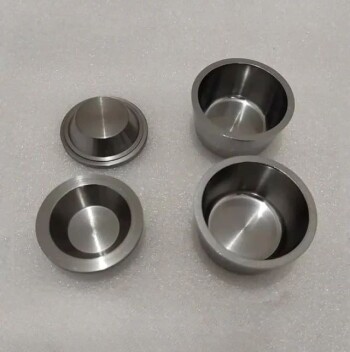
While the crucible body holds the solid mass, an alumina lid is often essential during calcination. Covering the crucible creates a closed environment that suppresses lithium loss, ensuring the final material does not become lithium-deficient.
Understanding the Trade-offs
Temperature Limitations
While alumina is excellent for the calcination phase (typically below 1000°C), it has limitations at extreme temperatures.
For processes requiring ultra-high temperatures (such as sintering above 1200°C–1400°C), alumina may begin to react with lithium-rich materials. In these extreme sintering scenarios, zirconia crucibles are often preferred due to their stability up to 1450°C.
Suitability for Solid-Phase Reactions
Alumina is specifically optimized for solid-phase synthesis.
It is the ideal choice for the initial reaction of precursor powders. However, if the material were to melt (liquid phase), the corrosive nature of molten lithium salts might attack the alumina more aggressively than in the solid phase.
Making the Right Choice for Your Goal
To ensure the success of your solid-state electrolyte synthesis, apply the following guidelines:
- If your primary focus is initial powder synthesis (Calcination): Use high-purity alumina crucibles to ensure structural rigidity and prevent chemical contamination at temperatures up to 1000°C.
- If your primary focus is preventing Lithium loss: Ensure your alumina crucible is fitted with a matching lid to contain volatile components during the heating ramp.
- If your primary focus is ultra-high temperature densification (Sintering): Evaluate if alumina is still suitable; if temperatures exceed 1200°C, consider switching to zirconia to prevent reaction with the container.
Select the crucible material that matches the specific thermal demands of your current processing step to guarantee electrolyte performance.
Summary Table:
| Feature | Role in LLZ Calcination | Benefit to Process |
|---|---|---|
| Thermal Stability | Withstands 800°C - 1000°C | Prevents vessel deformation or structural collapse. |
| Chemical Inertness | Physical barrier against reactions | Prevents cross-contamination and maintains stoichiometry. |
| Oxidation Resistance | Stable in oxidizing atmospheres | Ensures a clean environment in air or oxygen flows. |
| Volatilization Control | Paired with matching lid | Minimizes lithium loss to preserve electrolyte conductivity. |
Elevate Your Battery Research with Precision Engineering
To achieve high-performance solid-state electrolytes, the quality of your containment vessel is paramount. KINTEK specializes in providing high-purity laboratory equipment and consumables tailored for advanced material science. Whether you are conducting initial calcination or high-temperature sintering, our solutions ensure your research remains uncontaminated and precise.
Our specialized portfolio includes:
- Crucibles & Ceramics: High-purity alumina, zirconia, and PTFE products designed for extreme conditions.
- High-Temperature Furnaces: Muffle, tube, and vacuum furnaces for precise thermal processing.
- Advanced Reactors: High-temperature high-pressure reactors and autoclaves for complex synthesis.
- Battery Research Tools: Specialized tools and consumables to streamline your workflow.
Don't let vessel-induced impurities compromise your results. Contact the experts at KINTEK today to find the perfect crucible and furnace combination for your LLZ synthesis.
→ Contact Our Technical Team for a Quote
Related Products
- Engineering Advanced Fine Ceramics Alumina Al2O3 Crucible With Lid Cylindrical Laboratory Crucible
- Engineering Advanced Fine Alumina Al2O3 Ceramic Crucible for Laboratory Muffle Furnace
- Engineering Advanced Fine Ceramics Alumina Crucibles (Al2O3) for Thermal Analysis TGA DTA
- Arc-Shaped Alumina Ceramic Crucible High Temperature Resistant for Engineering Advanced Fine Ceramics
- Alumina Al2O3 Ceramic Crucible Semicircle Boat with Lid for Engineering Advanced Fine Ceramics
People Also Ask
- Why are high-purity alumina crucibles used for liquid lead corrosion experiments? Ensure Data Accuracy at 550°C
- Why are alumina crucibles and mother powder essential for LATP sintering? Optimize Your Solid Electrolyte Performance
- What is the primary purpose of using alumina crucibles for LLTO ceramics? Optimize Your High-Temperature Sintering
- Why Use Alumina Crucibles & Powder Burial for NaSICON? Ensure Phase Purity and Prevent Elemental Volatilization
- Why are alumina crucibles used as containers during the tungsten diffusion coating process on diamond surfaces?