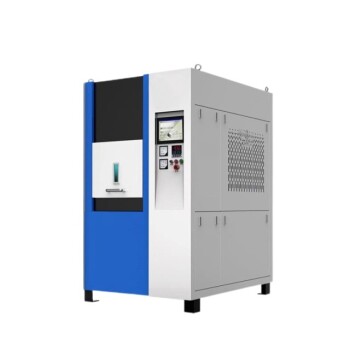
High-temperature sintering furnaces serve as the definitive fabrication step where loose ceramic particles are converted into a dense, functional solid electrolyte framework. Following tape casting and binder removal, these furnaces provide the thermal energy required to drive densification and grain growth, eliminating inter-particle pores to establish the mechanical strength and high ionic conductivity necessary for battery operation.
The sintering process is the bridge between a fragile precursor and a functional component, utilizing atomic diffusion to fuse particles into a unified structure capable of enduring the physical stress of lithium metal deposition and stripping.
The Mechanics of Densification
Driving Atomic Diffusion
The primary function of the furnace is to provide a stable high-temperature environment—often ranging from 650°C to 1150°C depending on the material.
This thermal energy activates atomic diffusion, allowing atoms to move across particle boundaries. This movement is essential for bonding individual ceramic particles (such as LATP or LAGP) into a coherent solid mass.
Eliminating Inter-Particle Pores
As diffusion occurs, the voids or pores located between ceramic particles are filled.
The furnace facilitates the removal of these inter-particle pores, which are detrimental to battery performance. Reducing porosity is critical because voids act as insulators that block ion flow and weaken the structural integrity of the framework.
Promoting Grain Growth
Beyond simple bonding, the heat treatment drives grain growth within the ceramic microstructure.
Controlled grain growth reduces the total surface area of grain boundaries. Since boundaries can impede ion movement, larger, well-connected grains typically result in a framework with superior electrochemical properties.
Critical Performance Outcomes
Maximizing Ionic Conductivity
The final density of the electrolyte directly determines its ionic transport performance.
By achieving high densification and a uniform microstructure, the furnace ensures the creation of efficient pathways for ions to travel. For materials like NZSP or LAGP, this step is non-negotiable for achieving the conductivity metrics required for practical application.
Establishing Mechanical Strength
A solid electrolyte must physically separate the anode and cathode while enduring mechanical stress.
The sintering process imparts the mechanical resilience needed to withstand the repeated expansion and contraction associated with lithium deposition and stripping. Without this thermal hardening, the framework would likely fail or fracture during battery cycling.
Refining Crystal Phase Purity
For many ceramics, the correct crystal structure is only fully formed during this high-temperature stage.
The furnace environment completes the crystal phase formation (e.g., forming a single-phase rhombohedral structure in LAGP). It also helps eliminate impurity phases at the grain boundaries—such as ZrO2 in NZSP ceramics—which would otherwise degrade performance.
Understanding the Trade-offs
Thermal Precision vs. Degradation
While high temperatures are necessary, the thermal environment must be precisely controlled.
Fluctuations in temperature can lead to uneven densification or incomplete phase formation. Conversely, excessive heat or improper duration can lead to abnormal grain growth, which may paradoxically reduce mechanical strength or induce brittleness.
Time and Energy Intensity
Sintering is a resource-intensive process, often requiring long dwell times (e.g., 18 hours for NZSP).
This requirement creates a bottleneck in manufacturing throughput. Balancing the need for extended thermal treatment to ensure full densification against the desire for rapid production is a key challenge in scaling solid-state battery fabrication.
Making the Right Choice for Your Goal
To optimize your solid electrolyte fabrication, align your sintering parameters with your specific performance targets:
- If your primary focus is Ionic Conductivity: Prioritize temperature profiles that maximize densification and eliminate grain boundary impurities to reduce resistance.
- If your primary focus is Mechanical Durability: Focus on achieving uniform grain boundary bonding to ensure the framework can withstand physical lithium stripping stresses.
- If your primary focus is Complex Geometries: Ensure the furnace provides uniform heat distribution to fuse intricate structures without warping or cracking the 3D framework.
The high-temperature furnace is not just a heating tool; it is the reactor that dictates the ultimate structural and electrochemical viability of your solid electrolyte.
Summary Table:
| Process Step | Primary Function | Impact on Performance |
|---|---|---|
| Atomic Diffusion | Fuses ceramic particles (e.g., LATP, LAGP) | Establishes a coherent solid mass |
| Pore Elimination | Removes inter-particle voids | Maximizes ion flow and structural integrity |
| Grain Growth | Reduces grain boundary surface area | Enhances ionic conductivity and transport |
| Phase Refining | Completes crystal phase formation | Ensures chemical purity and prevents degradation |
Transform Your Battery Research with KINTEK Precision
Elevate your solid-state electrolyte fabrication with KINTEK’s advanced high-temperature furnaces. Our equipment provides the thermal precision and stability required to achieve maximum densification and ionic conductivity for materials like LATP and LAGP.
Beyond our specialized muffle, vacuum, and atmosphere furnaces, KINTEK offers a comprehensive range of laboratory solutions, including:
- Material Processing: Crushing, milling systems, and hydraulic presses for pellet preparation.
- Advanced Reactors: High-temperature high-pressure reactors and autoclaves.
- Battery Research Tools: Electrolytic cells, electrodes, and professional consumables like ceramics and crucibles.
Ready to optimize your sintering profiles and ensure the mechanical resilience of your 3D frameworks? Contact KINTEK today to discuss your project requirements!
Related Products
- 2200 ℃ Tungsten Vacuum Heat Treat and Sintering Furnace
- Vacuum Heat Treat and Pressure Sintering Furnace for High Temperature Applications
- High Temperature Muffle Oven Furnace for Laboratory Debinding and Pre Sintering
- 2200 ℃ Graphite Vacuum Heat Treat Furnace
- Ultra-High Temperature Graphite Vacuum Graphitization Furnace
People Also Ask
- What is the melting point of tungsten in a vacuum? The Real Limit is Sublimation, Not Melting
- What happens to tungsten when heated? Discover Its Extreme Heat Resistance and Unique Properties
- How does a high-temperature vacuum sintering furnace facilitate the post-treatment of Zirconia coatings?
- Why is it necessary to use sintering aids for PLS? Achieve Full Density in Ultra-High Temperature Ceramics
- How does a high-temperature vacuum sintering furnace contribute to the formation of Fe-Cr-Al porous materials?