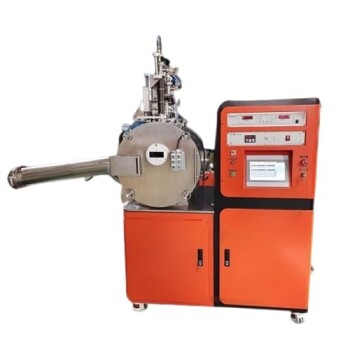
The Vacuum Induction Melting (VIM) furnace functions as the critical stabilization environment for the production of Alumina-Forming Austenitic (AFA) steel. Its primary role is to provide a high-purity vacuum atmosphere that prevents the oxidation of reactive alloying elements—specifically Aluminum (Al) and Niobium (Nb)—ensuring the final material adheres strictly to its designed chemical composition.
Core Takeaway The VIM furnace is not merely a melting tool; it is a precision instrument used to eliminate atmospheric contamination and oxide inclusions. By isolating the melt from oxygen, it enables the successful integration of reactive elements necessary for AFA steel’s corrosion resistance, establishing a reliable material baseline for performance testing.
Preserving Critical Alloying Elements
Preventing Oxidation of Active Metals
The defining characteristic of AFA steel is its reliance on specific reactive elements, particularly Aluminum (Al) and Niobium (Nb). These metals are highly "active," meaning they react aggressively with oxygen.
If melted in an open atmosphere, these elements would oxidize rapidly, turning into slag rather than integrating into the steel matrix. The VIM furnace eliminates this risk by operating under a controlled vacuum, preserving these active metals so they can perform their intended function in the alloy.
Precision in Chemical Composition
Producing AFA steel requires exact chemical ratios to achieve the desired alumina-forming capability.
The VIM process allows for the precise addition and retention of refractory and active elements. By removing the variable of atmospheric reaction, the furnace ensures that the amount of alloying material added to the furnace matches the amount found in the final ingot.
Achieving Microstructural Integrity
Elimination of Impurities and Inclusions
High-performance steels require a "clean" microstructure. The VIM furnace is essential for reducing non-metallic inclusions and removing dissolved impurity gases that can compromise the steel's structural integrity.
This purification process results in a high-purity ingot that is free from the defects that typically initiate mechanical failure or corrosion spots.
Homogenization of the Melt
Uniformity is critical for AFA steel. The electromagnetic induction used in these furnaces provides a natural stirring effect within the molten metal.
This continuous movement ensures that all alloying components are distributed evenly throughout the ingot. This prevents segregation—where elements clump together—and guarantees that the material properties are consistent from the surface to the core.
The Foundation for Reliable Research
Establishing a Valid Baseline
For researchers studying the corrosion performance of AFA steel, the quality of the base material is non-negotiable.
The VIM furnace creates a reliable material base. By minimizing impurities and ensuring uniform distribution of components, it isolates the variables. This ensures that subsequent data regarding heat treatment effects or corrosion resistance is accurate and not skewed by manufacturing defects.
Understanding the Trade-offs
Managing Volatile Elements
While the vacuum environment is excellent for preventing oxidation, it introduces a challenge regarding elements with high vapor pressures, such as Chromium (Cr) or Manganese.
Under deep vacuum, these elements can evaporate (volatilize) out of the melt. Consequently, operators must often introduce a partial pressure of inert gas (like Argon) or carefully control vacuum levels to suppress this evaporation and maintain the correct alloy balance.
Complexity of Scale
The VIM process is typically a batch process, often used for high-value or experimental ingots (e.g., 100 kg samples).
While it offers superior quality control, it does not offer the continuous throughput of lower-grade steelmaking processes. It is a specialized tool reserved for applications where purity and precise composition outweigh the need for high-volume commodity production.
Making the Right Choice for Your Goal
Depending on your specific objectives with AFA steel, the VIM furnace facilitates different outcomes:
- If your primary focus is Corrosion Research: The VIM furnace is essential to create a high-purity, inclusion-free baseline that ensures your corrosion data reflects the alloy chemistry, not material defects.
- If your primary focus is Alloy Design: The VIM furnace provides the necessary control to effectively integrate reactive elements like Aluminum and Niobium without losing them to oxidation.
- If your primary focus is Mechanical Reliability: The VIM furnace’s induction stirring ensures the chemical uniformity required to prevent segregation and mechanical weak points in the final component.
The Vacuum Induction Melting furnace is the gatekeeper of quality for AFA steel, transforming volatile raw ingredients into a stable, high-performance alloy.
Summary Table:
| Feature | Role in AFA Steel Production | Benefit to Material Properties |
|---|---|---|
| Vacuum Atmosphere | Prevents oxidation of Aluminum (Al) and Niobium (Nb) | Ensures correct chemical composition & corrosion resistance |
| Induction Stirring | Promotes homogenization of the melt | Prevents element segregation for uniform mechanical properties |
| Impurity Removal | Eliminates dissolved gases and non-metallic inclusions | Improves structural integrity and reduces failure points |
| Controlled Environment | Minimizes atmospheric contamination | Creates a reliable baseline for research and performance testing |
Elevate Your Advanced Material Research with KINTEK
Precision is the foundation of high-performance metallurgy. KINTEK specializes in cutting-edge laboratory equipment, providing the tools necessary for the most demanding thermal and chemical processes. Whether you are developing Alumina-Forming Austenitic (AFA) steel or researching novel alloys, our Vacuum Induction Melting (VIM) furnaces and induction melting systems deliver the purity and control your work requires.
Our extensive portfolio for material science includes:
- High-Temperature Furnaces: Muffle, tube, rotary, and atmosphere-controlled solutions.
- Specialized Reactors: High-temperature high-pressure reactors and autoclaves.
- Sample Preparation: Crushing, milling, and hydraulic pellet presses.
- Advanced Consumables: High-purity ceramics, crucibles, and PTFE products.
Ready to optimize your alloy development? Contact our technical experts today to discover how KINTEK’s precision engineering can enhance your laboratory’s efficiency and results.
References
- Zhaodandan Ma, Xianglong Guo. Corrosion Behavior of Alumina-Forming Austenitic Steel in Supercritical Carbon Dioxide Conditions: Effects of Nb Content and Temperature. DOI: 10.3390/ma16114081
This article is also based on technical information from Kintek Solution Knowledge Base .
Related Products
- Lab-Scale Vacuum Induction Melting Furnace
- Vacuum Induction Melting Spinning System Arc Melting Furnace
- Vacuum Heat Treat Furnace and Levitation Induction Melting Furnace
- Vacuum Arc Induction Melting Furnace
- Non Consumable Vacuum Arc Induction Melting Furnace
People Also Ask
- How do vacuum induction or arc melting furnaces facilitate the synthesis of U-Al-C MAX phases? Precision Heat & Purity
- What types of metals are typically processed in a vacuum induction melting furnace? High-Purity Alloys for Critical Applications
- Why use VIM for rare earth steel? Essential Precision for Melting Reactive Lanthanum and Cerium
- What is the primary function of a vacuum induction melting furnace in Ni-Mo-Cr-Fe master alloy prep? Ensure High Purity
- What are the key components inside the vacuum chamber of a vacuum induction melting furnace? A Guide to the Core Melting Assembly