Knowledge What is the role of vacuum drying equipment in the processing of SiC/B4C composite powders? Prevent Agglomeration Today
Author avatar

Tech Team · Kintek Solution

Updated 5 days ago

What is the role of vacuum drying equipment in the processing of SiC/B4C composite powders? Prevent Agglomeration Today


The primary function of vacuum drying equipment in the processing of SiC/B4C composite powders is the rapid and controlled removal of solvents immediately following the ball milling stage. Specifically, this equipment is used to evaporate solvents like ethanol from the ceramic slurry. By creating a low-pressure environment, it enables evaporation at significantly reduced temperatures, which is essential for maintaining the chemical and physical integrity of the ultra-fine powder mixture.

Core Insight: Vacuum drying is not merely about removing moisture; it is a preservation strategy. By lowering the boiling point of the solvent, the process prevents the two most common defects in fine ceramic powders: particle agglomeration and surface oxidation.

The Mechanism of Solvent Removal

Lowering the Boiling Point

The fundamental advantage of this equipment is its ability to manipulate the vapor pressure of the solvent. By reducing the ambient pressure within the chamber, the boiling point of the solvent (such as ethanol) drops significantly.

Low-Temperature Processing

This allows the solvent to evaporate rapidly without subjecting the SiC/B4C mixture to excessive heat. This "cold boiling" effect ensures that the drying phase is efficient without introducing thermal stress to the material.

Preserving Powder Quality

Preventing Agglomeration

One of the critical challenges in processing ultra-fine powders is their tendency to clump together, or agglomerate, as they dry. Vacuum drying facilitates a rapid phase change from liquid to gas, which minimizes the capillary forces that typically draw particles together during slow thermal drying.

Ensuring Uniform Dispersion

By preventing these hard agglomerates from forming, the equipment maintains the uniform dispersion achieved during the preceding ball milling step. This ensures that the Silicon Carbide (SiC) and Boron Carbide (B4C) particles remain distinct and evenly distributed.

Inhibiting Oxidation

Fine powders have a high surface area, making them highly susceptible to reacting with oxygen. Vacuum drying operates in an oxygen-deprived environment, effectively isolating the material from air. This prevents surface oxidation of the SiC and B4C particles, ensuring the chemical purity required for high-performance applications.

Common Pitfalls and Trade-offs

Vacuum vs. Blast Drying

While blast drying (using heated airflow) is effective for some composite powders like A356-SiCp to remove process control agents, it exposes materials to continuous airflow. For reactive or ultra-fine SiC/B4C powders, this exposure poses a higher risk of oxidation compared to the sealed environment of a vacuum dryer.

The Risk of Rapid Outgassing

While speed is a benefit, an uncontrolled drop in pressure can cause the solvent to boil too violently. This can lead to material splattering or the disruption of the powder bed, potentially affecting the homogeneity of the final batch.

Making the Right Choice for Your Goal

When integrating drying solutions into your SiC/B4C processing line, consider your specific material constraints:

  • If your primary focus is Chemical Purity: Prioritize vacuum drying to eliminate oxygen exposure and prevent the formation of surface oxides on the ceramic particles.
  • If your primary focus is Particle Size Distribution: Rely on vacuum drying to lock in the dispersion achieved during milling and prevent the formation of hard agglomerates.
  • If your primary focus is Process Safety: Ensure the vacuum system is calibrated to handle flammable solvent vapors (like ethanol) safely at low pressures.

The ultimate value of vacuum drying lies in its ability to transition a wet slurry into a dry powder without undoing the dispersion and refinement achieved in previous processing steps.

Summary Table:

Feature Vacuum Drying Advantage Impact on SiC/B4C Powder
Temperature Low-temperature evaporation Prevents thermal stress and chemical degradation
Environment Oxygen-deprived (low pressure) Inhibits surface oxidation of reactive particles
Particle State Reduced capillary forces Prevents hard agglomeration; maintains fine dispersion
Efficiency Rapid solvent removal Ensures consistent homogeneity across powder batches

Elevate Your Advanced Ceramic Processing with KINTEK

Precise material integrity is the difference between a high-performance composite and a failed batch. KINTEK specializes in high-precision laboratory equipment designed to protect your SiC/B4C mixtures. From our advanced vacuum drying solutions and high-temperature furnaces (muffle, vacuum, CVD) to our efficient crushing, milling, and hydraulic pellet presses, we provide the tools necessary to maintain chemical purity and uniform dispersion.

Whether you are refining ceramic slurries or conducting battery research, our comprehensive portfolio—including PTFE consumables, crucibles, and cooling solutions—ensures your lab operates at peak efficiency.

Ready to eliminate oxidation and agglomeration in your workflow?
Contact KINTEK experts today to find the perfect equipment for your application.

Related Products

People Also Ask

Related Products

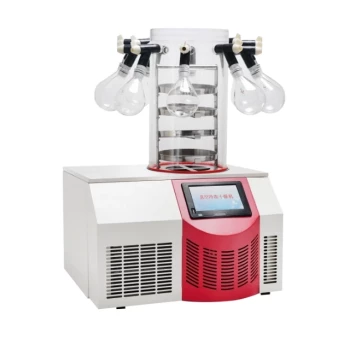
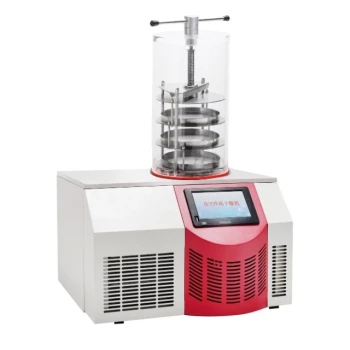
Benchtop Laboratory Freeze Dryer for Lab Use

Benchtop Laboratory Freeze Dryer for Lab Use

Premium benchtop laboratory freeze dryer for lyophilization, preserving samples with ≤ -60°C cooling. Ideal for pharmaceuticals & research.

Vacuum Hot Press Furnace Machine for Lamination and Heating

Vacuum Hot Press Furnace Machine for Lamination and Heating

Experience clean and precise lamination with Vacuum Lamination Press. Perfect for wafer bonding, thin-film transformations, and LCP lamination. Order now!

Stainless Steel Quick Release Vacuum Chain Three-Section Clamp

Stainless Steel Quick Release Vacuum Chain Three-Section Clamp

Discover our stainless steel quick release clamp vacuum clamp, Ideal for high vacuum applications, Strong connections, reliable sealing, Easy installation, and durable design.

Small Vacuum Heat Treat and Tungsten Wire Sintering Furnace

Small Vacuum Heat Treat and Tungsten Wire Sintering Furnace

The small vacuum tungsten wire sintering furnace is a compact experimental vacuum furnace specially designed for universities and scientific research institutes. The furnace features a CNC welded shell and vacuum piping to ensure leak-free operation. Quick-connect electrical connections facilitate relocation and debugging, and the standard electrical control cabinet is safe and convenient to operate.

Vacuum Heat Treat Sintering Brazing Furnace

Vacuum Heat Treat Sintering Brazing Furnace

A vacuum brazing furnace is a type of industrial furnace used for brazing, a metalworking process that joins two pieces of metal using a filler metal that melts at a lower temperature than the base metals. Vacuum brazing furnaces are typically used for high-quality applications where a strong, clean joint is required.

Vacuum Heat Treat Furnace with Ceramic Fiber Liner

Vacuum Heat Treat Furnace with Ceramic Fiber Liner

Vacuum furnace with polycrystalline ceramic fiber insulation liner for excellent heat insulation and uniform temperature field. Choose from 1200℃ or 1700℃ max. working temperature with high vacuum performance and precise temperature control.

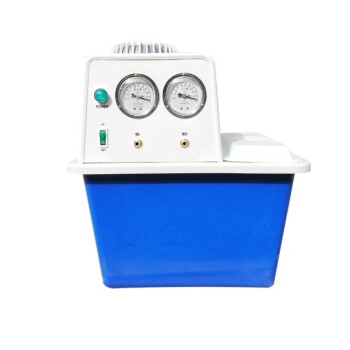
Circulating Water Vacuum Pump for Laboratory and Industrial Use

Circulating Water Vacuum Pump for Laboratory and Industrial Use

Efficient circulating water vacuum pump for labs - oil-free, corrosion-resistant, quiet operation. Multiple models available. Get yours now!

Silicon Carbide (SIC) Ceramic Sheet Wear-Resistant Engineering Advanced Fine Ceramics

Silicon Carbide (SIC) Ceramic Sheet Wear-Resistant Engineering Advanced Fine Ceramics

Silicon carbide (sic) ceramic sheet is composed of high-purity silicon carbide and ultra-fine powder, which is formed by vibration molding and high-temperature sintering.

Vertical High Temperature Graphite Vacuum Graphitization Furnace

Vertical High Temperature Graphite Vacuum Graphitization Furnace

Vertical high temperature graphitization furnace for carbonization and graphitization of carbon materials up to 3100℃.Suitable for shaped graphitization of carbon fiber filaments and other materials sintered in a carbon environment.Applications in metallurgy, electronics, and aerospace for producing high-quality graphite products like electrodes and crucibles.

Graphite Vacuum Furnace Bottom Discharge Graphitization Furnace for Carbon Materials

Graphite Vacuum Furnace Bottom Discharge Graphitization Furnace for Carbon Materials

Bottom-out graphitization furnace for carbon materials, ultra-high temperature furnace up to 3100°C, suitable for graphitization and sintering of carbon rods and carbon blocks. Vertical design, bottom discharging, convenient feeding and discharging, high temperature uniformity, low energy consumption, good stability, hydraulic lifting system, convenient loading and unloading.

High Pressure Laboratory Vacuum Tube Furnace Quartz Tubular Furnace

High Pressure Laboratory Vacuum Tube Furnace Quartz Tubular Furnace

KT-PTF High Pressure Tube Furnace: Compact split tube furnace with strong positive pressure resistance. Working temp up to 1100°C and pressure up to 15Mpa. Also works under controller atmosphere or high vacuum.

Molybdenum Vacuum Heat Treat Furnace

Molybdenum Vacuum Heat Treat Furnace

Discover the benefits of a high-configuration molybdenum vacuum furnace with heat shield insulation. Ideal for high-purity, vacuum environments like sapphire crystal growth and heat treatment.

Graphite Vacuum Furnace High Thermal Conductivity Film Graphitization Furnace

Graphite Vacuum Furnace High Thermal Conductivity Film Graphitization Furnace

The high thermal conductivity film graphitization furnace has uniform temperature, low energy consumption and can operate continuously.

Dental Porcelain Zirconia Sintering Ceramic Vacuum Press Furnace

Dental Porcelain Zirconia Sintering Ceramic Vacuum Press Furnace

Get precise dental results with Dental Vacuum Press Furnace. Automatic temperature calibration, low noise tray, and touch screen operation. Order now!

304 316 Stainless Steel Vacuum Ball Valve Stop Valve for High Vacuum Systems

304 316 Stainless Steel Vacuum Ball Valve Stop Valve for High Vacuum Systems

Discover 304/316 stainless steel vacuum ball valves, Ideal for high vacuum systems, Ensure precise control and durability. Explore now!

Laboratory Vacuum Tilt Rotary Tube Furnace Rotating Tube Furnace

Laboratory Vacuum Tilt Rotary Tube Furnace Rotating Tube Furnace

Discover the versatility of Laboratory Rotary Furnace: Ideal for calcination, drying, sintering, and high-temperature reactions. Adjustable rotating and tilting functions for optimal heating. Suitable for vacuum and controlled atmosphere environments. Learn more now!

Horizontal High Temperature Graphite Vacuum Graphitization Furnace

Horizontal High Temperature Graphite Vacuum Graphitization Furnace

Horizontal Graphitization Furnace: This type of furnace is designed with the heating elements placed horizontally, allowing for uniform heating of the sample. It's well-suited for graphitizing large or bulky samples that require precise temperature control and uniformity.

Graphite Vacuum Furnace IGBT Experimental Graphitization Furnace

Graphite Vacuum Furnace IGBT Experimental Graphitization Furnace

IGBT experimental graphitization furnace, a tailored solution for universities and research institutions, with high heating efficiency, user-friendliness, and precise temperature control.

2200 ℃ Graphite Vacuum Heat Treat Furnace

2200 ℃ Graphite Vacuum Heat Treat Furnace

Discover the power of the KT-VG Graphite Vacuum Furnace - with a maximum working temperature of 2200℃, it's perfect for vacuum sintering of various materials. Learn more now.

Graphite Vacuum Continuous Graphitization Furnace

Graphite Vacuum Continuous Graphitization Furnace

High-temperature graphitization furnace is a professional equipment for graphitization treatment of carbon materials. It is a key equipment for the production of high-quality graphite products. It has high temperature, high efficiency and uniform heating. It is suitable for various high-temperature treatments and graphitization treatments. It is widely used in metallurgy, electronics, aerospace, etc. industry.


Leave Your Message