Knowledge What is the sieving method of separation? A Guide to Efficient Particle Size Classification
Author avatar

Tech Team · Kintek Solution

Updated 6 days ago

What is the sieving method of separation? A Guide to Efficient Particle Size Classification


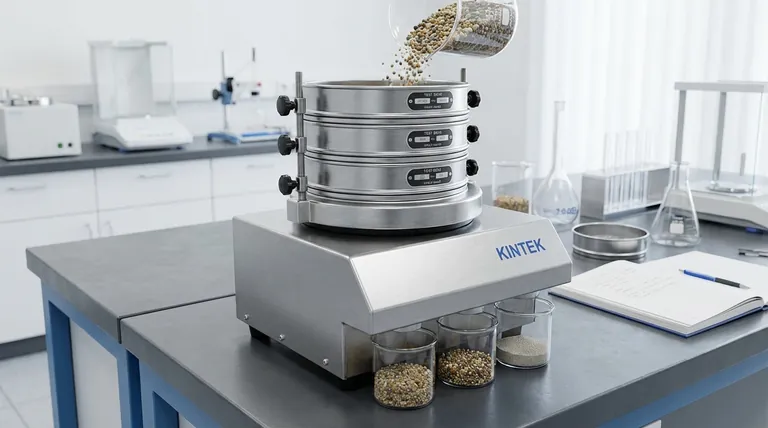
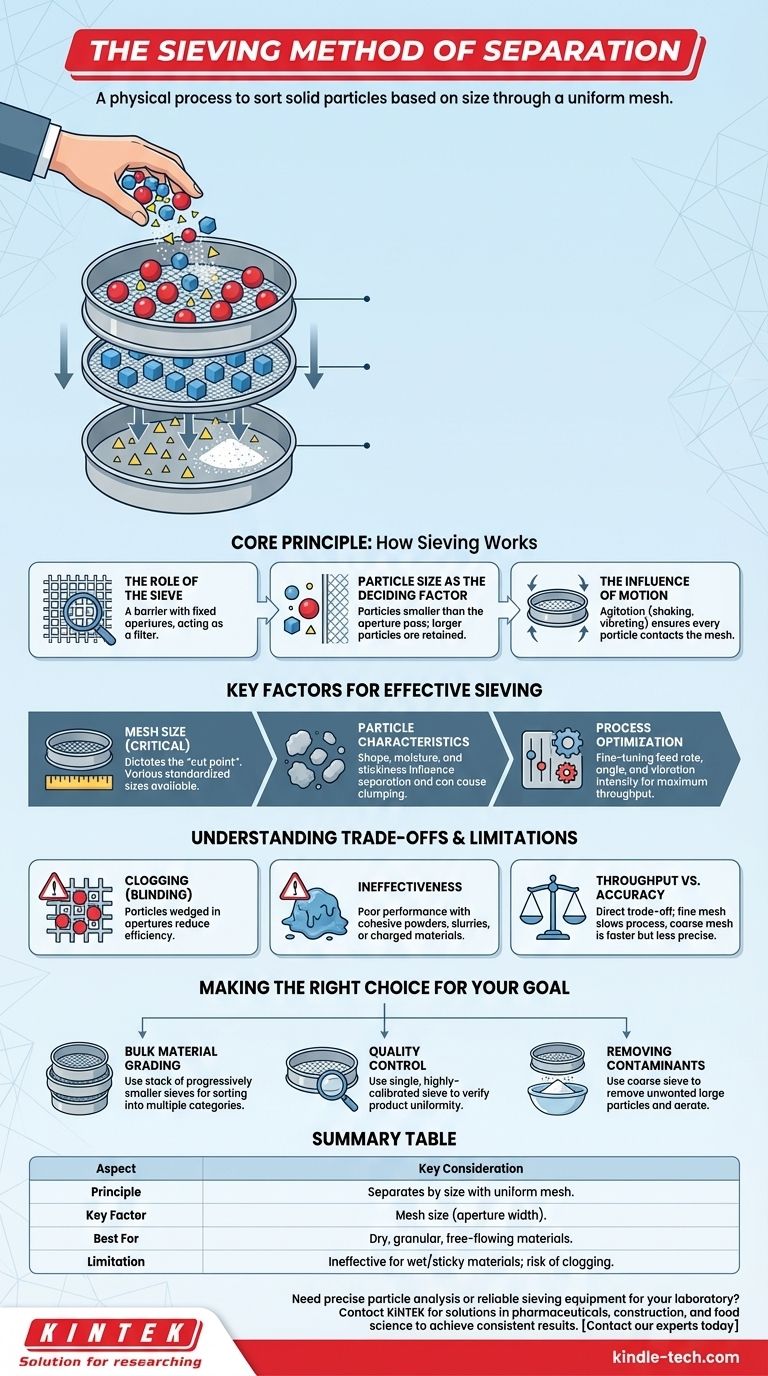
The sieving method of separation is a physical process used to distinguish and sort solid particles based on their size. It works by passing a mixture of materials through a screen or mesh with uniform openings; particles smaller than the openings pass through, while larger particles are retained on the surface.

The core principle of sieving is not merely filtering, but precise particle size classification. Its success depends entirely on the relationship between the particle size of the material and the aperture size of the chosen sieve mesh.
What is the sieving method of separation? A Guide to Efficient Particle Size Classification

The Core Principle: How Sieving Works

Sieving is one of the oldest and most intuitive methods of separation, relying on simple mechanical principles to achieve its goal.

The Role of the Sieve

A sieve is a device, often a wire mesh or a perforated plate, that features apertures (openings) of a fixed, uniform size. This screen acts as a physical barrier.

Particle Size as the Deciding Factor

When a mixture of particles is introduced to the sieve, the separation occurs. Any particle with dimensions smaller than the sieve's apertures will fall through, while any particle larger will be held back.

The Influence of Motion

For the process to be efficient, the material is typically agitated. This is done by shaking, vibrating, or tumbling the sieve to ensure every particle has an opportunity to come into contact with the mesh and pass through if it is small enough.

Key Factors for Effective Sieving

Optimizing the sieving process requires controlling several variables to achieve the desired separation with accuracy and efficiency.

Mesh Size

This is the most critical factor. The mesh size, or aperture width, dictates the "cut point" of the separation. Sieves are available in a vast range of standardized mesh sizes to suit different materials and classification needs.

Particle Characteristics

The shape and condition of the particles heavily influence the outcome. Elongated or irregular particles may pass through a mesh they wouldn't if they were spherical. Furthermore, wet or sticky materials can clump together, preventing effective separation and clogging the sieve.

Process Optimization

In industrial applications, "optimizing the process" involves fine-tuning the rate of material feed, the angle of the sieve, and the intensity of vibration. This ensures maximum throughput without sacrificing the accuracy of the separation.

Understanding the Trade-offs and Limitations

While powerful, sieving is not a universal solution and comes with inherent limitations that must be considered.

The Risk of Clogging (Blinding)

When particles are very close in size to the mesh openings, they can become wedged in the apertures. This phenomenon, known as blinding, reduces the available surface area of the sieve and dramatically lowers its efficiency.

Ineffectiveness with Certain Materials

Sieving is most effective for dry, granular, and free-flowing materials. It performs poorly with cohesive powders, slurries, or materials that carry a static charge, as these tend to agglomerate rather than separate.

Throughput vs. Accuracy

There is a direct trade-off between the speed of the process and its precision. Using a very fine mesh to achieve high-purity separation will slow down the rate at which material can be processed. Conversely, a coarse mesh allows for high throughput but offers less precise classification.

Making the Right Choice for Your Goal

To apply this method effectively, you must align the technique with your specific objective.

  • If your primary focus is bulk material grading (e.g., sand and gravel): Use a stack of sieves with progressively smaller mesh sizes to efficiently sort a single batch into multiple size categories at once.
  • If your primary focus is quality control (e.g., in pharmaceuticals): Use a single, highly-calibrated analysis sieve with a precise mesh size to verify that a product meets particle uniformity standards.
  • If your primary focus is removing contaminants (e.g., sifting flour): A simple, coarse sieve is sufficient to remove unwanted large particles and aerate the material.

Ultimately, mastering the sieving method lies in correctly matching the properties of your material to the specifications of the sieve.

Summary Table:

Aspect Key Consideration
Principle Separates particles based on size using a mesh with uniform openings.
Key Factor Mesh size (aperture width) is the most critical parameter.
Best For Dry, granular, free-flowing materials like sand, gravel, or powders.
Limitation Ineffective for wet, sticky, or cohesive materials; risk of clogging (blinding).

Need precise particle analysis or reliable sieving equipment for your laboratory?

KINTEK specializes in high-quality lab sieves and particle analysis equipment designed for accuracy and durability. Whether you're in pharmaceuticals, construction materials, or food science, our solutions help you achieve consistent, reliable results in your quality control and R&D processes.

Let us help you optimize your separation process. Contact our experts today to find the perfect sieving solution for your specific needs!

Visual Guide
What is the sieving method of separation? A Guide to Efficient Particle Size Classification Visual Guide

Related Products

People Also Ask

Related Products

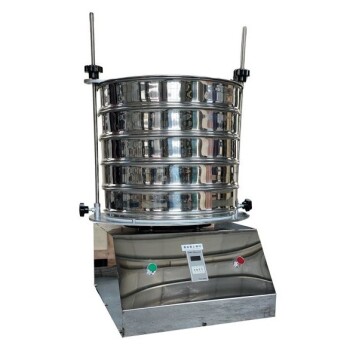
Laboratory Test Sieves and Sieving Machines

Laboratory Test Sieves and Sieving Machines

Precision lab test sieves & sieving machines for accurate particle analysis. Stainless steel, ISO-compliant, 20μm-125mm range. Request specs now!

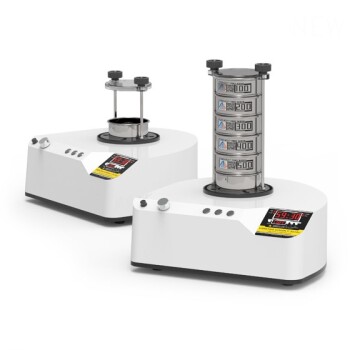
Three-dimensional electromagnetic sieving instrument

Three-dimensional electromagnetic sieving instrument

KT-VT150 is a desktop sample processing instrument for both sieving and grinding. Grinding and sieving can be used both dry and wet. The vibration amplitude is 5mm and the vibration frequency is 3000-3600 times/min.

Laboratory Vibratory Sieve Shaker Machine Slap Vibrating Sieve

Laboratory Vibratory Sieve Shaker Machine Slap Vibrating Sieve

KT-T200TAP is a slapping and oscillating sieving instrument for laboratory desktop use, with 300 rpm horizontal circular motion and 300 vertical slapping motions to simulate manual sieving to help sample particles pass through better.

Laboratory Sterilizer Lab Autoclave Vertical Pressure Steam Sterilizer for Liquid Crystal Display Automatic Type

Laboratory Sterilizer Lab Autoclave Vertical Pressure Steam Sterilizer for Liquid Crystal Display Automatic Type

Liquid crystal display automatic vertical sterilizer is a safe, reliable and automatic control sterilization equipment, which is composed of heating system, microcomputer control system and overheating and overvoltage protection system.

Laboratory Sterilizer Lab Autoclave Pulse Vacuum Lifting Sterilizer

Laboratory Sterilizer Lab Autoclave Pulse Vacuum Lifting Sterilizer

The pulse vacuum lifting sterilizer is a state-of-the-art equipment for efficient and precise sterilization. It uses pulsating vacuum technology, customizable cycles, and a user-friendly design for easy operation and safety.

Metallographic Specimen Mounting Machine for Laboratory Materials and Analysis

Metallographic Specimen Mounting Machine for Laboratory Materials and Analysis

Precision metallographic mounting machines for labs—automated, versatile, and efficient. Ideal for sample prep in research and quality control. Contact KINTEK today!

High Energy Vibratory Laboratory Ball Mill Grinding Mill Single Tank Type

High Energy Vibratory Laboratory Ball Mill Grinding Mill Single Tank Type

High-energy vibration ball mill is a small desktop laboratory grinding instrument.It can be ball-milled or mixed with different particle sizes and materials by dry and wet methods.

High Energy Planetary Ball Mill Machine for Laboratory Horizontal Tank Type

High Energy Planetary Ball Mill Machine for Laboratory Horizontal Tank Type

The KT-P2000H uses a unique Y-axis planetary trajectory, and utilizes the collision, friction and gravity between the sample and the grinding ball.

HFCVD Machine System Equipment for Drawing Die Nano-Diamond Coating

HFCVD Machine System Equipment for Drawing Die Nano-Diamond Coating

The nano-diamond composite coating drawing die uses cemented carbide (WC-Co) as the substrate, and uses the chemical vapor phase method ( CVD method for short ) to coat the conventional diamond and nano-diamond composite coating on the surface of the inner hole of the mold.

Benchtop Laboratory Vacuum Freeze Dryer

Benchtop Laboratory Vacuum Freeze Dryer

Benchtop laboratory freeze dryer for efficient lyophilization of biological, pharmaceutical, and food samples. Features intuitive touchscreen, high-performance refrigeration, and durable design. Preserve sample integrity—consult now!

Benchtop Laboratory Freeze Dryer for Lab Use

Benchtop Laboratory Freeze Dryer for Lab Use

Premium benchtop laboratory freeze dryer for lyophilization, preserving samples with ≤ -60°C cooling. Ideal for pharmaceuticals & research.

Anti-Cracking Press Mold for Lab Use

Anti-Cracking Press Mold for Lab Use

The anti-cracking press mold is a specialized equipment designed for molding various shapes and sizes of film using high pressure and electric heating.

Small Vacuum Heat Treat and Tungsten Wire Sintering Furnace

Small Vacuum Heat Treat and Tungsten Wire Sintering Furnace

The small vacuum tungsten wire sintering furnace is a compact experimental vacuum furnace specially designed for universities and scientific research institutes. The furnace features a CNC welded shell and vacuum piping to ensure leak-free operation. Quick-connect electrical connections facilitate relocation and debugging, and the standard electrical control cabinet is safe and convenient to operate.

Small Injection Molding Machine for Lab Use

Small Injection Molding Machine for Lab Use

The small injection molding machinehas fast and stable movements; good controllability and repeatability, super energy saving; the product can be automatically dropped and formed; the machine body is low, convenient for feeding, easy to maintain, and no height restrictions on the installation site.

Vacuum Dental Porcelain Sintering Furnace

Vacuum Dental Porcelain Sintering Furnace

Get precise and reliable results with KinTek's Vacuum Porcelain Furnace. Suitable for all porcelain powders, it features hyperbolic ceramic furnace function, voice prompt, and automatic temperature calibration.

Custom PTFE Teflon Parts Manufacturer Corrosion Resistant Cleaning Rack Flower Basket

Custom PTFE Teflon Parts Manufacturer Corrosion Resistant Cleaning Rack Flower Basket

The PTFE cleaning rack, also known as the PTFE flower basket cleaning flower basket, is a specialized laboratory tool designed for the efficient cleaning of PTFE materials. This cleaning rack ensures thorough and safe cleaning of PTFE items, maintaining their integrity and performance in laboratory settings.

Vacuum Hot Press Furnace Machine for Lamination and Heating

Vacuum Hot Press Furnace Machine for Lamination and Heating

Experience clean and precise lamination with Vacuum Lamination Press. Perfect for wafer bonding, thin-film transformations, and LCP lamination. Order now!

Precision Machined Zirconia Ceramic Ball for Engineering Advanced Fine Ceramics

Precision Machined Zirconia Ceramic Ball for Engineering Advanced Fine Ceramics

zirconia ceramic ball have the characteristics of high strength, high hardness, PPM wear level, high fracture toughness, good wear resistance, and high specific gravity.

Graphite Vacuum Furnace IGBT Experimental Graphitization Furnace

Graphite Vacuum Furnace IGBT Experimental Graphitization Furnace

IGBT experimental graphitization furnace, a tailored solution for universities and research institutions, with high heating efficiency, user-friendliness, and precise temperature control.

915MHz MPCVD Diamond Machine Microwave Plasma Chemical Vapor Deposition System Reactor

915MHz MPCVD Diamond Machine Microwave Plasma Chemical Vapor Deposition System Reactor

915MHz MPCVD Diamond Machine and its multi-crystal effective growth, the maximum area can reach 8 inches, the maximum effective growth area of single crystal can reach 5 inches. This equipment is mainly used for the production of large-size polycrystalline diamond films, the growth of long single crystal diamonds, the low-temperature growth of high-quality graphene, and other materials that require energy provided by microwave plasma for growth.


Leave Your Message