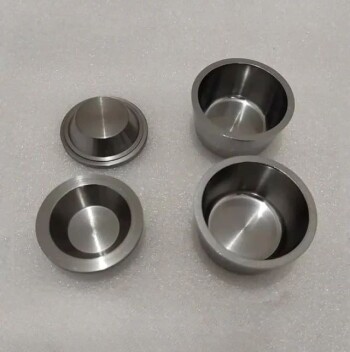
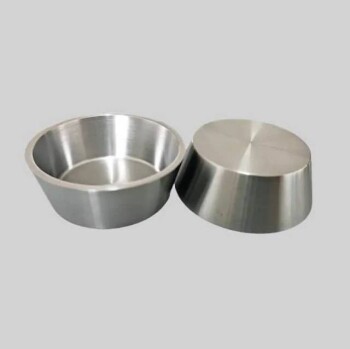
A stainless steel crucible functions primarily as a chemically inert, high-temperature vessel utilized during the specific preparation of Li-LLTO composite anodes. Its specific role is to hold the molten mixture of lithium metal and LLTO powder at a sustained temperature of 280°C, ensuring the process occurs without chemical interference.
Core Takeaway The crucible's defining role is to contain molten lithium without degrading. Its resistance to chemical attack by lithium ensures the composite material remains pure while allowing for safe, high-temperature processing.
The Critical Role of Material Compatibility
Withstanding High Processing Temperatures
The synthesis of Li-LLTO anodes requires heating the mixture to 280°C.
The stainless steel crucible maintains complete structural integrity at this specific operational temperature. It does not soften, deform, or degrade, providing a rigid environment necessary for mechanical stirring.
Inertness to Molten Lithium
Lithium metal is known for being highly reactive, a characteristic that intensifies significantly when the metal is in a molten state.
The stainless steel crucible is selected because it provides chemical stability against this specific threat. Unlike many other materials, it does not chemically react with the lithium during the stirring process, preventing the vessel from corroding or failing.
Ensuring Process Integrity and Safety
Preserving Anode Purity
The performance of an anode relies heavily on the purity of its components.
Because the stainless steel does not react with the molten lithium mixture, no foreign elements are leached from the crucible walls. This ensures that the final Li-LLTO composite material retains the exact chemical composition intended for the battery application.
Operational Safety
Handling molten lithium presents significant safety risks due to its volatility and reactivity.
The stainless steel crucible acts as a robust safety barrier. It ensures that the dangerous mixture is securely contained throughout the high-temperature stirring phase, preventing hazardous leaks or containment breaches.
Understanding the Constraints
Temperature Specificity
While stainless steel is effective for this specific application, its utility is bound by temperature.
It is chosen specifically for the 280°C requirement. At significantly higher temperatures beyond this process window, the risk of the steel alloying with lithium or losing structural strength would increase, necessitating different containment strategies.
Chemical Specificity
The choice of stainless steel is dictated by the specific chemistry of the Li-LLTO mixture.
It serves as a replacement for standard laboratory vessels (such as silica glass), which would likely react violently or shatter under these specific conditions. The utility of the crucible is directly tied to its specific resistance to lithium corrosion.
Making the Right Choice for Your Synthesis
To ensure the successful preparation of Li-LLTO composite anodes, consider the following:
- If your primary focus is Material Purity: Rely on stainless steel to prevent the leaching of contaminants that occurs with less stable vessel materials.
- If your primary focus is Process Safety: Utilize stainless steel to provide a mechanically robust barrier against the hazards of molten lithium at 280°C.
Ultimately, the stainless steel crucible is the foundational tool that enables the transformation of a volatile mixture into a stable anode by providing a non-reactive, heat-resistant containment zone.
Summary Table:
| Feature | Role in Li-LLTO Preparation |
|---|---|
| Material | Stainless Steel (Chemically Inert) |
| Temperature Limit | Sustained stability at 280°C |
| Chemical Stability | Resistant to corrosion from molten lithium metal |
| Safety Role | Robust containment for volatile mixtures |
| Purity Impact | Prevents leaching of contaminants into the anode |
Elevate Your Material Research with KINTEK Precision
Achieving the perfect Li-LLTO composite requires equipment that stands up to the most reactive environments. KINTEK specializes in high-performance laboratory solutions, offering a comprehensive range of stainless steel, ceramic, and specialty crucibles designed to withstand extreme temperatures and chemical challenges.
Whether you are scaling up battery research or optimizing high-temperature synthesis, our portfolio includes everything from muffle and vacuum furnaces to crushing systems and hydraulic presses. Partner with KINTEK for reliable consumables and advanced tools that ensure process integrity and material purity.
Ready to optimize your lab's performance? Contact us today to find the perfect containment solution for your application!
Related Products
- Electron Beam Evaporation Coating Tungsten Crucible and Molybdenum Crucible for High Temperature Applications
- Custom Machined and Molded PTFE Teflon Parts Manufacturer with PTFE Crucible and Lid
- Electron Beam Evaporation Coating Gold Plating Tungsten Molybdenum Crucible for Evaporation
- High Purity Pure Graphite Crucible for Electron Beam Evaporation
- High Purity Pure Graphite Crucible for Evaporation
People Also Ask
- What is the container that holds the metal source material called in e-beam evaporation? Ensure Purity and Quality in Your Thin-Film Deposition
- What materials are used in electron beam evaporation? Master High-Purity Thin Film Deposition
- What is the voltage of e-beam evaporation? Achieve Precise Thin-Film Deposition
- What are the applications of e-beam evaporation? Achieve High-Purity Coatings for Optics & Electronics
- What is e-beam evaporation? Achieve High-Purity Thin Film Deposition for Your Lab