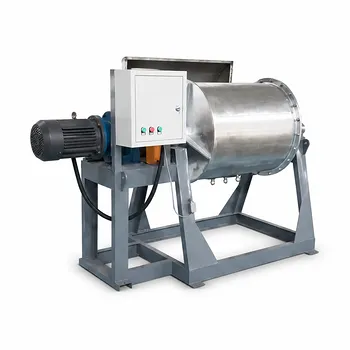
The specific role of a planetary ball mill in the A356-SiCp composite process is to provide the high-energy mechanical force necessary to achieve a uniform dispersion of reinforcement particles. Unlike standard mixing, this process actively breaks down clusters of micron-sized Silicon Carbide (SiC) to ensure they are homogeneously distributed throughout the A356 aluminum alloy matrix.
Core Takeaway The planetary ball mill transforms the mixture from a simple blend of powders into a homogeneous composite precursor. Its primary function is de-agglomeration: shattering particle clusters to ensure the reinforcement phase is evenly spaced, which is the physical prerequisite for achieving isotropic (uniform) mechanical properties in the final material.
The Problem: Particle Agglomeration
The Natural Tendency to Cluster
In metal matrix composites, micron-sized reinforcement particles like SiC naturally tend to cluster together.
If these particles remain in clusters (agglomerates), the final material will have weak spots and inconsistent strength.
Breaking the Bond
Simple stirring or low-energy mixing is often insufficient to separate these clusters.
The planetary ball mill is introduced specifically to overcome the inter-particle forces holding these agglomerates together.
The Solution: High-Energy Mechanical Milling
Impact and Shear Forces
The planetary ball mill generates intense kinetic energy through the collision of grinding balls.
As the mill rotates, it creates significant shear and impact forces. These forces are physically responsible for shattering the SiC agglomerates and forcing the particles apart.
Matrix Deformation and Coating
While the primary reference highlights dispersion, the mechanics of ball milling (as seen in similar composite processes) involve the plastic deformation of the softer metal matrix.
The high-energy impact deforms the soft A356 aluminum powder.
This deformation facilitates the mechanical alloying process, effectively trapping and embedding the harder SiC particles within or around the aluminum matrix, locking in the dispersion.
The Result: Isotropic Properties
Achieving Homogeneity
The ultimate goal of using a planetary ball mill is homogeneity.
By ensuring every area of the A356 matrix contains an equal distribution of SiC particles, the process eliminates "particle-poor" and "particle-rich" zones.
Consistent Mechanical Performance
This uniform structure is critical for achieving isotropic mechanical properties.
Isotropic means the material demonstrates the same strength and characteristics regardless of the direction in which the load is applied. Without the ball milling stage, the composite would likely suffer from direction-dependent weaknesses.
Understanding the Trade-offs
Balancing Energy Input
While high-energy milling is essential for dispersion, it is an aggressive process.
Insufficient milling time or speed will fail to break down all agglomerates, leaving defects in the material.
However, excessive milling can lead to over-refinement of the particles or excessive work hardening of the aluminum powder before the sintering stage. The process parameters must be tuned to achieve dispersion without degrading the powder's ability to be consolidated later.
Making the Right Choice for Your Goal
If your primary focus is Structural Integrity:
- Ensure the milling duration is sufficient to completely eliminate SiC agglomerates, as these clusters become stress concentration points that lead to premature failure.
If your primary focus is Microstructural Uniformity:
- Prioritize the optimization of shear forces to achieve a homogeneous distribution, which directly correlates to isotropic mechanical behavior in the final component.
If your primary focus is Process Efficiency:
- Recognize that planetary ball milling is a high-energy step; it adds time and cost but is non-negotiable for high-performance composites where simple blending fails to disperse the reinforcement.
The planetary ball mill acts not just as a mixer, but as a mechanical dispersing engine that dictates the reliability of the final composite material.
Summary Table:
| Feature | Role in A356-SiCp Processing | Impact on Material Quality |
|---|---|---|
| Energy Action | High-energy impact & shear forces | Breaks down hard SiC clusters/agglomerates |
| Matrix Interaction | Plastic deformation of A356 | Embeds reinforcement particles into the metal matrix |
| Dispersion Goal | Homogeneous particle distribution | Eliminates weak spots and "particle-poor" zones |
| Physical Result | Isotropic mechanical properties | Ensures uniform strength in all load directions |
Elevate Your Composite Material Research with KINTEK
Achieving perfect homogeneity in A356-SiCp composites requires precision and power. KINTEK specializes in advanced laboratory solutions designed for high-performance material science. From our high-energy planetary ball mills, crushing, and milling systems to precision sieving equipment and hydraulic presses, we provide the tools necessary for superior de-agglomeration and mechanical alloying.
Whether you are refining metal matrix composites or exploring battery research, KINTEK offers a comprehensive range of high-temperature furnaces, autoclaves, and specialized consumables to support your workflow.
Ready to optimize your powder mixing and consolidation process? Contact KINTEK today for expert guidance and tailored equipment solutions!
Related Products
- High Energy Planetary Ball Mill for Laboratory Horizontal Tank Type Milling Machine
- Laboratory Planetary Ball Mill Rotating Ball Milling Machine
- High-Energy Omnidirectional Planetary Ball Mill Milling Machine for Laboratory
- High Energy Planetary Ball Mill Milling Machine for Laboratory
- Laboratory Horizontal Planetary Ball Mill Milling Machine
People Also Ask
- What is the role of a planetary ball mill in sulfide-based solid-state batteries? Engineer High-Performance Cathodes
- What are the parameters of a planetary ball mill? Master Speed, Time, and Media for Perfect Grinding
- What is the function of a planetary ball mill for nanostructured eutectic steel? Essential Prep for High-Strength Alloys
- What role does a planetary ball mill play in the preparation of NASICON-type solid electrolytes like LATP and LAGP?
- What is the function of a planetary ball mill in solid-state electrolyte prep? Milling vs. SDS Methods Explained