Knowledge engineering ceramics What is the temperature for ceramic parts sintering? A Guide to Material-Specific Sintering Cycles
Author avatar

Tech Team · Kintek Solution

Updated 3 months ago

What is the temperature for ceramic parts sintering? A Guide to Material-Specific Sintering Cycles


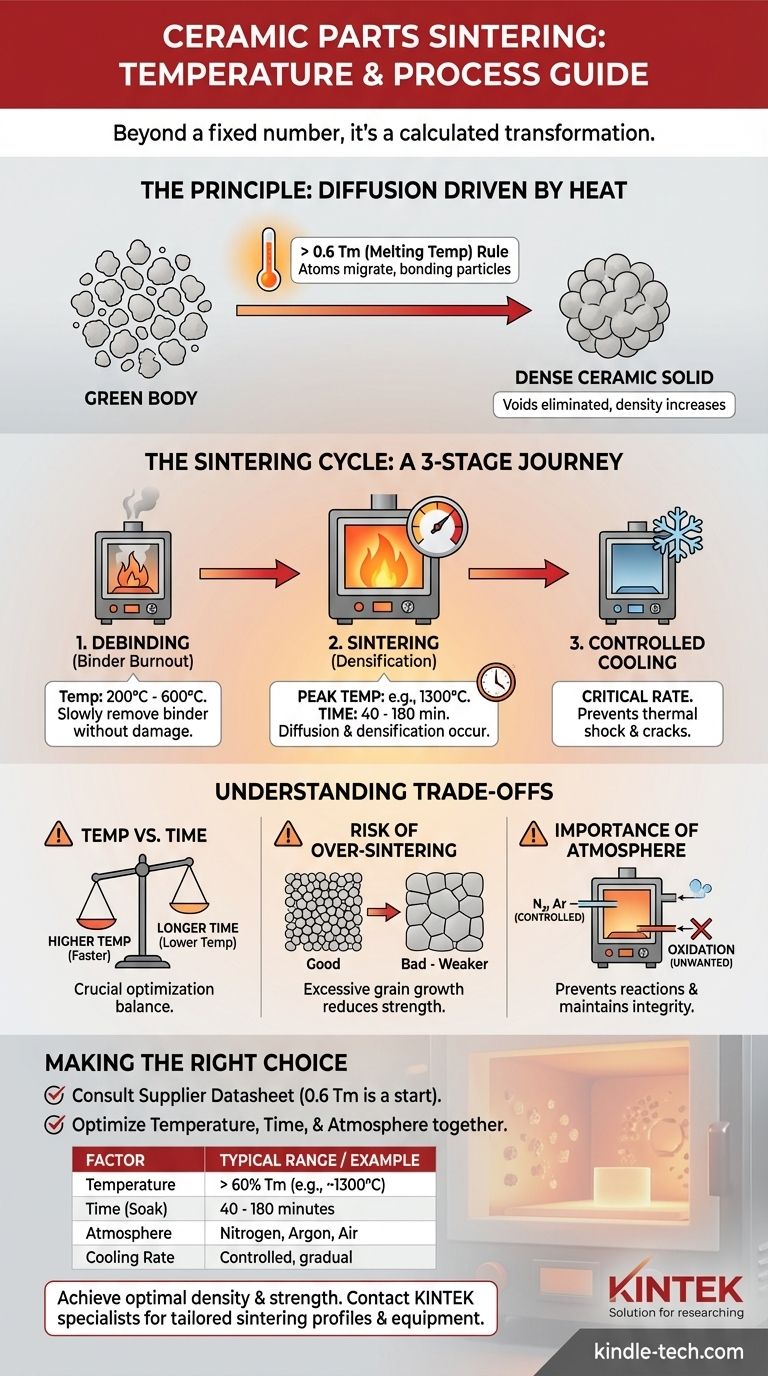
For ceramic parts, there is no single universal sintering temperature. While a typical peak temperature for some common ceramics is around 1,300°C, the precise value is fundamentally dependent on the specific material being used. The process involves a carefully controlled heating and cooling cycle, not just a single setpoint.

The critical takeaway is that sintering temperature is not a fixed number but a calculated parameter, generally set to be greater than 60% of the material's absolute melting temperature (Tm). This ensures sufficient thermal energy is available to bond the ceramic particles into a dense, solid part.
What is the temperature for ceramic parts sintering? A Guide to Material-Specific Sintering Cycles

The Principle of Sintering: More Than Just Heat

Sintering is the process that transforms a compacted powder, known as a "green body," into a dense, coherent solid. This transformation relies on atomic-level mechanics driven by high temperatures.

From Powder to Solid

The goal of sintering is to reduce the empty space (porosity) between the initial powder particles. By heating the material, these particles fuse together, gradually eliminating the voids and increasing the part's overall density and strength.

The Role of Temperature in Diffusion

High temperature provides the necessary energy for atoms to move and migrate across the boundaries of adjacent particles. This process, called diffusion, is the core mechanism of sintering. It allows the particles to bond, reduces surface area, and consolidates the material into a strong ceramic body.

The "0.6 Tm" Rule of Thumb

As a guiding principle, the sintering temperature must be high enough to enable significant diffusion. This typically requires a temperature greater than approximately 0.6 times the material's melting temperature (Tm). Below this threshold, the atomic movement is too slow for effective densification to occur in a reasonable timeframe.

A Sintering Cycle Is a Multi-Stage Process

Achieving a successful outcome involves more than just reaching a peak temperature. Sintering is a complete thermal cycle with distinct stages, each serving a critical purpose.

Stage 1: Debinding (Binder Burnout)

Before sintering, ceramic powders are often mixed with a binder to form the initial shape. The first phase of the heating cycle, often at lower temperatures (e.g., 200°C - 600°C), is designed to slowly burn out this binder material without damaging the part.

Stage 2: Sintering (Densification)

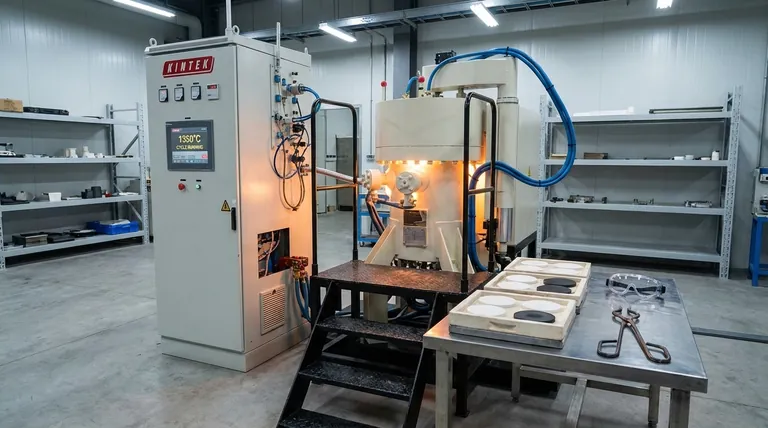
This is the high-temperature phase where the actual consolidation occurs. The furnace ramps up to the target sintering temperature (e.g., 1,300°C) and is held there for a specific duration, often between 40 to 180 minutes. During this "soak time," diffusion works to densify the part.

Stage 3: Controlled Cooling

After the high-temperature hold, the part must be cooled in a controlled manner. Cooling too quickly can induce thermal shock, leading to cracks and component failure. The cooling rate is an essential part of the overall process profile.

Understanding the Trade-offs

Optimizing a sintering cycle requires balancing competing factors. The choices you make directly impact the final properties of the ceramic component.

Temperature vs. Time

A higher sintering temperature can achieve densification more quickly. However, a similar level of density can often be reached by holding the part at a slightly lower temperature for a longer period. This trade-off is crucial for process optimization.

The Risk of Over-sintering

Using a temperature that is too high or holding it for too long can be detrimental. This can lead to excessive grain growth, where smaller grains merge into larger ones. While the part may be dense, large grains can often reduce the material's mechanical strength and fracture toughness.

The Importance of Atmosphere

Sintering does not happen in a vacuum unless specified. The gas inside the furnace (the atmosphere) is critical. A controlled atmosphere (like nitrogen or argon) can prevent unwanted chemical reactions, such as oxidation, ensuring the material's chemical integrity is maintained.

Making the Right Choice for Your Material

The ideal sintering cycle is a tailored solution based on the material and the desired final properties.

  • If your primary focus is a specific ceramic (e.g., Alumina, Zirconia): Always begin by consulting the material supplier's datasheet. The "0.6 Tm" rule provides an excellent starting point, but precise, validated cycles are always material-specific.
  • If your primary focus is process optimization: Remember that temperature, time, and atmosphere are interconnected variables. Adjusting one will affect the others, influencing final density, grain size, and mechanical strength.

Ultimately, successful sintering is a process of controlled transformation, not just an application of heat.

Summary Table:

Factor Key Consideration Typical Range/Example
Temperature Based on material's melting point (Tm) > 60% of Tm (e.g., ~1300°C for many ceramics)
Time (Soak) Duration at peak temperature 40 - 180 minutes
Atmosphere Prevents unwanted reactions Nitrogen, Argon, Air
Cooling Rate Prevents thermal shock Controlled, gradual

Achieve optimal density and strength for your ceramic components. The precise sintering temperature and cycle are critical to your product's performance. KINTEK specializes in lab equipment and consumables, serving laboratory needs. Our experts can help you select the right furnace and develop a tailored sintering profile for your specific material—whether it's Alumina, Zirconia, or a specialized technical ceramic. Contact our sintering specialists today to discuss your application and ensure your process is a success.

Visual Guide
What is the temperature for ceramic parts sintering? A Guide to Material-Specific Sintering Cycles Visual Guide

Related Products

People Also Ask

Related Products

Dental Porcelain Zirconia Sintering Ceramic Furnace Chairside with Transformer

Dental Porcelain Zirconia Sintering Ceramic Furnace Chairside with Transformer

Experience top-notch sintering with Chairside Sintering Furnace with Transformer. Easy to operate, noise-free pallet, and automatic temperature calibration. Order now!

Dental Porcelain Zirconia Sintering Ceramic Vacuum Press Furnace

Dental Porcelain Zirconia Sintering Ceramic Vacuum Press Furnace

Get precise dental results with Dental Vacuum Press Furnace. Automatic temperature calibration, low noise tray, and touch screen operation. Order now!

Vacuum Dental Porcelain Sintering Furnace

Vacuum Dental Porcelain Sintering Furnace

Get precise and reliable results with KinTek's Vacuum Porcelain Furnace. Suitable for all porcelain powders, it features hyperbolic ceramic furnace function, voice prompt, and automatic temperature calibration.

Vacuum Heat Treat Furnace with Ceramic Fiber Liner

Vacuum Heat Treat Furnace with Ceramic Fiber Liner

Vacuum furnace with polycrystalline ceramic fiber insulation liner for excellent heat insulation and uniform temperature field. Choose from 1200℃ or 1700℃ max. working temperature with high vacuum performance and precise temperature control.

Spark Plasma Sintering Furnace SPS Furnace

Spark Plasma Sintering Furnace SPS Furnace

Discover the benefits of Spark Plasma Sintering Furnaces for rapid, low-temperature material preparation. Uniform heating, low cost & eco-friendly.

High Temperature Muffle Oven Furnace for Laboratory Debinding and Pre Sintering

High Temperature Muffle Oven Furnace for Laboratory Debinding and Pre Sintering

KT-MD High temperature debinding and pre-sintering furnace for ceramic materials with various molding processes. Ideal for electronic components such as MLCC and NFC.

Vacuum Heat Treat and Sintering Furnace with 9MPa Air Pressure

Vacuum Heat Treat and Sintering Furnace with 9MPa Air Pressure

The air pressure sintering furnace is a high-tech equipment commonly used for the sintering of advanced ceramic materials. It combines vacuum sintering and pressure sintering techniques to achieve high-density and high-strength ceramics.

Vacuum Heat Treat and Molybdenum Wire Sintering Furnace for Vacuum Sintering

Vacuum Heat Treat and Molybdenum Wire Sintering Furnace for Vacuum Sintering

A vacuum molybdenum wire sintering furnace is a vertical or bedroom structure, which is suitable for withdrawal, brazing, sintering and degassing of metal materials under high vacuum and high temperature conditions. It is also suitable for dehydroxylation treatment of quartz materials.

Vacuum Heat Treat and Pressure Sintering Furnace for High Temperature Applications

Vacuum Heat Treat and Pressure Sintering Furnace for High Temperature Applications

Vacuum pressure sintering furnaces are designed for high temperature hot pressing applications in metal and ceramic sintering. Its advanced features ensure precise temperature control, reliable pressure maintenance, and a robust design for seamless operation.

600T Vacuum Induction Hot Press Furnace for Heat Treat and Sintering

600T Vacuum Induction Hot Press Furnace for Heat Treat and Sintering

Discover the 600T Vacuum Induction Hot Press Furnace, designed for high-temperature sintering experiments in vacuum or protected atmospheres. Its precise temperature and pressure control, adjustable working pressure, and advanced safety features make it ideal for nonmetal materials, carbon composites, ceramics, and metal powders.

Mesh belt controlled atmosphere furnace

Mesh belt controlled atmosphere furnace

Discover our KT-MB mesh belt sintering furnace - perfect for high-temperature sintering of electronic components & glass insulators. Available for open air or controlled atmosphere environments.

Small Vacuum Heat Treat and Tungsten Wire Sintering Furnace

Small Vacuum Heat Treat and Tungsten Wire Sintering Furnace

The small vacuum tungsten wire sintering furnace is a compact experimental vacuum furnace specially designed for universities and scientific research institutes. The furnace features a CNC welded shell and vacuum piping to ensure leak-free operation. Quick-connect electrical connections facilitate relocation and debugging, and the standard electrical control cabinet is safe and convenient to operate.

Ultra-High Temperature Graphite Vacuum Graphitization Furnace

Ultra-High Temperature Graphite Vacuum Graphitization Furnace

The ultra-high temperature graphitization furnace utilizes medium frequency induction heating in a vacuum or inert gas environment. The induction coil generates an alternating magnetic field, inducing eddy currents in the graphite crucible, which heats up and radiates heat to the workpiece, bringing it to the desired temperature. This furnace is primarily used for graphitization and sintering of carbon materials, carbon fiber materials, and other composite materials.

2200 ℃ Graphite Vacuum Heat Treat Furnace

2200 ℃ Graphite Vacuum Heat Treat Furnace

Discover the power of the KT-VG Graphite Vacuum Furnace - with a maximum working temperature of 2200℃, it's perfect for vacuum sintering of various materials. Learn more now.

2200 ℃ Tungsten Vacuum Heat Treat and Sintering Furnace

2200 ℃ Tungsten Vacuum Heat Treat and Sintering Furnace

Experience the ultimate refractory metal furnace with our Tungsten vacuum furnace. Capable of reaching 2200℃, perfect for sintering advanced ceramics and refractory metals. Order now for high-quality results.

Controlled Nitrogen Inert Hydrogen Atmosphere Furnace

Controlled Nitrogen Inert Hydrogen Atmosphere Furnace

KT-AH Hydrogen atmosphere furnace - induction gas furnace for sintering/annealing with built-in safety features, dual housing design, and energy-saving efficiency. Ideal for lab and industrial use.

Boron Nitride (BN) Crucible for Phosphorous Powder Sintered

Boron Nitride (BN) Crucible for Phosphorous Powder Sintered

Phosphorus powder sintered boron nitride (BN) crucible has a smooth surface, dense, pollution-free and long service life.

Vertical High Temperature Graphite Vacuum Graphitization Furnace

Vertical High Temperature Graphite Vacuum Graphitization Furnace

Vertical high temperature graphitization furnace for carbonization and graphitization of carbon materials up to 3100℃.Suitable for shaped graphitization of carbon fiber filaments and other materials sintered in a carbon environment.Applications in metallurgy, electronics, and aerospace for producing high-quality graphite products like electrodes and crucibles.

Graphite Vacuum Furnace High Thermal Conductivity Film Graphitization Furnace

Graphite Vacuum Furnace High Thermal Conductivity Film Graphitization Furnace

The high thermal conductivity film graphitization furnace has uniform temperature, low energy consumption and can operate continuously.

Graphite Vacuum Continuous Graphitization Furnace

Graphite Vacuum Continuous Graphitization Furnace

High-temperature graphitization furnace is a professional equipment for graphitization treatment of carbon materials. It is a key equipment for the production of high-quality graphite products. It has high temperature, high efficiency and uniform heating. It is suitable for various high-temperature treatments and graphitization treatments. It is widely used in metallurgy, electronics, aerospace, etc. industry.


Leave Your Message