Knowledge dental furnace What is the temperature of zirconia? Mastering the Sintering Cycle for Maximum Strength
Author avatar

Tech Team · Kintek Solution

Updated 2 months ago

What is the temperature of zirconia? Mastering the Sintering Cycle for Maximum Strength


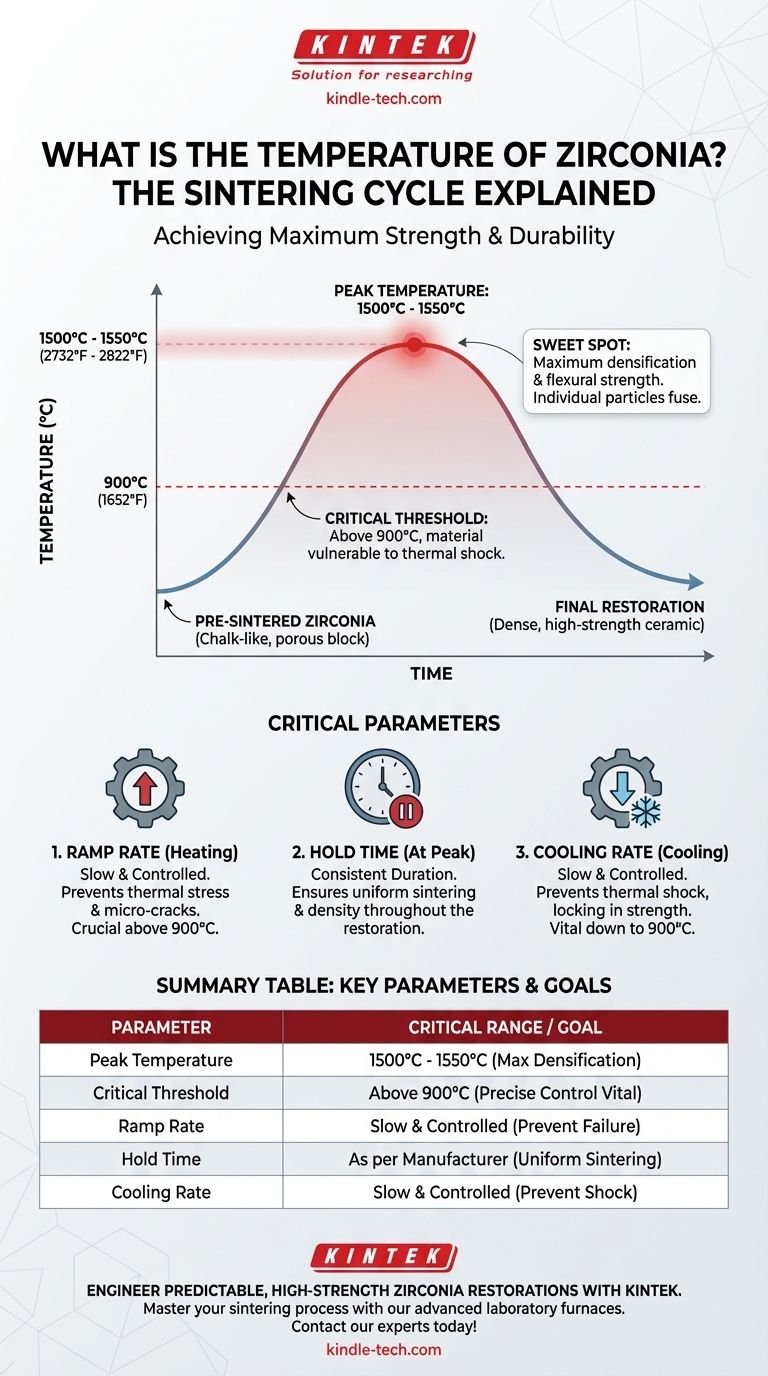
The optimal firing temperature for achieving maximum strength in most dental zirconia restorations is between 1500°C and 1550°C (2732°F - 2822°F). However, hitting this peak temperature is only one part of a much more critical thermal process that dictates the final quality and durability of the material.

Achieving a successful zirconia restoration is less about a single temperature and more about precisely controlling the entire sintering cycle. The critical phases of heating and cooling, particularly above 900°C, are what truly determine the final strength and stability of the material.
What is the temperature of zirconia? Mastering the Sintering Cycle for Maximum Strength

Why Sintering Is a Process, Not a Number

To understand the temperature of zirconia, you must understand the goal of sintering. This process transforms a chalk-like, pre-sintered zirconia block into a dense, high-strength ceramic restoration.

The Goal of Sintering

Sintering works by heating the material to a point where its individual particles begin to fuse, eliminating the porous spaces between them. This densification is what gives the final restoration its immense strength and desired translucency.

Reaching Peak Temperature (1500°C - 1550°C)

This specific temperature range represents the "sweet spot" for most zirconia formulations. It is at this peak that the material achieves maximum densification and, therefore, maximum flexural strength. Firing below this range can result in an under-sintered, weaker restoration.

The Critical 900°C Threshold

The temperature profile below 900°C (1652°F) has a minimal effect on the zirconia. The critical phase change that makes the material vulnerable to thermal shock occurs above this point.

Therefore, the entire process—from 900°C up to the peak temperature and back down to 900°C—must be precisely managed.

Understanding the Trade-offs and Critical Parameters

Simply setting the oven to 1550°C is not enough. The rates of heating and cooling are arguably more important than the peak temperature itself for preventing failures.

The Impact of Ramp Rate

The ramp rate is the speed at which the furnace temperature increases. A rapid ramp rate, especially after 900°C, can introduce thermal stresses into the material, leading to micro-cracks or even catastrophic failure. A slow, controlled ramp is essential for thermal stability.

The Importance of Hold Time

Once the peak temperature is reached, it must be held consistently for a specified duration, known as the hold time. This allows the sintering process to complete evenly throughout the entire restoration, ensuring uniform density and strength.

Cooling: The Critical Final Step

Controlled cooling is just as important as controlled heating. The restoration must be cooled slowly and steadily back to below 900°C. Rapid cooling will cause thermal shock, compromising the integrity and strength gained during the hold time.

How to Apply This to Your Process

Your approach should be guided by the manufacturer's instructions for the specific zirconia material you are using, as different formulations can have slightly different ideal cycles.

  • If your primary focus is maximum strength: Adhere strictly to the recommended peak temperature, typically between 1500°C and 1550°C, and ensure your furnace is properly calibrated.
  • If your primary focus is preventing fractures and ensuring stability: Pay closest attention to the heating and cooling rates, especially within the critical window between 900°C and the peak sintering temperature.

By mastering the entire thermal cycle, you move from simply firing zirconia to engineering a predictable and durable final restoration.

Summary Table:

Parameter Critical Range / Goal Why It Matters
Peak Temperature 1500°C - 1550°C (2732°F - 2822°F) Achieves maximum densification and strength.
Critical Threshold Above 900°C (1652°F) Material is vulnerable to thermal shock; precise control is vital.
Ramp Rate Slow and Controlled Prevents thermal stress, micro-cracks, and catastrophic failure.
Hold Time As per manufacturer Ensures uniform sintering and consistent density throughout the restoration.
Cooling Rate Slow and Controlled Prevents thermal shock, locking in the strength gained during sintering.

Engineer predictable, high-strength zirconia restorations with a KINTEK dental furnace.

Achieving the perfect sintering cycle requires precise control over temperature, ramp rates, and cooling. KINTEK's advanced laboratory furnaces are engineered to deliver the repeatable accuracy your dental lab needs for flawless results batch after batch.

We specialize in providing reliable lab equipment to dental technicians focused on quality and efficiency. Let us help you master your sintering process.

Contact our experts today to find the ideal furnace for your zirconia workflow!

Visual Guide
What is the temperature of zirconia? Mastering the Sintering Cycle for Maximum Strength Visual Guide

Related Products

People Also Ask

Related Products

Dental Porcelain Zirconia Sintering Ceramic Furnace Chairside with Transformer

Dental Porcelain Zirconia Sintering Ceramic Furnace Chairside with Transformer

Experience top-notch sintering with Chairside Sintering Furnace with Transformer. Easy to operate, noise-free pallet, and automatic temperature calibration. Order now!

Dental Porcelain Zirconia Sintering Ceramic Vacuum Press Furnace

Dental Porcelain Zirconia Sintering Ceramic Vacuum Press Furnace

Get precise dental results with Dental Vacuum Press Furnace. Automatic temperature calibration, low noise tray, and touch screen operation. Order now!

Vacuum Dental Porcelain Sintering Furnace

Vacuum Dental Porcelain Sintering Furnace

Get precise and reliable results with KinTek's Vacuum Porcelain Furnace. Suitable for all porcelain powders, it features hyperbolic ceramic furnace function, voice prompt, and automatic temperature calibration.

Vacuum Heat Treat and Sintering Furnace with 9MPa Air Pressure

Vacuum Heat Treat and Sintering Furnace with 9MPa Air Pressure

The air pressure sintering furnace is a high-tech equipment commonly used for the sintering of advanced ceramic materials. It combines vacuum sintering and pressure sintering techniques to achieve high-density and high-strength ceramics.

High Temperature Muffle Oven Furnace for Laboratory Debinding and Pre Sintering

High Temperature Muffle Oven Furnace for Laboratory Debinding and Pre Sintering

KT-MD High temperature debinding and pre-sintering furnace for ceramic materials with various molding processes. Ideal for electronic components such as MLCC and NFC.

Spark Plasma Sintering Furnace SPS Furnace

Spark Plasma Sintering Furnace SPS Furnace

Discover the benefits of Spark Plasma Sintering Furnaces for rapid, low-temperature material preparation. Uniform heating, low cost & eco-friendly.

Vacuum Heat Treat and Molybdenum Wire Sintering Furnace for Vacuum Sintering

Vacuum Heat Treat and Molybdenum Wire Sintering Furnace for Vacuum Sintering

A vacuum molybdenum wire sintering furnace is a vertical or bedroom structure, which is suitable for withdrawal, brazing, sintering and degassing of metal materials under high vacuum and high temperature conditions. It is also suitable for dehydroxylation treatment of quartz materials.

Small Vacuum Heat Treat and Tungsten Wire Sintering Furnace

Small Vacuum Heat Treat and Tungsten Wire Sintering Furnace

The small vacuum tungsten wire sintering furnace is a compact experimental vacuum furnace specially designed for universities and scientific research institutes. The furnace features a CNC welded shell and vacuum piping to ensure leak-free operation. Quick-connect electrical connections facilitate relocation and debugging, and the standard electrical control cabinet is safe and convenient to operate.

600T Vacuum Induction Hot Press Furnace for Heat Treat and Sintering

600T Vacuum Induction Hot Press Furnace for Heat Treat and Sintering

Discover the 600T Vacuum Induction Hot Press Furnace, designed for high-temperature sintering experiments in vacuum or protected atmospheres. Its precise temperature and pressure control, adjustable working pressure, and advanced safety features make it ideal for nonmetal materials, carbon composites, ceramics, and metal powders.

Vacuum Heat Treat and Pressure Sintering Furnace for High Temperature Applications

Vacuum Heat Treat and Pressure Sintering Furnace for High Temperature Applications

Vacuum pressure sintering furnaces are designed for high temperature hot pressing applications in metal and ceramic sintering. Its advanced features ensure precise temperature control, reliable pressure maintenance, and a robust design for seamless operation.

Vacuum Heat Treat Sintering Brazing Furnace

Vacuum Heat Treat Sintering Brazing Furnace

A vacuum brazing furnace is a type of industrial furnace used for brazing, a metalworking process that joins two pieces of metal using a filler metal that melts at a lower temperature than the base metals. Vacuum brazing furnaces are typically used for high-quality applications where a strong, clean joint is required.

Ultra-High Temperature Graphite Vacuum Graphitization Furnace

Ultra-High Temperature Graphite Vacuum Graphitization Furnace

The ultra-high temperature graphitization furnace utilizes medium frequency induction heating in a vacuum or inert gas environment. The induction coil generates an alternating magnetic field, inducing eddy currents in the graphite crucible, which heats up and radiates heat to the workpiece, bringing it to the desired temperature. This furnace is primarily used for graphitization and sintering of carbon materials, carbon fiber materials, and other composite materials.

2200 ℃ Tungsten Vacuum Heat Treat and Sintering Furnace

2200 ℃ Tungsten Vacuum Heat Treat and Sintering Furnace

Experience the ultimate refractory metal furnace with our Tungsten vacuum furnace. Capable of reaching 2200℃, perfect for sintering advanced ceramics and refractory metals. Order now for high-quality results.

Mesh belt controlled atmosphere furnace

Mesh belt controlled atmosphere furnace

Discover our KT-MB mesh belt sintering furnace - perfect for high-temperature sintering of electronic components & glass insulators. Available for open air or controlled atmosphere environments.

2200 ℃ Graphite Vacuum Heat Treat Furnace

2200 ℃ Graphite Vacuum Heat Treat Furnace

Discover the power of the KT-VG Graphite Vacuum Furnace - with a maximum working temperature of 2200℃, it's perfect for vacuum sintering of various materials. Learn more now.

Controlled Nitrogen Inert Hydrogen Atmosphere Furnace

Controlled Nitrogen Inert Hydrogen Atmosphere Furnace

KT-AH Hydrogen atmosphere furnace - induction gas furnace for sintering/annealing with built-in safety features, dual housing design, and energy-saving efficiency. Ideal for lab and industrial use.

Vacuum Heat Treat Furnace with Ceramic Fiber Liner

Vacuum Heat Treat Furnace with Ceramic Fiber Liner

Vacuum furnace with polycrystalline ceramic fiber insulation liner for excellent heat insulation and uniform temperature field. Choose from 1200℃ or 1700℃ max. working temperature with high vacuum performance and precise temperature control.

Vertical High Temperature Graphite Vacuum Graphitization Furnace

Vertical High Temperature Graphite Vacuum Graphitization Furnace

Vertical high temperature graphitization furnace for carbonization and graphitization of carbon materials up to 3100℃.Suitable for shaped graphitization of carbon fiber filaments and other materials sintered in a carbon environment.Applications in metallurgy, electronics, and aerospace for producing high-quality graphite products like electrodes and crucibles.

Large Vertical Graphite Vacuum Graphitization Furnace

Large Vertical Graphite Vacuum Graphitization Furnace

A large vertical high-temperature graphitization furnace is a type of industrial furnace used for the graphitization of carbon materials, such as carbon fiber and carbon black. It is a high-temperature furnace that can reach temperatures of up to 3100°C.

Horizontal High Temperature Graphite Vacuum Graphitization Furnace

Horizontal High Temperature Graphite Vacuum Graphitization Furnace

Horizontal Graphitization Furnace: This type of furnace is designed with the heating elements placed horizontally, allowing for uniform heating of the sample. It's well-suited for graphitizing large or bulky samples that require precise temperature control and uniformity.


Leave Your Message