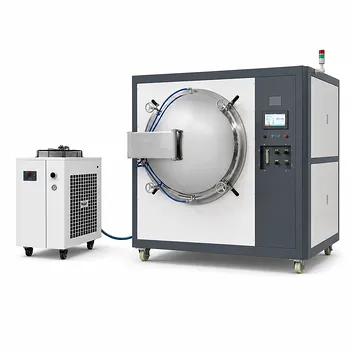
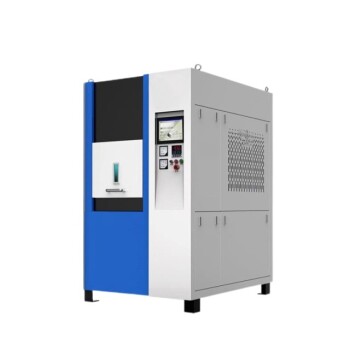
A vacuum hot press sintering furnace functions as a specialized processing chamber that integrates high vacuum, thermal energy, and mechanical force to synthesize composites. For 30% SiCp/2024Al composites specifically, it creates a controlled environment of $2.3 \times 10^{-3}$ Pa vacuum, 580°C temperature, and 70 MPa uniaxial pressure to transform loose powder into a solid, high-performance material.
The critical value of this equipment is its ability to overcome the natural barriers to bonding in metal matrix composites. By applying mechanical pressure while the material is protected by a vacuum, it forces the aluminum matrix to bond with silicon carbide particles, achieving a density and strength that standard sintering cannot match.
Creating the Optimal Processing Environment
Prevention of Matrix Oxidation
The primary function of the vacuum system is to minimize the oxygen partial pressure within the chamber.
This prevents the oxidation of the highly reactive 2024 aluminum matrix and its alloying elements (such as magnesium) at elevated temperatures. Without this vacuum protection, oxide layers would form on the particle surfaces, inhibiting bonding and weakening the final composite.
Enhancement of Wettability
The vacuum environment facilitates the removal of adsorbed gases and volatile impurities trapped in the gaps between powder particles.
Cleaning these particle surfaces significantly improves the wettability between the silicon carbide (SiC) particles and the aluminum matrix. Improved wettability ensures that the molten or softened aluminum adheres tightly to the ceramic reinforcement, rather than beading away from it.
Mechanisms of Densification and Bonding
Promoting Plastic Deformation
The furnace applies a substantial uniaxial pressure of 70 MPa simultaneously with heat.
This pressure forces the aluminum particles to undergo plastic deformation and flow around the rigid silicon carbide particles. This mechanical rearrangement is essential for filling the interstitial voids between particles, eliminating internal porosity that would otherwise act as crack initiation sites.
Facilitating Diffusion Bonding
The sustained temperature of 580°C provides the thermal energy necessary to activate atomic movement.
Combined with the contact pressure, this promotes atomic diffusion across the boundaries of the aluminum and silicon carbide. This process results in a strong metallurgical bond, ensuring the load can be effectively transferred from the matrix to the reinforcement particles during use.
Understanding the Process Trade-offs
The Necessity of Simultaneous Application
It is not enough to apply heat and pressure sequentially; they must be applied simultaneously within the vacuum.
Isolating these factors often leads to defects: heat without pressure results in a porous structure (low density), while pressure without sufficient heat fails to bond the particles metallurgically. The furnace's ability to synchronize these variables allows the composite to achieve a pore-free, dense structure with optimized mechanical properties.
Making the Right Choice for Your Goal
The vacuum hot press sintering furnace is a precision tool designed to balance competing physical requirements. Depending on your specific fabrication targets for 30% SiCp/2024Al, focus on the following parameters:
- If your primary focus is Structural Density: Prioritize the maintenance of continuous uniaxial pressure (70 MPa) to force particle rearrangement and eliminate internal porosity.
- If your primary focus is Interfacial Strength: Ensure the vacuum level is maintained at or better than $2.3 \times 10^{-3}$ Pa to maximize wettability and ensure clean diffusion bonding between the matrix and reinforcement.
Success in fabricating this composite relies on the precise synchronization of vacuum protection and mechanical compression to achieve a fully dense, oxide-free material.
Summary Table:
| Function | Parameter | Primary Benefit to 30% SiCp/2024Al |
|---|---|---|
| Vacuum Environment | $2.3 \times 10^{-3}$ Pa | Prevents matrix oxidation and improves SiC/Al wettability |
| Thermal Energy | 580°C | Activates atomic diffusion for strong metallurgical bonding |
| Mechanical Force | 70 MPa (Uniaxial) | Forces plastic deformation to eliminate porosity and voids |
| Process Sync | Simultaneous | Ensures a fully dense, pore-free composite structure |
Elevate Your Material Science with KINTEK Precision
Unlock the full potential of metal matrix composites with KINTEK’s advanced vacuum hot press sintering furnaces. Whether you are fabricating SiCp/2024Al or exploring high-performance alloys, our equipment provides the precise synchronization of vacuum, heat, and pressure needed for superior density and interfacial strength.
Our laboratory solutions include:
- High-temperature furnaces (Vacuum, Atmosphere, CVD/PECVD, and Dental)
- High-temperature high-pressure reactors and autoclaves
- Precision hydraulic presses (Pellet, Hot, and Isostatic)
- Milling, crushing, and sieving systems for powder preparation
- Advanced cooling solutions and essential consumables (PTFE, Ceramics, Crucibles)
Ready to optimize your fabrication process? Contact our technical experts today to find the perfect equipment for your research and production goals.
Related Products
- 600T Vacuum Induction Hot Press Furnace for Heat Treat and Sintering
- Vacuum Heat Treat and Sintering Furnace with 9MPa Air Pressure
- Vacuum Heat Treat and Pressure Sintering Furnace for High Temperature Applications
- 2200 ℃ Tungsten Vacuum Heat Treat and Sintering Furnace
- Vacuum Hot Press Furnace Heated Vacuum Press Machine Tube Furnace
People Also Ask
- What role does an induction vacuum hot pressing furnace play in sintering? Achieve 98% Density in Carbide Blocks
- What advantages does a vacuum hot press furnace provide for LSLBO ceramic electrolytes? Achieve 94% Relative Density
- What role does a Vacuum Hot Press (VHP) furnace play in the densification of austenitic stainless steel 316 composites?
- What are the advantages of a vacuum hot press furnace for W-50%Cu? Achieve 99.6% Density at Lower Temperatures
- What role does mechanical pressure play during the vacuum diffusion bonding of tungsten and copper? Keys to Solid Bonding