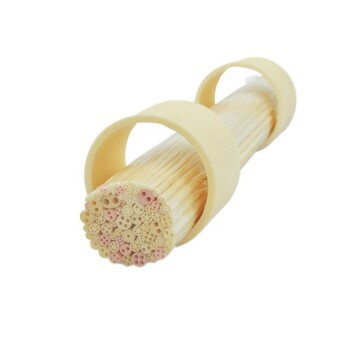
Quartz tubes act as a fundamental isolation barrier during the high-temperature synthesis of Na3SbS4 solid electrolytes. Specifically, they encapsulate cold-pressed precursor materials during annealing at 550 °C to prevent chemical degradation from atmospheric exposure and to physically contain volatile components that would otherwise escape.
The sealed quartz tube creates a stabilized micro-environment that serves a dual purpose: it shields the material from external oxygen and moisture while simultaneously trapping internal sulfur vapors to maintain the precise chemical stoichiometry required for high performance.
The Mechanics of Protection
Preventing Environmental Contamination
Sulfide-based electrolytes like Na3SbS4 are highly reactive to the ambient atmosphere, particularly at elevated temperatures.
When annealing at 550 °C, the risk of oxidation or hydrolysis increases significantly.
The quartz tube creates a hermetically sealed environment, ensuring that oxygen and moisture cannot reach the electrolyte and degrade its chemical structure.
Containing Volatile Components
Beyond external threats, the synthesis process faces an internal challenge: sulfur volatility.
At high annealing temperatures, sulfur components within the precursor mix tend to vaporize.
The sealed quartz tube inhibits this loss, creating a closed system where sulfur vapor pressure reaches equilibrium rather than escaping into the furnace.
Maintaining Stoichiometry
The retention of sulfur is not merely about yield; it is about chemical precision.
To achieve the correct stoichiometric ratio, every mole of sulfur intended for the crystal lattice must remain within the reaction vessel.
By preventing sulfur depletion, the quartz tube ensures the final product maintains the exact chemical composition required for the target phase.
Ensuring Phase Purity and Performance
Facilitating the Phase Transformation
The ultimate goal of the annealing process is to convert amorphous, ball-milled powders into a highly crystalline structure.
This transformation requires a stable thermal environment to organize the atomic structure.
The protective atmosphere within the tube allows this crystallization to proceed without the interference of impurity phases that would form in an open environment.
Eliminating Lattice Defects
High ionic conductivity—the measure of the electrolyte's efficiency—depends on a pristine crystal lattice.
The annealing process at 550 °C is intended to eliminate lattice defects inherent in the precursor powders.
By maintaining phase purity and stoichiometry, the quartz tube encapsulation ensures these defects are healed effectively, maximizing the conductivity of the final Na3SbS4 solid electrolyte.
Operational Considerations and Risks
Dependence on Seal Integrity
The entire protective function relies entirely on the quality of the vacuum seal.
If the quartz tube is not sealed perfectly, the pressure differential at high temperatures will cause immediate contamination.
Even a microscopic leak can lead to sulfur loss or oxidation, rendering the batch unusable.
Thermal Expansion Management
While quartz has excellent thermal properties, the materials inside undergo significant changes.
The encapsulation process must account for the volume changes and outgassing of the cold-pressed pellets.
Improper loading or sealing can lead to pressure accumulation that risks rupturing the tube during the heating cycle.
Optimizing the Synthesis Process
To ensure high-quality Na3SbS4 electrolytes, align your encapsulation strategy with your specific synthesis goals:
- If your primary focus is Phase Purity: Ensure the quartz tube is meticulously sealed to prevent any interaction with atmospheric oxygen or moisture, which creates impurity phases.
- If your primary focus is Ionic Conductivity: Prioritize the containment of sulfur vapors to maintain strict stoichiometry, as sulfur deficiency directly impairs the crystal lattice and ionic transport.
The quartz tube is not just a container; it is the active control mechanism that guarantees the chemical fidelity of your final electrolyte.
Summary Table:
| Protection Mechanism | Function in Na3SbS4 Synthesis | Impact on Final Electrolyte |
|---|---|---|
| Atmospheric Isolation | Blocks oxygen and moisture at 550 °C | Prevents oxidation and chemical degradation |
| Volatile Containment | Traps sulfur vapors within the tube | Maintains precise chemical stoichiometry |
| Pressure Regulation | Creates a stabilized micro-environment | Facilitates crystalline phase transformation |
| Defect Reduction | Enables healing of lattice defects | Maximizes ionic conductivity and performance |
Elevate Your Materials Research with KINTEK
Precision in solid-state electrolyte synthesis requires the highest quality laboratory tools. KINTEK specializes in high-performance laboratory equipment designed for rigorous thermal processes. Whether you are annealing Na3SbS4 or developing next-generation batteries, our comprehensive range of high-temperature furnaces (muffle, tube, vacuum) and specialized ceramics and crucibles provide the reliability your research demands.
From crushing and milling systems for precursor preparation to high-pressure reactors and autoclaves for advanced synthesis, KINTEK supports every stage of your lab workflow. Ensure phase purity and peak ionic conductivity in your materials today.
Contact KINTEK for Expert Solutions and Equipment
Related Products
- Laboratory Rapid Thermal Processing (RTP) Quartz Tube Furnace
- 1200℃ Split Tube Furnace with Quartz Tube Laboratory Tubular Furnace
- Optical Window Glass Substrate Wafer Quartz Plate JGS1 JGS2 JGS3
- High Temperature Resistant Optical Quartz Glass Sheet
- Rotary Tube Furnace Split Multi Heating Zone Rotating Tube Furnace
People Also Ask
- What technical advantages does an RTP tube furnace offer for photoelectrodes? Achieve Precision & High Phase Purity
- What is the temperature of a quartz tube furnace? Master the Limits for Safe, High-Temp Operation
- How does a quartz tube furnace facilitate the synthesis of rGO? Optimize Your Cathode Matrix with Precise Pyrolysis
- What are the advantages of using an electric heating furnace with a quartz tube for liquid bismuth corrosion control?
- What is the maximum temperature for a quartz tube furnace? Key Limits for Safe & Efficient Operation