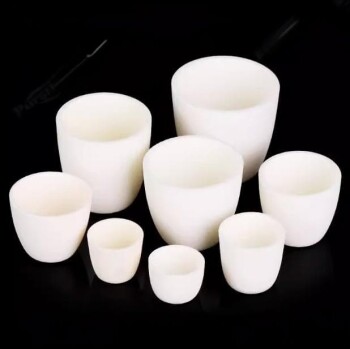
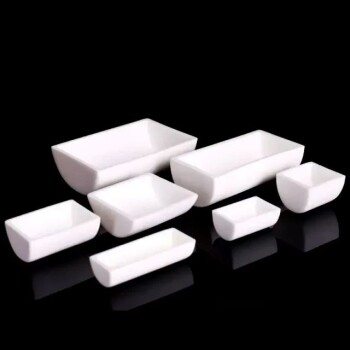
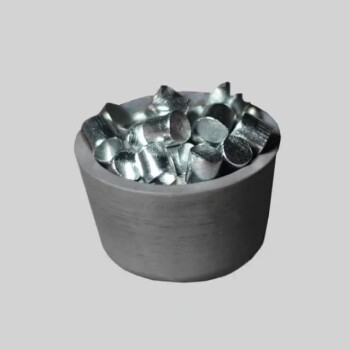
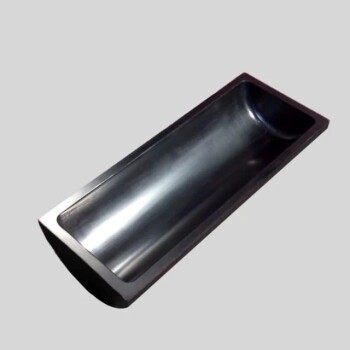
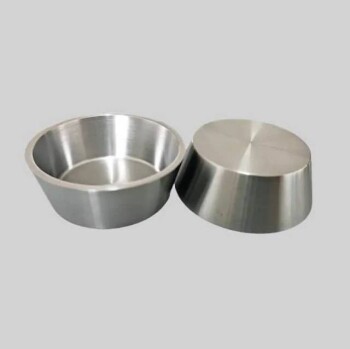
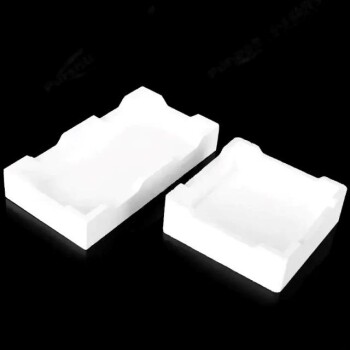
In the synthesis of Li7La3Zr2O12 (LLZO) solid-state electrolytes, ceramic crucibles serve as the fundamental isolation vessels required to purify raw materials before the synthesis process begins. Their primary role is to provide a chemically stable and high-temperature resistant environment used to remove crystallization water from Lanthanum Oxide (La2O3) at 1273 K and to dry Lithium Carbonate (Li2CO3) at 153 K, ensuring the inputs meet strict purity standards.
The critical value of the ceramic crucible during pre-treatment is its ability to withstand extreme thermal processing without contributing impurities. By isolating raw materials during dehydration and drying, it guarantees the chemical integrity required for a successful solid-state reaction.
The Mechanics of Material Pre-treatment
Removing Hydrates from Lanthanum Oxide
One of the most critical steps in preparing LLZO involves processing Lanthanum Oxide (La2O3). This material must be heated to 1273 K to effectively remove crystallization water.
Ceramic crucibles are essential here because they maintain structural integrity at these extreme temperatures. They allow the heat to penetrate the raw material without softening or degrading, which ensures complete dehydration.
Drying Lithium Carbonate
The pre-treatment process also involves drying Lithium Carbonate (Li2CO3) at 153 K. While this temperature is significantly lower, the requirement for containment remains the same.
The crucible acts as a clean, defined vessel that prevents the powder from dispersing or absorbing ambient moisture during the cooling phases following the drying process.
Preventing Environmental Contamination
Beyond handling heat, the crucible serves as a physical barrier. It isolates the high-purity raw materials from the furnace environment.
This isolation is vital to prevent interactions with heating elements or furnace linings, which could introduce foreign ions that would degrade the conductivity of the final electrolyte.
Why Chemical Inertness Matters
Ensuring Stoichiometric Accuracy
Solid-state reactions rely on precise ratios of ingredients. If a container reacts with the raw materials, it alters the chemical composition.
Ceramic crucibles, particularly those made of high-purity alumina, offer exceptional chemical inertness. This ensures that the amount of Lithium or Lanthanum put into the vessel remains constant throughout the heating cycle.
Protecting Laboratory Equipment
During calcination and pre-treatment, raw materials can sometimes exhibit acidic or strongly oxidizing behaviors.
The dense material of the ceramic crucible safely contains these components. This prevents corrosive damage to expensive furnace equipment and ensures the safety of the laboratory setup.
Understanding the Trade-offs
Thermal Shock Sensitivity
While ceramic crucibles are heat resistant, they can be susceptible to thermal shock.
Rapid heating or cooling cycles during pre-treatment can cause the crucible to crack. It is essential to ramp temperatures up and down gradually to preserve the integrity of the container and the sample inside.
Material Compatibility Risks
Not all ceramics are suitable for all precursors. While generally inert, specific crucible materials (like lower-grade alumina) can sometimes react with Lithium at very high temperatures.
Operators must ensure the specific ceramic composition is compatible with the corrosive nature of molten lithium salts if the process exceeds standard pre-treatment temperatures.
Optimizing Your Pre-treatment Protocol
To ensure the highest quality Li7La3Zr2O12 electrolyte, select your equipment based on your specific processing parameters:
- If your primary focus is material purity: prioritize high-density, high-purity alumina crucibles to minimize the risk of cross-contamination or leaching during the 1273 K heating stage.
- If your primary focus is equipment longevity: ensure the crucible volume is sufficient to prevent spillage of precursors, thereby protecting your furnace lining from corrosive reactions.
Ultimately, the ceramic crucible is not just a container; it is a critical process variable that dictates the baseline purity and performance of your final solid-state battery material.
Summary Table:
| Pre-treatment Stage | Target Material | Temperature | Primary Function |
|---|---|---|---|
| Dehydration | Lanthanum Oxide (La2O3) | 1273 K | Removes crystallization water and ensures material purity. |
| Drying | Lithium Carbonate (Li2CO3) | 153 K | Eliminates moisture and prevents powder dispersion. |
| Contamination Control | All Raw Materials | High Thermal | Isolates precursors from furnace environment and impurities. |
| Stoichiometry | All Raw Materials | High Thermal | Chemical inertness ensures precise ratios of Li and La. |
Elevate Your Solid-State Battery Research with KINTEK
Precise material synthesis begins with the right containment. KINTEK specializes in high-performance laboratory equipment designed for the rigorous demands of battery research. From high-purity ceramic crucibles that ensure the stoichiometric accuracy of your LLZO electrolytes to our advanced muffle and vacuum furnaces for precise thermal processing, we provide the tools necessary for breakthrough results.
Our extensive portfolio includes:
- High-Temperature Furnaces: Muffle, tube, and vacuum systems for critical calcination.
- Crucibles & Ceramics: High-density alumina and PTFE products for superior chemical resistance.
- Processing Equipment: Crushing, milling, and hydraulic presses for material preparation.
Don't let impurities compromise your electrolyte's conductivity. Contact KINTEK today to discover how our premium laboratory solutions can optimize your pre-treatment protocols and enhance your research outcomes.
Related Products
- Arc-Shaped Alumina Ceramic Crucible High Temperature Resistant for Engineering Advanced Fine Ceramics
- Alumina Al2O3 Ceramic Crucible Semicircle Boat with Lid for Engineering Advanced Fine Ceramics
- Engineering Advanced Fine Alumina Al2O3 Ceramic Crucible for Laboratory Muffle Furnace
- Boron Nitride (BN) Crucible for Phosphorous Powder Sintered
- Engineering Advanced Fine Ceramics Alumina Al2O3 Crucible With Lid Cylindrical Laboratory Crucible
People Also Ask
- Why Use Alumina Crucibles & Powder Burial for NaSICON? Ensure Phase Purity and Prevent Elemental Volatilization
- What is the primary purpose of using alumina crucibles for LLTO ceramics? Optimize Your High-Temperature Sintering
- Why are alumina crucibles and mother powder essential for LATP sintering? Optimize Your Solid Electrolyte Performance
- Why are high-purity alumina crucibles used for liquid lead corrosion experiments? Ensure Data Accuracy at 550°C
- Primary considerations for choosing alumina crucibles and quartz tubes in indium intercalation: Ensure Material Purity