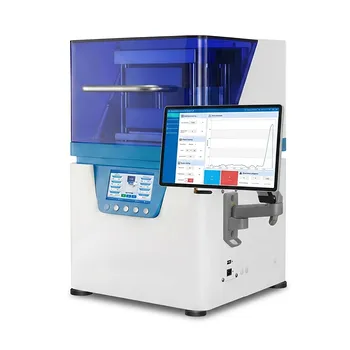
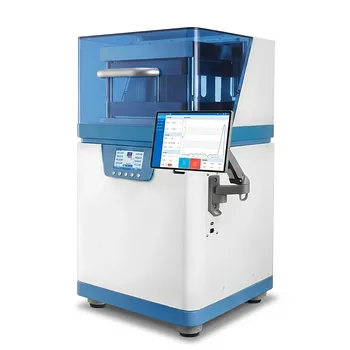
High-precision laboratory hydraulic presses are the primary instruments used to transform loose powder materials into dense, structurally sound solids known as "green bodies." By applying uniform and highly controlled pressure, these presses compress powder particles into specific geometric shapes with high mechanical strength. This process is the critical first step in powder metallurgy and ceramic manufacturing, ensuring that the resulting samples have the necessary density and structural integrity for subsequent thermal processing or physical analysis.
The laboratory hydraulic press serves as the bridge between raw powder and a functional material sample, providing the precise pressure control needed to eliminate internal voids and ensure uniform density. Without this precision, the final material would likely suffer from structural defects, warping, or failure during downstream processes like sintering.
Achieving Structural Integrity Through Compaction
The Role of Mechanical Interlocking
At the heart of the molding process is the forced rearrangement of powder particles. As the hydraulic press applies tonnage, particles undergo plastic deformation, causing them to interlock mechanically and create a solid structure from a loose medium.
Elimination of Internal Voids
Loose powders contain significant air gaps, or voids, which compromise the material's strength. High-precision presses apply stable pressure—often reaching tens of thousands of pounds per square inch—to minimize these gaps and increase the contact area between particles.
Creation of High-Density Green Bodies
A "green body" is the term for a compacted sample that has not yet been fired or sintered. The hydraulic press ensures these bodies reach a critical density, providing the initial mechanical strength required for handling and further treatment.
Ensuring Uniformity and Process Success
Minimizing Density Gradients
One of the greatest challenges in powder molding is maintaining the same density throughout the entire sample. Precision presses use closed-loop control systems to apply pressure evenly, which prevents "density gradients" that could lead to cracking or uneven shrinkage.
Preparing for the Sintering Process
Most powder samples undergo sintering, a high-heat process that fuses particles together. A precisely molded sample ensures structural consistency, preventing the warping, micro-cracking, or "bloating" that occurs when a sample has inconsistent internal pressure.
Facilitating Chemical and Physical Analysis
For applications like Infrared Spectroscopy (IR), the press is used to create thin, transparent pellets. Precise pressure control allows researchers to achieve the specific thickness and clarity required for light to pass through the sample accurately.
Understanding the Trade-offs and Limitations
The Risk of Elastic Recovery (Springback)
When pressure is released, some materials undergo "springback," where the sample expands slightly. If the pressing speed or pressure is not finely tuned, this sudden expansion can cause delamination or internal fractures within the green body.
Requirement for Binder Materials
In many cases, dry powder will not hold its shape through pressure alone. Researchers must often add a small percentage of binders (like PVA) to assist in lubrication and adhesion, though these must be carefully "burned out" later in the process.
Tooling and Mold Wear
The high pressures required—sometimes exceeding 650 MPa in industrial simulations—place extreme stress on the steel or alloy molds. Using a press without smooth loading cycles can lead to premature mold failure or contamination of the sample with metallic debris.
How to Apply This to Your Research Goal
Choosing the Right Approach for Your Objectives
Modern laboratory presses offer a range of capabilities depending on whether you are conducting basic research or industrial simulation.
- If your primary focus is analytical chemistry (e.g., IR Pellets): Prioritize a press with a small footprint and highly sensitive manual or digital controls to produce thin, translucent samples without cracking.
- If your primary focus is material science and sintering: Select a press with a programmable, closed-loop system to ensure repeatable density and minimize internal stress in your green bodies.
- If your primary focus is industrial process simulation: Utilize a high-tonnage press capable of varying its pressing speeds to evaluate how materials respond to different strain rates and loading cycles.
By mastering the precise application of force, you ensure that your material research begins with a reliable, defect-free foundation.
Summary Table:
| Key Role | Technical Benefit | Typical Application |
|---|---|---|
| Mechanical Interlocking | Transforms loose powder into high-strength green bodies | Powder Metallurgy & Ceramics |
| Void Elimination | Minimizes internal air gaps to ensure uniform density | Structural Material Testing |
| Precision Control | Produces thin, transparent, and crack-free samples | IR Spectroscopy & Chemical Analysis |
| Programmable Cycles | Minimizes springback and reduces tool/mold wear | Industrial Process Simulation |
Elevate Your Sample Preparation with KINTEK Precision
Ensure the structural integrity of your research with KINTEK’s industry-leading laboratory solutions. Whether you are performing analytical chemistry or advanced material sintering, our high-precision hydraulic presses (pellet, hot, isostatic) provide the stable, repeatable pressure necessary to eliminate voids and density gradients.
At KINTEK, we specialize in a comprehensive range of laboratory equipment designed for excellence, including:
- Sample Preparation: Crushing and milling systems, sieving equipment, and specialized hydraulic presses.
- Thermal Processing: High-temperature furnaces (muffle, tube, vacuum, CVD) and high-pressure reactors.
- Material Analysis: Electrolytic cells, electrodes, and essential consumables like PTFE and ceramics.
Don’t let structural defects compromise your results. Contact KINTEK today to find the perfect equipment for your laboratory and achieve superior mechanical strength in every sample.
References
- Zhiwei Zhu, Bo You. Efficient Noble‐Metal‐Free Integration Electrolysis for Solar H<sub>2</sub> and Supercapacitor Electrode Coproduction in Acidic Water. DOI: 10.1002/cssc.202301213
This article is also based on technical information from Kintek Solution Knowledge Base .
Related Products
- Laboratory Hydraulic Press Split Electric Lab Pellet Press
- Laboratory Hydraulic Press Lab Pellet Press Machine for Glove Box
- Laboratory Hydraulic Press Lab Pellet Press for Button Battery
- Automatic Laboratory Hydraulic Pellet Press Machine for Lab Use
- Fully Automatic Heated Hydraulic Lab Press for Materials Sintering and Sample Preparation
People Also Ask
- What are the roles of a laboratory hydraulic press and stainless steel molds in the preparation of graphite samples?
- What is the role of a laboratory hydraulic press in electrode prep? Maximize Energy Density & Sealing Precision
- How does a laboratory hydraulic press ensure the quality of alumina-forming alloy green bodies? Optimize CSP Research
- How is a laboratory hydraulic press used to evaluate the mechanical performance of nano-modified concrete? Expert Guide
- Why is a laboratory hydraulic press used for ASSB assembly? Achieving 392 MPa for Optimal Solid-State Battery Density