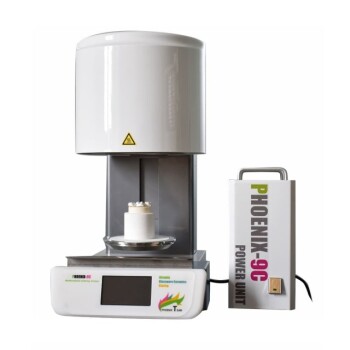
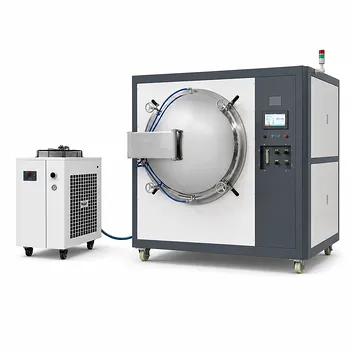
High-temperature sintering furnaces act as the critical transformation vessel in the fabrication of Lithium Aluminum Titanium Phosphate (LATP) solid electrolytes. By maintaining stable thermal environments, often between 950°C and 1100°C, these furnaces facilitate atomic diffusion and grain boundary bonding to convert fragile "green bodies" into dense, conductive ceramic pellets.
Sintering is not merely a heating step; it is a structural evolution that eliminates porosity and fosters grain connectivity. This densification is the defining factor that grants LATP electrolytes the mechanical integrity and ionic conductivity required for high-performance battery operation.
The Mechanism of Densification
Thermal Energy and Atomic Diffusion
Furnaces provide the high activation energy required to mobilize atoms within the LATP material. This thermal input promotes atomic diffusion, allowing particles to rearrange and bond at a fundamental level.
Elimination of Porosity
As diffusion occurs, the voids (pores) between individual particles are filled or expelled. The furnace environment drives this reduction in internal porosity, transforming a loosely packed powder compact into a solid, cohesive mass.
Grain Boundary Bonding
The prolonged heat treatment fuses individual grains together. This creates a continuous 3D framework, ensuring that the boundaries between grains are tight and robust rather than weak points in the structure.
Impact on Material Performance
Maximizing Ionic Conductivity
A dense, pore-free structure is essential for the movement of lithium ions. By fusing particles and minimizing voids, the sintering process creates clear pathways for ions to travel, directly resulting in the high ionic conductivity LATP is known for.
Mechanical Integrity
The heat treatment imparts the mechanical strength necessary for the electrolyte to function in a real-world battery. A well-sintered LATP pellet can withstand the physical stresses associated with the repeated deposition and stripping of lithium metal during charge cycles.
Enhancing Crystallinity
Sintering ensures the material achieves a highly crystalline state. The stable high-temperature environment promotes the formation of a uniform crystal lattice, which is vital for maintaining consistent electrochemical properties throughout the electrolyte.
Understanding the Trade-offs
Managing Lithium Volatilization
While high temperatures (such as 1100°C) drive densification, they also introduce the risk of lithium loss. At these sustained temperatures, lithium can volatilize, potentially altering the stoichiometry of the material and degrading performance if not carefully managed.
Controlling Grain Coarsening
Extended holding times, which can last approximately 12 hours, are necessary for fusing particles but can lead to excessive grain growth (coarsening). If grains become too large, the mechanical and electrochemical properties of the electrolyte may be compromised.
Balancing Time and Temperature
There is a delicate balance between the temperature applied (e.g., 950°C vs. 1100°C) and the duration of the sinter. Operators must optimize these parameters to achieve maximum density without inducing chemical instability or structural defects.
Making the Right Choice for Your Goal
To optimize your LATP fabrication process, consider your specific performance targets when configuring furnace parameters.
- If your primary focus is Ionic Conductivity: Prioritize higher sintering temperatures (up to 1100°C) to maximize densification and grain connectivity, but ensure the atmosphere is controlled to prevent lithium loss.
- If your primary focus is Structural Homogeneity: Utilize stable temperatures around 950°C with controlled ramp rates to promote uniform atomic diffusion and avoid the defects associated with rapid grain coarsening.
The success of LATP fabrication relies on using the furnace not just as a heater, but as a precision tool to balance densification against chemical stability.
Summary Table:
| Feature | Impact on LATP Electrolyte |
|---|---|
| Sintering Temperature | 950°C to 1100°C; critical for atomic diffusion and grain bonding |
| Densification | Eliminates porosity to create clear pathways for lithium-ion movement |
| Grain Connectivity | Creates a robust 3D framework for enhanced mechanical integrity |
| Crystallinity | Promotes a uniform crystal lattice for stable electrochemical properties |
| Stoichiometry Control | Requires precise thermal management to prevent lithium volatilization |
Elevate Your Solid-State Battery Research with KINTEK
Precision is the key to unlocking the full potential of LATP solid electrolytes. KINTEK provides the high-performance thermal tools needed to balance densification and chemical stability. Our comprehensive range of high-temperature muffle and tube furnaces, along with our vacuum and atmosphere furnaces, are specifically designed to meet the rigorous demands of battery material research.
Beyond heating solutions, KINTEK specializes in laboratory equipment and consumables, including crushing and milling systems for precursor preparation, hydraulic presses for pellet formation, and battery research tools. Whether you are working on grain boundary bonding or managing lithium volatilization, our experts are here to support your laboratory's success.
Ready to optimize your sintering process? Contact KINTEK today to find the perfect solution for your lab!
Related Products
- Spark Plasma Sintering Furnace SPS Furnace
- Vacuum Heat Treat and Molybdenum Wire Sintering Furnace for Vacuum Sintering
- Dental Porcelain Zirconia Sintering Ceramic Furnace Chairside with Transformer
- High Temperature Muffle Oven Furnace for Laboratory Debinding and Pre Sintering
- Controlled Nitrogen Inert Hydrogen Atmosphere Furnace
People Also Ask
- What is SPS sintering method? A Guide to High-Speed, High-Performance Material Fabrication
- Why are Spark Plasma Sintering (SPS) furnaces or hot presses utilized in the preparation of Li3PS4 solid electrolytes?
- What is the difference between spark plasma sintering and flash sintering? A Guide to Advanced Sintering Methods
- What technical advantages does a Spark Plasma Sintering (SPS) furnace offer for LZP ceramics? Enhance Ionic Conductivity
- What is the theory of spark plasma sintering? A Guide to Rapid, Low-Temperature Densification