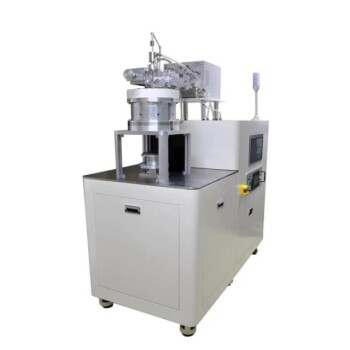
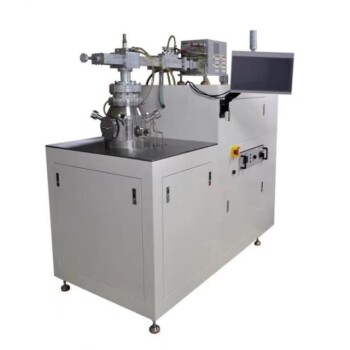
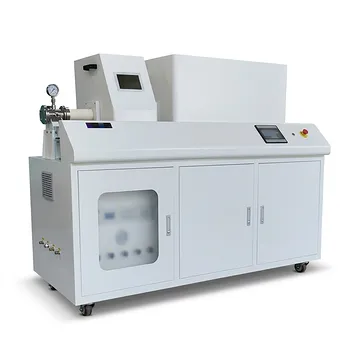
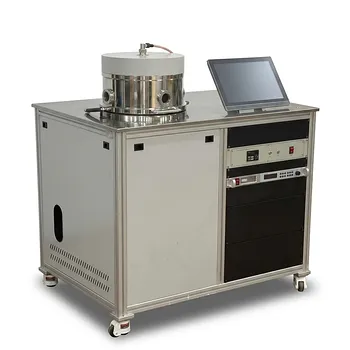
The Chemical Vapor Deposition (CVD) reactor functions as a non-line-of-sight coating environment designed to encapsulate parts regardless of their intricacy. By introducing volatile precursor gases into a heated chamber, the reactor ensures that the coating material diffuses into every accessible area of a component, including deep internal holes, narrow slots, and recessed surfaces that directional coating methods cannot reach.
Core Insight: The defining characteristic of a CVD reactor is its superior "throwing power." Unlike processes that require a direct line of sight, a CVD reactor relies on gas diffusion to create a uniform, chemically bonded film on every exposed surface, ensuring total encapsulation of complex geometries.
The Mechanics of Coating Complex Geometries
Overcoming Line-of-Sight Limitations
In many coating processes, if the source cannot "see" the surface, it cannot coat it. A CVD reactor eliminates this limitation by utilizing a gaseous medium.
The Role of Gas Diffusion
Once the substrate is placed in the reaction chamber, volatile precursor gases are introduced. These gases naturally expand and diffuse throughout the entire chamber volume.
Penetrating Internal Features
Because the process relies on gas flow, the coating agents can navigate tortuous paths. This allows for the effective coating of blind holes, internal channels, and complex undercuts found in precision components.
Achieving High Conformality
Defining Conformality
Conformality refers to the ability of a coating to maintain a uniform thickness across irregular shapes. CVD reactors excel at creating highly conformal thin films.
Uniformity Across Surfaces
Whether the surface is flat, curved, or tucked inside a narrow slot, the chemical reaction occurs at the surface level. This results in a functional protective film with precise composition and uniform thickness across the entire part.
Chemical and Metallurgical Bonding
The reactor environment facilitates a reaction between the gas mixture and the substrate. This creates a strong chemical and metallurgical bond, rather than a superficial adhesion, ensuring the coating remains durable even on complex contours.
Understanding the Trade-offs
High-Temperature Requirements
Achieving this level of coverage often requires significant heat. Standard CVD processes often operate at temperatures around 1925°F, which may necessitate subsequent heat treating for steel parts to restore their mechanical properties.
Edge Build-up and Tolerances
While coverage is uniform, the process can result in a higher rate of build-up on sharp edges. Consequently, CVD is often associated with a looser tolerance range compared to other methods.
Post-Coating Finishing
Due to edge build-up and the nature of the deposition, parts with tight dimensional tolerances may require post-coating finishing or polishing to meet final specifications.
Making the Right Choice for Your Goal
While CVD offers unmatched coverage for complex shapes, the thermal and dimensional implications must be weighed against your design constraints.
- If your primary focus is internal geometry: The CVD reactor is the superior choice due to its exceptional throwing power and ability to coat internal holes and slots.
- If your primary focus is holding extremely tight edge tolerances: You must account for potential edge build-up and plan for post-coating finishing or polishing.
- If your primary focus is substrate temperature sensitivity: You must verify that your material can withstand the standard processing temperatures (approx. 1925°F) or plan for restorative heat treatment.
Ultimately, the CVD reactor provides the most reliable method for total encapsulation of complex parts, provided the substrate can endure the rigorous thermal environment.
Summary Table:
| Feature | CVD Reactor Performance | Benefit for Complex Shapes |
|---|---|---|
| Coating Method | Non-line-of-sight gas diffusion | Reaches deep internal holes and narrow slots |
| Conformality | Highly conformal thin films | Maintains uniform thickness across irregular surfaces |
| Bonding Type | Chemical and Metallurgical | Ensures durable adhesion on all accessible contours |
| Throwing Power | Superior | Guarantees total encapsulation of intricate components |
| Process Temp | Approx. 1925°F | Facilitates high-quality, dense protective coatings |
Elevate Your Coating Precision with KINTEK Advanced CVD Solutions
Don't let complex geometries compromise your component performance. KINTEK specializes in high-performance laboratory equipment, offering state-of-the-art CVD and PECVD reactors designed to handle the most intricate coating challenges. Whether you need to ensure total encapsulation of internal channels or require uniform, chemically bonded films for research and production, our expertise ensures your materials withstand the most rigorous environments.
From high-temperature furnaces and vacuum systems to specialized PTFE and ceramic consumables, KINTEK provides the comprehensive tools needed for advanced material science. Contact us today to discuss your project requirements and discover how our precision-engineered solutions can optimize your lab's coating efficiency and material durability.
References
- Subin Antony Jose, Pradeep L. Menezes. Wear- and Corrosion-Resistant Coatings for Extreme Environments: Advances, Challenges, and Future Perspectives. DOI: 10.3390/coatings15080878
This article is also based on technical information from Kintek Solution Knowledge Base .
Related Products
- Microwave Plasma Chemical Vapor Deposition MPCVD Machine System Reactor for Lab and Diamond Growth
- 915MHz MPCVD Diamond Machine Microwave Plasma Chemical Vapor Deposition System Reactor
- Customer Made Versatile CVD Tube Furnace Chemical Vapor Deposition Chamber System Equipment
- Cylindrical Resonator MPCVD Machine System Reactor for Microwave Plasma Chemical Vapor Deposition and Lab Diamond Growth
- Split Chamber CVD Tube Furnace with Vacuum Station Chemical Vapor Deposition System Equipment Machine
People Also Ask
- How does a microwave plasma reactor facilitate the synthesis of diamond? Master MPCVD with Precision Technology
- What are the advantages of a Microwave Plasma CVD reactor for MCD/NCD coatings? Precision Multilayer Diamond Engineering
- How do vacuum pumps and valves collaborate in MPCVD? Achieve Precise Pressure Control for Superior CNT Synthesis
- How does MPCVD work? A Guide to Low-Temperature, High-Quality Film Deposition
- What is microwave plasma chemical vapor deposition? A Guide to High-Purity Diamond Film Growth