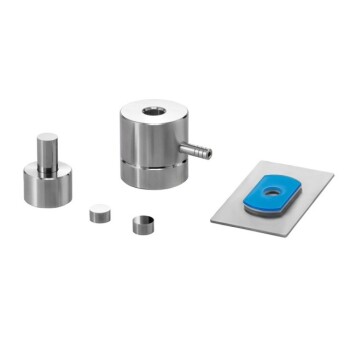
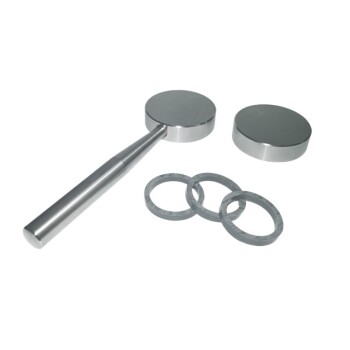
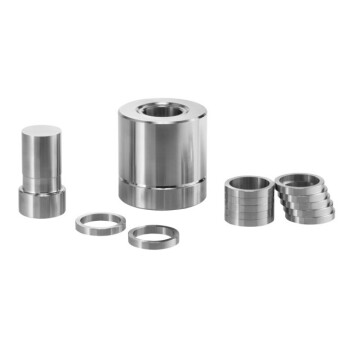
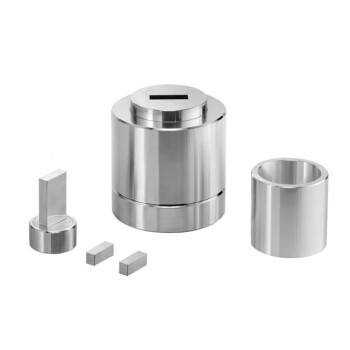
The primary role of a graphite mold in this context is to serve as a high-precision, robust containment vessel that enables the sequential stacking and consolidation of distinct material layers. It provides the necessary structural integrity to withstand high temperatures and pressures while physically supporting the WCp (Tungsten Carbide particle) and Cu (Copper) powders as they are arranged layer by layer.
The graphite mold is not merely a shaping tool; it is the critical stabilizer that allows for independent pre-pressing of individual layers, ensuring the delicate gradient structure is preserved rather than mixing into a homogeneous mass.
The Mechanics of Layered Stacking
Precision Cavity for Powder Filling
The mold creates a defined volume where loose powders can be introduced with high accuracy. In Functionally Graded Materials (FGMs), the composition changes across the volume (e.g., shifting from pure copper to a tungsten-heavy mix). The graphite mold acts as a precision boundary, confining these powders to a specific geometry.
Supporting Sequential Layering
As WCp and Cu powders are laid down layer by layer, the mold walls provide lateral support. This containment prevents the powders from spreading or collapsing outward, which is essential for building a vertical gradient.
Facilitating Independent Pre-Pressing
This is the most critical function during the stacking phase. The mold allows the operator to apply pressure to each layer individually before adding the next. This step consolidates the layer, locking in the particle distribution before new material is introduced.
Ensuring Geometric and Structural Integrity
Preserving the Gradient Architecture
For an FGM to function correctly, the transition between layers must be controlled. By providing a rigid cavity, the graphite mold ensures that the distribution of components remains accurate within each specific layer. It prevents the cross-contamination or uncontrolled mixing that would occur without a stable containment structure.
Transmission of Pressure
During the final molding and sintering phases, the mold acts as the medium for pressure transmission. It directs the applied force uniformly into the powder compact, ensuring that the layers bond together effectively without distorting the overall shape of the component.
Understanding the Material Advantages
Thermal Stability Under Load
Graphite is chosen because it maintains its structural dimensions even under extreme conditions (high heat and high pressure). While metal molds might deform or react chemically at sintering temperatures, a graphite mold retains the geometric integrity of the FGM throughout the heating cycle.
Built-in Lubricity
Graphite possesses natural self-lubricating properties. This characteristic facilitates the easy removal of the finished WCp/Cu composite after processing. It reduces friction between the mold walls and the consolidated part, preventing damage to the surface of the newly formed gradient material.
Making the Right Choice for Your Goal
When designing a molding process for WCp/Cu Functionally Graded Materials, consider the following focus areas:
- If your primary focus is Gradient Definition: Prioritize a mold design with tight tolerances to ensure that independent pre-pressing creates sharp, well-defined transitions between layers.
- If your primary focus is Sample Quality: Ensure the graphite grade selected has high thermal stability to prevent mold deformation from compromising the final geometry of the sintered part.
Ultimately, the graphite mold acts as the guarantor of the material's internal architecture, translating a complex theoretical design into a physically cohesive solid.
Summary Table:
| Function | Role in WCp/Cu FGM Processing | Benefit |
|---|---|---|
| Containment | Provides a precision cavity for powder filling | Defined geometry and accurate boundaries |
| Layer Support | Facilitates independent pre-pressing of layers | Preserves gradient architecture; prevents mixing |
| Thermal Stability | Maintains dimensions under high heat/pressure | Ensures geometric integrity during sintering |
| Self-Lubricity | Reduces friction between walls and compact | Easy removal without damaging the composite surface |
Elevate Your Material Research with KINTEK Precision Solutions
Achieving the perfect gradient in WCp/Cu Functionally Graded Materials requires more than just high-quality powders; it demands the right processing environment. KINTEK specializes in advanced laboratory equipment and high-performance consumables designed for the most rigorous material science applications.
From our robust graphite molds and crucibles that ensure structural integrity to our precision hydraulic presses (pellet, hot, and isostatic) and high-temperature vacuum furnaces, we provide the end-to-end solutions you need for superior consolidation. Whether you are working on battery research, advanced ceramics, or complex metallurgy, our high-precision tools—including crushing systems, sieving equipment, and cooling solutions—are engineered to deliver consistent, high-quality results.
Ready to optimize your FGM fabrication? Contact KINTEK today to discover how our expertise and comprehensive equipment portfolio can enhance your lab's efficiency and sample quality.
Related Products
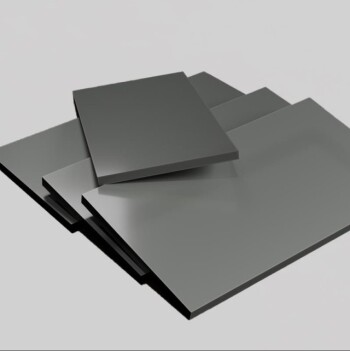
- Carbon Graphite Plate Manufactured by Isostatic Pressing Method
- High Purity Pure Graphite Crucible for Evaporation
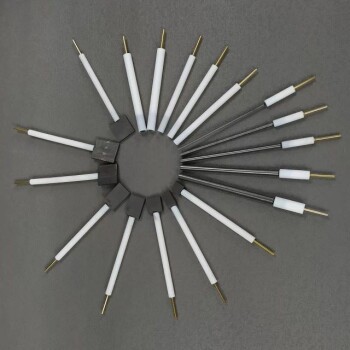
- Graphite Disc Rod and Sheet Electrode Electrochemical Graphite Electrode
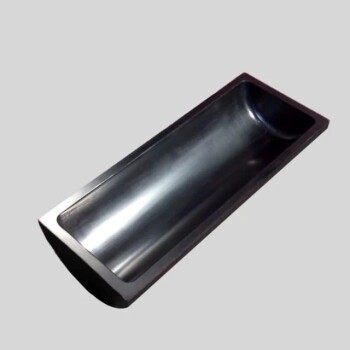
- Carbon Graphite Boat -Laboratory Tube Furnace with Cover
- High Purity Pure Graphite Crucible for Electron Beam Evaporation
People Also Ask
- What is the process of isostatic graphite manufacturing? Achieve Unmatched Material Uniformity and Performance
- What is isostatic graphite? The Ultimate Material for High-Tech and High-Temperature Applications
- What is the density of isostatic graphite? Unlock Superior Performance for Demanding Applications
- How big is the isostatic pressing market? A Deep Dive into the $1.2B+ Advanced Manufacturing Enabler
- Why Use an Isostatic or High-Precision Hydraulic Press for Li/LLZO/Li Batteries? Master Solid-State Interfaces