Knowledge What factors influence the selection of high-purity alumina crucibles or graphite boats for W-Cu infiltration?
Author avatar

Tech Team · Kintek Solution

Updated 1 day ago

What factors influence the selection of high-purity alumina crucibles or graphite boats for W-Cu infiltration?


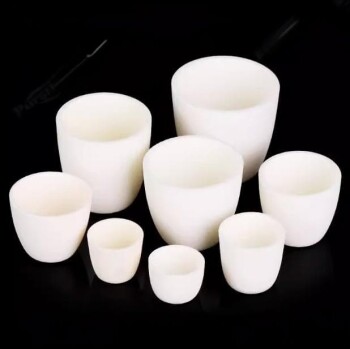
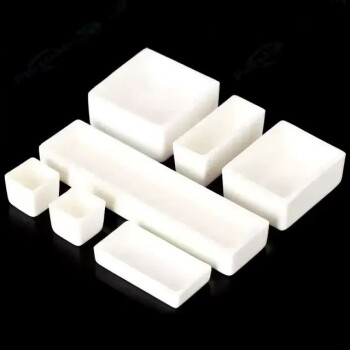
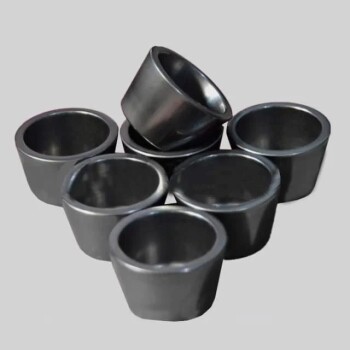
The primary factors influencing the selection of high-purity alumina crucibles or graphite boats for Tungsten-Copper (W-Cu) infiltration are high-temperature structural stability and absolute chemical inertness. These vessels are specifically chosen for their ability to withstand the infiltration temperature range of 1100°C to 1400°C without reacting with the molten copper or the tungsten skeleton, thereby preventing contamination.

Successful W-Cu infiltration relies on a containment vessel that remains chemically and physically invisible to the process. The choice of alumina or graphite is driven by the necessity to maintain strict material purity while surviving the mechanical stress of extreme thermal cycling.

Critical Material Properties

Thermal Stability at Infiltration Temperatures

The infiltration process operates within a rigorous thermal window, specifically between 1100°C and 1400°C.

The selected vessel must maintain complete structural integrity at these temperatures. Both high-purity alumina and graphite are chosen because they do not soften, deform, or lose strength while holding the heavy tungsten skeleton and molten copper.

Chemical Inertness

The most critical factor in selection is the prevention of chemical interaction.

The vessel must be chemically neutral relative to both Tungsten (W) and Copper (Cu). If the crucible reacts with the molten metal, it will alter the composition of the final composite and compromise the experimental data.

Ensuring Process Integrity

Prevention of Contamination

High-purity alumina and graphite are selected specifically to guarantee the purity of the final composite.

Any impurities leaching from a lower-quality container would degrade the electrical and thermal properties of the W-Cu composite. By using these stable materials, researchers ensure that the results reflect only the properties of the tungsten and copper interaction.

Resistance to Thermal Cycling

The infiltration process involves significant heating and cooling phases.

The container must possess excellent resistance to thermal shock. Alumina and graphite are utilized because they can endure these thermal cycles without cracking, preventing the catastrophic failure of the vessel and the loss of the molten sample.

The Risks of Material Failure

While alumina and graphite are the standards, understanding the risks they mitigate is essential for strict quality control.

The Cost of Chemical Reactivity

If a vessel is not sufficiently inert, it acts as a contaminant source rather than a passive container. This reaction not only ruins the sample but can permanently damage the furnace environment.

Mechanical Failure and Safety

A vessel that cannot handle the thermal expansion and contraction of the process poses a safety hazard. A crack during the high-temperature phase can lead to molten metal leakage, threatening both the equipment and the operator.

Making the Right Choice for Your Goal

When setting up a W-Cu infiltration process, your vessel selection is the foundation of your material quality.

  • If your primary focus is experimental purity: Ensure the crucible material is certified high-purity to eliminate any risk of trace element contamination during the melt.
  • If your primary focus is process safety: Verify the vessel's rating for thermal shock resistance to prevent cracking during rapid heating or cooling cycles.

Select your containment vessel not just to hold the material, but to isolate it completely from the extreme environment it must endure.

Summary Table:

Selection Factor Requirement Importance in W-Cu Infiltration
Operating Temp 1100°C to 1400°C Must maintain structural integrity without softening or deforming.
Chemical Purity Absolute Inertness Prevents contamination of the molten copper and tungsten skeleton.
Thermal Shock High Resistance Withstands extreme heating/cooling cycles to prevent vessel cracking.
Mechanical Strength High Load Bearing Must support the heavy tungsten skeleton at peak temperatures.

Elevate Your Materials Research with KINTEK

Precision in W-Cu composite infiltration demands containment vessels that offer uncompromising purity and thermal resilience. KINTEK specializes in high-performance laboratory equipment, providing the industry-leading high-purity alumina crucibles, graphite boats, and high-temperature furnaces needed to ensure your experimental integrity.

From advanced ceramics and crucibles to specialized vacuum and atmosphere furnaces, our solutions are designed to eliminate contamination and withstand the most rigorous thermal cycles. Partner with KINTEK to secure the reliability of your data and the safety of your lab.

Ready to optimize your infiltration process? Contact our experts today to find the perfect high-temperature solutions for your research.

Related Products

People Also Ask

Related Products

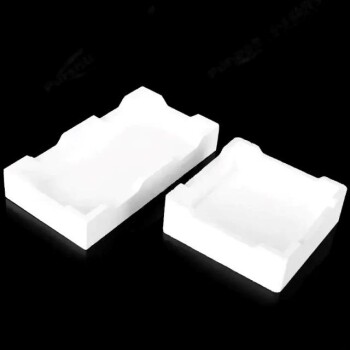
Carbon Graphite Boat -Laboratory Tube Furnace with Cover

Carbon Graphite Boat -Laboratory Tube Furnace with Cover

Covered Carbon Graphite Boat Laboratory Tube Furnaces are specialized vessels or vessels made of graphite material designed to withstand extreme high temperatures and chemically aggressive environments.

Engineering Advanced Fine Alumina Al2O3 Ceramic Crucible for Laboratory Muffle Furnace

Engineering Advanced Fine Alumina Al2O3 Ceramic Crucible for Laboratory Muffle Furnace

Alumina ceramic crucibles are used in some materials and metal melting tools, and flat-bottomed crucibles are suitable for melting and processing larger batches of materials with better stability and uniformity.

Arc-Shaped Alumina Ceramic Crucible High Temperature Resistant for Engineering Advanced Fine Ceramics

Arc-Shaped Alumina Ceramic Crucible High Temperature Resistant for Engineering Advanced Fine Ceramics

In the journey of scientific exploration and industrial production, every detail is crucial. Our arc-shaped alumina ceramic crucibles, with their excellent high temperature resistance and stable chemical properties, have become a powerful assistant in laboratories and industrial fields. They are made of high-purity alumina materials and manufactured through precision processes to ensure excellent performance in extreme environments.

Alumina Al2O3 Ceramic Crucible Semicircle Boat with Lid for Engineering Advanced Fine Ceramics

Alumina Al2O3 Ceramic Crucible Semicircle Boat with Lid for Engineering Advanced Fine Ceramics

Crucibles are containers widely used for melting and processing various materials, and semicircular boat-shaped crucibles are suitable for special smelting and processing requirements. Their types and uses vary by material and shape.

Engineering Advanced Fine Ceramics Alumina Crucibles (Al2O3) for Thermal Analysis TGA DTA

Engineering Advanced Fine Ceramics Alumina Crucibles (Al2O3) for Thermal Analysis TGA DTA

TGA/DTA thermal analysis vessels are made of aluminum oxide (corundum or aluminum oxide). It can withstand high temperature and is suitable for analyzing materials that require high temperature testing.

Custom Machined and Molded PTFE Teflon Parts Manufacturer with PTFE Crucible and Lid

Custom Machined and Molded PTFE Teflon Parts Manufacturer with PTFE Crucible and Lid

PTFE crucibles, made from pure Teflon, offer chemical inertness and resistance from -196°C to 280°C, ensuring compatibility with a wide range of temperatures and chemicals. These crucibles feature machine-finished surfaces for easy cleaning and prevention of contamination, making them ideal for precise laboratory applications.

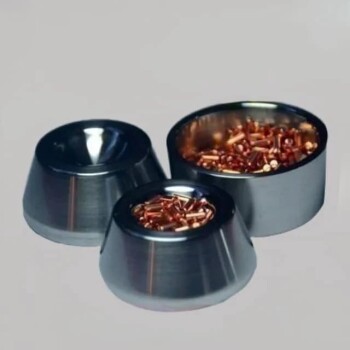
Electron Beam Evaporation Coating Tungsten Crucible and Molybdenum Crucible for High Temperature Applications

Electron Beam Evaporation Coating Tungsten Crucible and Molybdenum Crucible for High Temperature Applications

Tungsten and molybdenum crucibles are commonly used in electron beam evaporation processes due to their excellent thermal and mechanical properties.

Evaporation Crucible for Organic Matter

Evaporation Crucible for Organic Matter

An evaporation crucible for organic matter, referred to as an evaporation crucible, is a container for evaporating organic solvents in a laboratory environment.

Electron Beam Evaporation Coating Gold Plating Tungsten Molybdenum Crucible for Evaporation

Electron Beam Evaporation Coating Gold Plating Tungsten Molybdenum Crucible for Evaporation

These crucibles act as containers for the gold material evaporated by the electron evaporation beam while precisely directing the electron beam for precise deposition.

Electron Beam Evaporation Coating Oxygen-Free Copper Crucible and Evaporation Boat

Electron Beam Evaporation Coating Oxygen-Free Copper Crucible and Evaporation Boat

Electron Beam Evaporation Coating Oxygen-Free Copper Crucible enables precise co-deposition of various materials. Its controlled temperature and water-cooled design ensure pure and efficient thin film deposition.

Boron Nitride (BN) Crucible for Phosphorous Powder Sintered

Boron Nitride (BN) Crucible for Phosphorous Powder Sintered

Phosphorus powder sintered boron nitride (BN) crucible has a smooth surface, dense, pollution-free and long service life.

Electron Beam Evaporation Coating Conductive Boron Nitride Crucible BN Crucible

Electron Beam Evaporation Coating Conductive Boron Nitride Crucible BN Crucible

High-purity and smooth conductive boron nitride crucible for electron beam evaporation coating, with high temperature and thermal cycling performance.

Laboratory High Pressure Horizontal Autoclave Steam Sterilizer for Lab Use

Laboratory High Pressure Horizontal Autoclave Steam Sterilizer for Lab Use

The horizontal autoclave steam sterilizer adopts the gravity displacement method to remove the cold air in the inner chamber, so that the inner steam and cold air content is less, and the sterilization is more reliable.

Graphite Disc Rod and Sheet Electrode Electrochemical Graphite Electrode

Graphite Disc Rod and Sheet Electrode Electrochemical Graphite Electrode

High-quality graphite electrodes for electrochemical experiments. Complete models with acid and alkali resistance, safety, durability, and customization options.

Platinum Sheet Electrode for Laboratory and Industrial Applications

Platinum Sheet Electrode for Laboratory and Industrial Applications

Elevate your experiments with our Platinum Sheet Electrode. Crafted with quality materials, our safe and durable models can be tailored to fit your needs.

Laboratory Oscillating Orbital Shaker

Laboratory Oscillating Orbital Shaker

Mixer-OT orbital shaker uses brushless motor, which can run for a long time. It is suitable for vibration tasks of culture dishes, flasks and beakers.

Square Bidirectional Pressure Mold for Lab Use

Square Bidirectional Pressure Mold for Lab Use

Discover precision in molding with our Square Bidirectional Pressure Mold. Ideal for creating diverse shapes and sizes, from squares to hexagons, under high pressure and uniform heating. Perfect for advanced material processing.

Desktop Fast Laboratory Autoclave Sterilizer 35L 50L 90L for Lab Use

Desktop Fast Laboratory Autoclave Sterilizer 35L 50L 90L for Lab Use

The desktop fast steam sterilizer is a compact and reliable device used for rapid sterilization of medical, pharmaceutical, and research items. It efficiently sterilizes surgical instruments, glassware, medicines, and resistant materials, making it suitable for various applications.

Twin Screw Extruder Plastic Granulation Machine

Twin Screw Extruder Plastic Granulation Machine

Twin screw extruder plastic granulation machine is designed for the mixing and processing experiments of engineering plastics, modified plastics, waste plastics and masterbatches.

Platinum Sheet Electrode for Battery Lab Applications

Platinum Sheet Electrode for Battery Lab Applications

Platinum sheet is composed of platinum, which is also one of the refractory metals. It is soft and can be forged, rolled and drawn into rod, wire, plate, tube and wire.


Leave Your Message