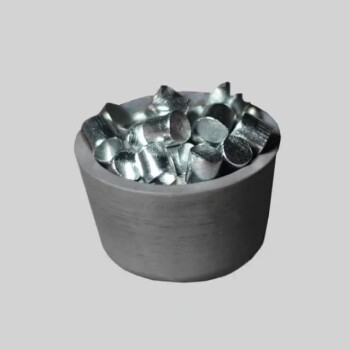
Graphite crucibles are selected for melting AlMgZn cross-over alloys primarily because of their exceptional high-temperature resistance and chemical stability. Unlike other vessel materials, graphite can withstand the rigorous conditions of induction heating without reacting violently with active metals like aluminum and magnesium, ensuring the melt remains free of impurity contamination.
The selection of graphite is driven by the need to balance thermal durability with chemical inertness. It acts as a neutral vessel that withstands extreme heat while preventing reactive elements from degrading the crucible or contaminating the alloy.
Thermal and Chemical Stability
Withstanding Induction Heating
The melting process for AlMgZn alloys requires a vessel capable of enduring extreme temperatures.
Graphite is uniquely suited for this, maintaining structural integrity during the intense thermal cycles of induction heating. It does not soften or deform, ensuring the physical safety of the melting operation.
Inertness to Active Metals
Aluminum (Al) and Magnesium (Mg) are highly active metals that can aggressively attack many standard crucible materials.
Graphite exhibits excellent chemical stability in this context. It does not react violently with the AlMgZn melt, which is critical for preventing the introduction of foreign impurities that would degrade the alloy's performance.
Controlling Alloy Composition
Managing High Vapor Pressure
A significant challenge in melting alloys containing Magnesium (Mg) and Zinc (Zn) is their high vapor pressure. These elements have a strong tendency to evaporate at melting temperatures.
While the graphite material itself provides thermal stability, the design of the graphite crucible often plays a role here. As seen in similar applications (such as Mg3Sb2 processing), graphite crucibles can be configured with plugs or lids to create a closed reaction environment.
Preserving Stoichiometry
By utilizing a closed graphite system, you effectively suppress the evaporation of volatile elements like Magnesium.
This containment is essential for maintaining the precise chemical stoichiometry of the final alloy. If evaporation were left unchecked, the ratio of Magnesium or Zinc would drop, altering the fundamental properties of the AlMgZn alloy.
Understanding the Process Requirements
The Necessity of Containment
While graphite is chemically the right material, the geometry of the vessel is equally important when handling volatile elements.
Simply using an open graphite crucible may not be sufficient for alloys high in Magnesium. To fully capitalize on graphite's benefits, the system often requires a closed configuration (such as a plugged crucible) to prevent the loss of critical alloying elements through evaporation.
Making the Right Choice for Your Goal
To ensure the successful production of AlMgZn cross-over alloys, consider the following based on your specific priorities:
- If your primary focus is Melt Purity: Rely on high-grade graphite to prevent chemical reactions with active Aluminum and Magnesium components.
- If your primary focus is Compositional Accuracy: Ensure the graphite crucible design includes a plug or lid to suppress the evaporation of high-vapor-pressure elements like Magnesium.
Graphite provides the foundational stability required to melt reactive alloys without compromising their chemical integrity.
Summary Table:
| Feature | Benefit for AlMgZn Alloys | Importance |
|---|---|---|
| High Thermal Stability | Withstands intense induction heating cycles | Prevents vessel deformation or failure |
| Chemical Inertness | Low reactivity with active Al and Mg | Ensures melt purity and prevents contamination |
| Closed Vessel Design | Suppresses evaporation of Mg and Zn | Maintains precise chemical stoichiometry |
| Structural Integrity | Resists softening at extreme temperatures | Ensures safety and durability during melting |
Elevate Your Material Research with KINTEK Precision Solutions
Achieving the perfect AlMgZn alloy requires equipment that can handle the heat. KINTEK specializes in high-performance laboratory equipment, providing the graphite crucibles, induction melting systems, and muffle furnaces necessary for high-purity results. Whether you are managing high vapor pressure with our specialized reactors or preparing samples with our hydraulic presses and milling systems, we offer the technical expertise to support your lab's success.
Ready to optimize your melting process? Contact us today to find the perfect solution for your application!
References
- Matheus A. Tunes, Stefan Pogatscher. Prototypic Lightweight Alloy Design for Stellar‐Radiation Environments. DOI: 10.1002/advs.202002397
This article is also based on technical information from Kintek Solution Knowledge Base .
Related Products
- High Purity Pure Graphite Crucible for Evaporation
- High Purity Pure Graphite Crucible for Electron Beam Evaporation
- Carbon Graphite Boat -Laboratory Tube Furnace with Cover
- Arc-Shaped Alumina Ceramic Crucible High Temperature Resistant for Engineering Advanced Fine Ceramics
- Engineering Advanced Fine Ceramics Alumina Al2O3 Crucible With Lid Cylindrical Laboratory Crucible
People Also Ask
- Why are high-purity graphite crucibles preferred for sulfide solid electrolytes? Achieve Superior Material Purity
- Why is a high-purity graphite crucible required for Chromel-TaC composites? Ensure Peak Purity at 1400°C
- What role do high-purity graphite crucibles play in molten salt corrosion research? Ensure Reactor-Grade Precision
- Why are high-purity graphite crucibles used for magnesium distillation? Ensure 3N8 Purity & Thermal Stability
- Why is a high-purity graphite crucible ideal for nitrogen-doped graphene at 1500 °C? Maximize Purity and Stability