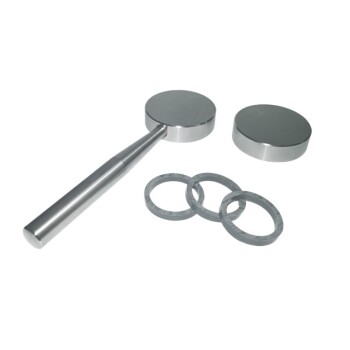
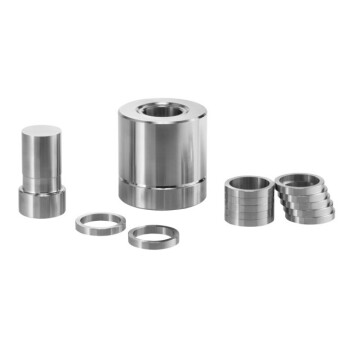
The role of a graphite mold during vacuum hot-pressing is fundamental to the physical transformation of the material. It functions as a high-strength, thermally stable interface that translates external hydraulic force into the internal compressive stress required to densify Y3+:CaF2 powder.
Core Takeaway The graphite mold acts as more than just a shaping container; it is the primary vehicle for transmitting mechanical pressure (typically 30 MPa) to the ceramic powder at high temperatures. This pressure transmission is the critical driver for particle rearrangement and plastic deformation, mechanisms necessary to eliminate pores and achieve the high density required for optical transparency.
The Mechanics of Densification
Defining Geometric Parameters
The most immediate function of the graphite mold is to serve as a precise containment vessel.
It holds the loose Y3+:CaF2 powder, strictly defining the geometric shape and physical dimensions of the final ceramic sample.
This ensures that the loose powder is consolidated into a cohesive unit, typically forming a specific shape such as a disk, during the sintering process.
Transmission of Mechanical Pressure
The efficacy of hot-pressing relies entirely on the mold's ability to transmit force.
The mold acts as a conduit, transferring significant mechanical pressure—specifically around 30 MPa in this context—from the external hydraulic press directly to the powder.
Unlike pressureless sintering, this application of force is active and continuous, forcing the material to compact beyond what heat alone could achieve.
Facilitating Microstructural Change
The pressure transmitted by the mold triggers specific physical mechanisms within the ceramic powder.
It promotes particle rearrangement, where grains shift positions to fill voids, and plastic deformation, where the material physically yields to close remaining gaps.
These processes are vital for achieving a high-density structure, which is a prerequisite for transparency in Y3+:CaF2 ceramics.
Thermal and Structural Integrity
Withstanding Extreme Environments
The mold must maintain its structural integrity while subjected to the simultaneous stresses of high heat and high pressure.
Graphite is selected because it retains its strength at sintering temperatures that would cause other materials to fail or deform.
This stability prevents the mold from collapsing or warping, which ensures the applied pressure remains uniaxial and effective throughout the cycle.
Ensuring Uniform Distribution
Beyond simply surviving the heat, the mold contributes to the uniformity of the process.
While the primary reference highlights mechanical pressure, supplementary data suggests that graphite's material properties help distribute this pressure and associated thermal energy evenly.
Uniform distribution is critical; any localized drop in pressure or temperature could lead to uneven densification, resulting in optical defects or opaque spots in the ceramic.
Understanding the Trade-offs
The Risk of Mold Deformation
While graphite is robust, it is not indestructible.
If the mold degrades or deforms slightly under the 30 MPa load, the pressure transmission becomes inefficient.
This can lead to density gradients within the ceramic, where the edges might be fully dense but the center retains porosity, compromising optical performance.
Material Compatibility
The mold is in direct contact with the ceramic powder at high temperatures.
It is essential that the mold material acts as a barrier without chemically contaminating the Y3+:CaF2 matrix.
The vacuum environment aids in this by removing reactive gases, but the physical stability of the mold surface remains paramount to prevent surface defects on the sample.
Making the Right Choice for Your Goal
To maximize the quality of Y3+:CaF2 transparent ceramics, consider how the mold interacts with your specific processing parameters:
- If your primary focus is Optical Transparency: Prioritize a mold design and grade capable of sustaining uniform pressure transmission to ensure complete pore closure via plastic deformation.
- If your primary focus is Dimensional Precision: Ensure the graphite grade chosen has high thermal stability to prevent creep or deformation of the mold walls during the holding phase.
The success of your sintering run depends on the graphite mold acting as an unyielding vessel that forces the ceramic powder to rearrange into a flawless, dense solid.
Summary Table:
| Function of Graphite Mold | Impact on Y3+:CaF2 Ceramics | Key Mechanism |
|---|---|---|
| Pressure Transmission | Drives densification at 30 MPa | Particle rearrangement & plastic deformation |
| Geometric Containment | Defines sample shape and dimensions | Powder consolidation into cohesive disks |
| Structural Integrity | Resists high heat/pressure failure | Maintains uniaxial force distribution |
| Thermal Stability | Prevents mold creep and warping | Ensures uniform density and optical clarity |
Elevate Your Material Research with KINTEK Expertise
Achieving flawless optical transparency in Y3+:CaF2 ceramics requires more than just heat—it demands precision-engineered equipment and high-performance consumables. KINTEK specializes in advanced laboratory solutions, providing the high-temperature vacuum hot-pressing systems and premium graphite molds essential for uniform densification and dimensional precision.
Whether you are refining battery research, developing dental ceramics, or pioneering new optical materials, our comprehensive range of vacuum furnaces, hydraulic presses, and high-purity crucibles ensures your lab achieves superior results every time.
Ready to optimize your sintering process? Contact KINTEK today to discover how our high-temperature systems and specialized laboratory consumables can enhance your research efficiency and material quality.
Related Products
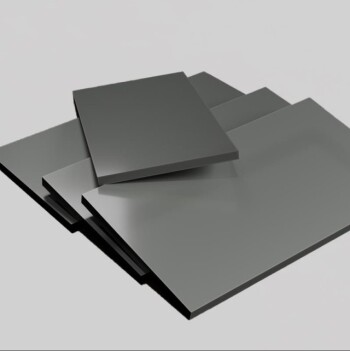
- Carbon Graphite Plate Manufactured by Isostatic Pressing Method
- High Purity Pure Graphite Crucible for Evaporation
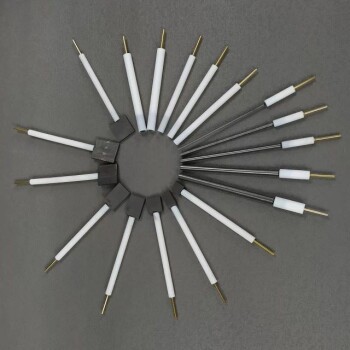
- Graphite Disc Rod and Sheet Electrode Electrochemical Graphite Electrode
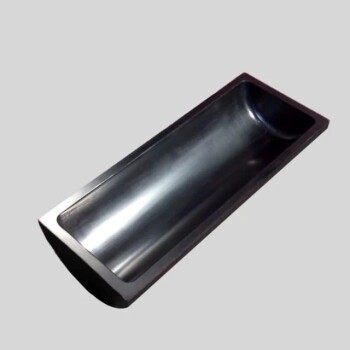
- Carbon Graphite Boat -Laboratory Tube Furnace with Cover
- High Purity Pure Graphite Crucible for Electron Beam Evaporation
People Also Ask
- What is the process of isostatic graphite manufacturing? Achieve Unmatched Material Uniformity and Performance
- What is isostatic graphite? The Ultimate Material for High-Tech and High-Temperature Applications
- What is the density of isostatic graphite? Unlock Superior Performance for Demanding Applications
- How big is the isostatic pressing market? A Deep Dive into the $1.2B+ Advanced Manufacturing Enabler
- Why Use an Isostatic or High-Precision Hydraulic Press for Li/LLZO/Li Batteries? Master Solid-State Interfaces