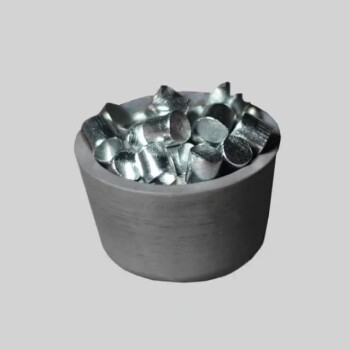
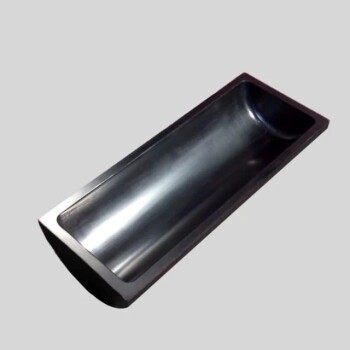
In a Rapid Thermal Evaporation (RTE) system, the high-purity graphite crucible acts as a chemically inert, thermally conductive thermal interface between the heat source and the Antimony Selenide ($Sb_2Se_3$) raw material. It serves the dual purpose of ensuring a uniform evaporation rate through superior heat distribution and safeguarding the semiconductor's electrical properties by preventing metallic or carbon-based contamination.
The graphite crucible is the foundational component for high-quality $Sb_2Se_3$ thin-film deposition, providing the thermal stability required for rapid sublimation while maintaining the high-purity environment necessary for semiconductor efficiency.
Precision Thermal Management
Ensuring Uniform Sublimation
The high thermal conductivity of graphite is critical for the "Rapid" aspect of RTE. It ensures that heat from the external elements is distributed evenly across the entire volume of the $Sb_2Se_3$ source material.
This uniformity prevents localized "hot spots" that could lead to uneven evaporation rates or spitting of the material. A stable evaporation rate is essential for controlling the thickness and morphology of the resulting thin film.
Thermal Shock Resistance
RTE processes involve rapid heating and cooling cycles that would cause many ceramic materials to crack. Graphite possesses exceptional thermal shock resistance, allowing the crucible to maintain its structural integrity over repeated high-temperature runs.
This durability ensures that the container does not introduce particulate matter into the vacuum chamber due to mechanical failure or surface flaking.
Preserving Semiconductor Purity
Chemical Inertness at High Temperatures
At the temperatures required to evaporate $Sb_2Se_3$, many materials become reactive. High-purity graphite (typically 99.9% or higher) remains chemically stable and does not react with the source material.
This inertness prevents the introduction of metallic impurities, which can act as recombination centers in semiconductors. By keeping the film pure, the crucible helps maintain the desired carrier mobility and lifetime of the $Sb_2Se_3$ layer.
Preventing Carbon Inclusion
Despite being made of carbon, high-purity graphite is engineered to prevent the leaching of carbon atoms into the vapor stream. This ensures that the stoichiometry of the Antimony Selenide remains precise.
Maintaining this purity is vital for the formation of the specific crystalline phases required for optoelectronic applications, such as solar cells.
Facilitating Optimal Grain Growth
Maintaining Saturated Vapor Pressure
In systems similar to Close Space Sublimation (CSS), the graphite crucible helps define a semi-enclosed environment. This setup is crucial for maintaining a saturated vapor pressure of $Sb_2Se_3$ between the source and the substrate.
Controlled vapor pressure promotes the growth of larger grains and influences the preferred crystalline orientation. This is often necessary to achieve high-performance orientations, such as the (211) or (221) directions.
Promoting Crystalline Quality
By stabilizing the thermal environment, the graphite crucible allows for high deposition rates even at lower vacuum levels. This stability is a key factor in improving the overall crystalline quality of the film.
Better crystallinity directly translates to fewer defects in the semiconductor lattice, enhancing the final device's performance.
Understanding the Trade-offs
Sensitivity to Oxygen
While graphite is stable in vacuum or inert atmospheres, it is highly susceptible to oxidation at high temperatures if oxygen is present. Any leak in the RTE system can lead to the formation of $CO$ or $CO_2$ gases, which can degrade the crucible and contaminate the film.
Mechanical Fragility
Despite its thermal robustness, graphite is mechanically brittle. Crucibles must be handled with care during loading and cleaning to avoid micro-fractures that could eventually lead to failure under vacuum pressure.
Porosity and Outgassing
Lower-grade graphite can be porous, potentially trapping moisture or gases that outgas during the heating cycle. This is why high-purity, high-density graphite is mandatory for semiconductor-grade evaporation to ensure a clean vacuum environment.
How to Apply This to Your Project
Making the Right Choice for Your Goal
- If your primary focus is maximizing device efficiency: Prioritize ultra-high purity (99.99%) graphite crucibles to eliminate any risk of metallic cross-contamination in the $Sb_2Se_3$ layer.
- If your primary focus is high-throughput production: Use high-density graphite with superior thermal conductivity to ensure the fastest possible ramp-up times and uniform evaporation across large surface areas.
- If your primary focus is controlling film morphology: Ensure the crucible geometry allows for a close-space configuration to maintain saturated vapor pressure and promote specific grain orientations.
By selecting the correct grade and geometry of a high-purity graphite crucible, you ensure that the RTE process produces high-quality, high-performance $Sb_2Se_3$ thin films consistently.
Summary Table:
| Key Role | Benefit to RTE Process | Material Advantage |
|---|---|---|
| Thermal Management | Ensures uniform sublimation & prevents hot spots | High Thermal Conductivity |
| Purity Protection | Eliminates metallic & carbon contamination | Chemical Inertness |
| Structural Integrity | Resists cracking during rapid thermal cycles | Thermal Shock Resistance |
| Vapor Control | Promotes large grain growth & specific orientation | Semi-enclosed Geometry |
Elevate Your Thin-Film Research with KINTEK
Precision in semiconductor deposition starts with high-performance materials. KINTEK specializes in providing the laboratory equipment and consumables essential for advanced material science. Whether you are optimizing Antimony Selenide ($Sb_2Se_3$) solar cells or developing next-generation optoelectronics, our high-purity graphite crucibles and ceramics ensure the thermal stability and chemical integrity your project demands.
Our comprehensive portfolio includes:
- Thermal Processing: CVD, PECVD, and vacuum furnaces for controlled growth.
- Specialized Consumables: High-density graphite, PTFE products, and alumina crucibles.
- Advanced Systems: High-temperature high-pressure reactors, electrolytic cells, and hydraulic pellet presses.
- Sample Prep: Precision crushing, milling, and sieving equipment.
Ready to achieve superior crystalline quality? Contact our technical experts today to find the perfect high-temperature solutions and consumables tailored to your specific research goals.
References
- Huafei Guo, Jianning Ding. Enhancement in the Efficiency of Sb<sub>2</sub>Se<sub>3</sub> Solar Cells by Triple Function of Lithium Hydroxide Modified at the Back Contact Interface. DOI: 10.1002/advs.202304246
This article is also based on technical information from Kintek Solution Knowledge Base .
Related Products
- High Purity Pure Graphite Crucible for Evaporation
- High Purity Pure Graphite Crucible for Electron Beam Evaporation
- Electron Beam Evaporation Coating Oxygen-Free Copper Crucible and Evaporation Boat
- Evaporation Crucible for Organic Matter
- Electron Beam Evaporation Coating Gold Plating Tungsten Molybdenum Crucible for Evaporation
People Also Ask
- Why are high-purity graphite crucibles preferred for sulfide solid electrolytes? Achieve Superior Material Purity
- Why is a high-purity graphite crucible required for Chromel-TaC composites? Ensure Peak Purity at 1400°C
- What role do high-purity graphite crucibles play in molten salt corrosion research? Ensure Reactor-Grade Precision
- Why are high-purity graphite crucibles used for magnesium distillation? Ensure 3N8 Purity & Thermal Stability
- Why is a high-purity graphite crucible ideal for nitrogen-doped graphene at 1500 °C? Maximize Purity and Stability