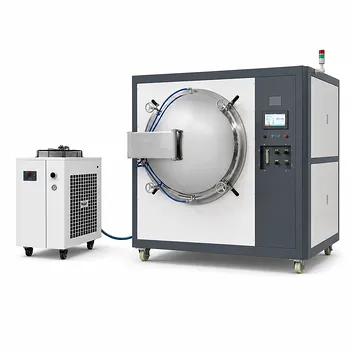
A high-temperature heat treatment furnace acts as the critical vessel for post-weld microstructural stabilization. It plays a dual role: enabling multi-stage stress relief annealing to eliminate residual welding stresses and facilitating a main tempering process that decomposes brittle constituents. This transformation is essential for enhancing the weld metal's ductility and impact toughness to meet rigorous safety standards.
By precisely controlling heating and cooling cycles, the furnace transforms a brittle as-welded structure into a tough, durable material. It decomposes hazardous Martensite-Austenite (M-A) constituents into fine carbides, preventing failure in high-pressure environments.
The Mechanism of Microstructural Transformation
Eliminating Brittle Constituents
The primary function of the furnace is to alter the "as-welded" structure. In its raw state, 2.25Cr-1Mo-0.25V weld metal contains Martensite-Austenite (M-A) constituents.
These constituents are inherently brittle and detrimental to the material's performance. The furnace provides the sustained thermal energy required to decompose these M-A structures.
Formation of Fine Carbides
As the brittle M-A constituents break down, they do not simply disappear; they transform. The heat treatment process converts them into fine carbide precipitates.
This precipitation is the key driver for improved material properties. It significantly enhances ductility and ensures the metal possesses the necessary low-temperature impact toughness required for safety.
Operational Control and Stress Management
Precision Stress Relief
Beyond microstructural changes, the furnace facilitates multi-stage stress relief annealing. Welding generates significant internal tension that can lead to distortion or failure.
By holding the material at elevated temperatures, the furnace allows the metal to relax. This eliminates residual welding stresses, stabilizing the component for future use.
Exacting Process Parameters
To achieve these results, the furnace must maintain specific conditions identified in technical protocols. This typically involves soaking temperatures between 700°C and 710°C.
The process often requires extended holding times, such as 11 hours, to ensure the heat penetrates fully and the transformation is complete.
Understanding the Trade-offs
The Risk of Reheat Cracking
While heat treatment is beneficial, it introduces specific risks for 2.25Cr-1Mo steel. The material is susceptible to reheat cracking if the process is mismanaged.
The furnace's role is to prevent this by ensuring absolute temperature uniformity. Any hot spots or uneven heating zones can trigger cracking mechanisms rather than relieving stress.
Critical Cooling Control
The cooling phase is just as critical as the heating phase. The furnace must provide precise cooling rate control after the soaking period.
Rapid or uncontrolled cooling can re-introduce stress or lock in undesirable microstructures. Controlled cooling ensures the material maintains operational stability in high-temperature and high-pressure environments.
Making the Right Choice for Your Goal
To maximize the performance of 2.25Cr-1Mo-0.25V weld metal, align your furnace operations with your specific engineering objectives:
- If your primary focus is mechanical integrity: Ensure the furnace cycle is sufficiently long to fully decompose brittle M-A constituents into fine carbides for maximum ductility.
- If your primary focus is process reliability: Prioritize furnace temperature uniformity and precise cooling rates to mitigate the specific risk of reheat cracking in this alloy.
Mastering the heat treatment cycle is not just about relieving stress; it is the defining step that turns a raw weld into an engineering-grade component capable of surviving extreme conditions.
Summary Table:
| Process Phase | Primary Function | Microstructural Effect |
|---|---|---|
| Soaking (700°C-710°C) | Stress Relief & Tempering | Decomposes brittle M-A constituents into fine carbides |
| Extended Holding (11h) | Deep Thermal Penetration | Ensures uniform transformation and enhanced ductility |
| Controlled Cooling | Stabilization | Prevents reheat cracking and maintains impact toughness |
| Post-Weld Annealing | Stress Management | Eliminates residual welding stresses and prevents distortion |
Elevate Your Material Integrity with KINTEK Precision
For critical alloys like 2.25Cr-1Mo-0.25V, there is no margin for error. KINTEK provides the advanced thermal solutions required to master complex heat treatment cycles. Our comprehensive range of high-temperature furnaces (muffle, vacuum, and atmosphere), alongside high-pressure reactors and material testing tools, ensures your laboratory or production line achieves perfect microstructural stabilization every time.
Why choose KINTEK for your metallurgy needs?
- Unmatched Uniformity: Prevent reheat cracking with precise temperature control.
- Integrated Workflow: From crushing and milling to pellet pressing and final heat treatment.
- Reliable Performance: Durable consumables including crucibles and ceramics for high-pressure environments.
Ready to transform your weld metal properties and ensure safety in extreme conditions? Contact our technical experts today to find the perfect equipment for your research and production goals.
References
- Kefan Wu, Jianhong Chen. Microstructure and Charpy Impact Toughness of a 2.25Cr-1Mo-0.25V Steel Weld Metal. DOI: 10.3390/ma13133013
This article is also based on technical information from Kintek Solution Knowledge Base .
Related Products
- Vacuum Heat Treat and Pressure Sintering Furnace for High Temperature Applications
- 2200 ℃ Tungsten Vacuum Heat Treat and Sintering Furnace
- Molybdenum Vacuum Heat Treat Furnace
- 2200 ℃ Graphite Vacuum Heat Treat Furnace
- High Temperature Muffle Oven Furnace for Laboratory Debinding and Pre Sintering
People Also Ask
- What is the purpose of the heat treatment (sintering) step? Engineering Robust Electroactive Membranes
- What is a vacuum sintering furnace? Unlock Purity and Performance in Advanced Materials
- What are some alternative atmospheres to pure hydrogen for powder metallurgy sintering processes? Top Sintering Solutions
- How does the vacuum environment impact sintering of diamond-copper composites? Protect Against Thermal Damage
- Why must green bodies produced via binder jetting undergo treatment in a vacuum sintering furnace?