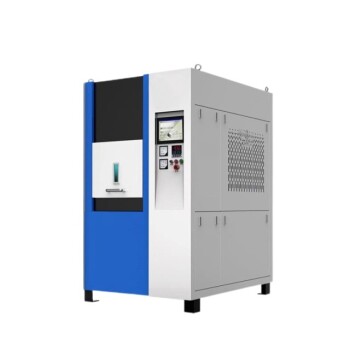
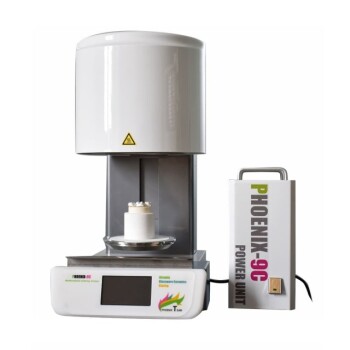
The high-temperature industrial furnace acts as a critical reactor that fundamentally alters the chemical structure of scheelite ore before extraction begins. By heating the ore mixed with sodium carbonate to approximately 800 °C, the furnace facilitates a solid-phase reaction that converts the mineral into sodium tungstate.
Core Takeaway The furnace is not merely a heating device; it is a chemical enabler that transforms insoluble scheelite into soluble sodium tungstate. This "roasting" step is essential for reducing the pressure and temperature requirements of the subsequent leaching process.
The Mechanism of High-Temperature Transformation
The primary function of the furnace in this context is to drive a specific chemical change known as roasting.
Solid-Phase Reaction
The furnace provides the thermal energy required to mix scheelite with sodium carbonate.
Unlike simple melting, this facilitates a solid-phase reaction where the components interact chemically without necessarily becoming fully liquid.
Operating Temperature
To achieve this reaction effectively, the furnace must maintain temperatures of approximately 800 °C.
This specific heat threshold is necessary to break down the stable scheelite structure and enable the formation of new compounds.
Phase Structure Alteration
The intense heat pre-converts the raw scheelite into sodium tungstate.
This alteration is the pivot point of the process, changing the mineral from a difficult-to-process ore into a chemically accessible intermediate.
Impact on the Leaching Process
The work done inside the furnace dictates the efficiency of the leaching steps that follow.
Simplifying Downstream Extraction
Because the furnace converts the ore into sodium tungstate, the subsequent leaching process becomes significantly less aggressive.
Operators can perform water or alkaline leaching at lower temperatures and pressures than would be required for raw ore.
Deep Tungsten Extraction
This thermal pre-treatment is categorized as an indispensable physical-chemical preparation step.
It is particularly vital when dealing with high-impurity resources, ensuring that deep extraction of tungsten is technically feasible.
Understanding the Trade-offs
While the furnace is critical for extraction efficiency, utilizing high-temperature processing introduces specific operational considerations.
Energy Intensity
Operating a furnace at 800 °C requires significant energy input.
You are trading the cost of thermal energy in the roasting phase for reduced chemical complexity and lower pressures in the leaching phase.
Process Complexity
Adding a high-temperature roasting step increases the mechanical footprint of the operation.
It introduces a distinct "dry" processing stage that must be managed before the "wet" leaching stage can begin.
Making the Right Choice for Your Goal
When designing a scheelite processing workflow, the inclusion of a high-temperature furnace depends on the nature of your raw material and extraction targets.
- If your primary focus is processing high-impurity resources: The furnace is essential to alter the phase structure, ensuring you can extract tungsten deeply despite the impurities.
- If your primary focus is operational safety: The furnace converts the ore into a state that allows downstream leaching to occur at lower pressures, reducing the risks associated with high-pressure chemical vessels.
The furnace essentially front-loads the energy investment to simplify the chemical extraction of tungsten.
Summary Table:
| Process Stage | Function of Furnace | Key Outcome |
|---|---|---|
| Roasting | Maintains ~800 °C for solid-phase reaction | Converts scheelite to sodium tungstate |
| Phase Alteration | Breaks down stable mineral structures | Increases chemical accessibility of the ore |
| Pre-Leaching | Pre-converts ore to soluble compounds | Lowers downstream pressure & temperature needs |
| Extraction | Facilitates processing of high-impurity ore | Ensures deep and efficient tungsten recovery |
Maximize Your Tungsten Extraction Efficiency with KINTEK
Are you looking to optimize your mineral processing or high-temperature metallurgy workflows? KINTEK specializes in precision-engineered laboratory and industrial equipment designed for the most demanding applications.
Our extensive portfolio includes high-performance rotary and muffle furnaces for roasting, crushing and milling systems for ore preparation, and advanced high-temperature high-pressure reactors for downstream leaching. Whether you are refining tungsten or conducting complex material research, our solutions provide the thermal accuracy and durability your lab requires.
Contact us today to find the perfect equipment for your extraction goals!
References
- Xinran Li, Zexi Gong. Leaching of Scheelite Concentrate for Tungsten Extraction. DOI: 10.3390/min15050475
This article is also based on technical information from Kintek Solution Knowledge Base .
Related Products
- High Temperature Muffle Oven Furnace for Laboratory Debinding and Pre Sintering
- Vacuum Heat Treat and Pressure Sintering Furnace for High Temperature Applications
- Ultra-High Temperature Graphite Vacuum Graphitization Furnace
- 2200 ℃ Tungsten Vacuum Heat Treat and Sintering Furnace
- 2200 ℃ Graphite Vacuum Heat Treat Furnace
People Also Ask
- Why is the annealing treatment in a high-temperature muffle furnace critical for the preparation of an Sb-SnO2 interlayer?
- What role does a high-temperature muffle furnace play in the synthesis of manganese/cobalt-modified ceramic catalysts?
- What function does a high-temperature muffle furnace serve in Ti3AlC2 MAX phase synthesis? Master Molten Salt Diffusion
- Why is a high-temp muffle furnace essential for ZnO-WO3 & ZnO-BiOI? Optimize Heterojunction Catalyst Performance
- What conditions does a muffle furnace provide for molten salt energy storage? Expert Simulation for CSP Environments