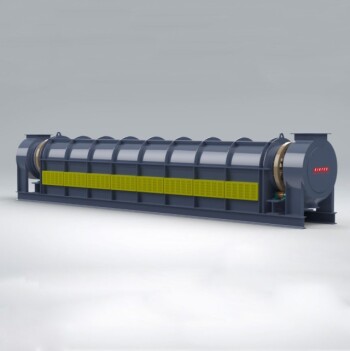
A high-temperature muffle furnace acts as the precise reactor vessel necessary to drive the carbothermal reduction required to produce silicon carbide. Specifically, it maintains a stable environment at 1500°C under a protective argon atmosphere, which is the exact threshold needed to convert the silica and carbon within rice husks into crystalline silicon carbide (SiC) powder.
The furnace provides more than just heat; it creates a strictly controlled, inert thermal field that forces the chemical transformation of organic precursors into specific inorganic crystalline morphologies.
The Mechanism of Transformation
Driving Carbothermal Reduction
The production of silicon carbide from rice husks is not merely about incineration; it requires a specific chemical reaction called carbothermal reduction.
The muffle furnace must sustain a temperature of 1500°C to initiate and maintain this reaction. At this energy level, the silica (SiO2) naturally present in the husk reacts with carbon to form silicon carbide (SiC).
Protective Atmospheric Control
Standard combustion would simply turn the husks into ash. To create silicon carbide, the furnace creates a protective argon atmosphere.
This inert environment prevents oxygen from entering the chamber. By excluding oxygen, the furnace ensures the carbon acts as a reducing agent for the silica rather than burning off as carbon dioxide.
Ensuring Reaction Consistency
A defining feature of a high-quality muffle furnace is the creation of a uniform temperature field within the chamber.
This uniformity is critical for batch consistency. It ensures that the thermochemical reaction occurs evenly throughout the rice husk precursor, resulting in SiC powder with a consistent crystalline structure rather than a mixture of reacted and unreacted material.
Distinguishing Pre-treatment from Synthesis
The Role of Calcination (Pre-treatment)
It is important to distinguish the SiC synthesis stage from the lower-temperature pre-treatment steps often performed in similar furnaces.
Supplementary processes use the furnace at 575°C to 600°C in an oxidative (air) environment. This "calcination" or "ashing" process is used to decompose organics and isolate high-purity silica, not silicon carbide.
The Impact on Pore Structure
While the 1500°C stage creates the final SiC crystal, the thermal history of the material matters.
The pyrolysis and decomposition phases facilitate the formation of a porous structure within the material. This porosity is vital if the final application requires the material to act as a carrier for catalysts.
Critical Operational Considerations
The Risks of Atmospheric Leaks
The most significant trade-off in this process is the reliance on atmospheric integrity.
If the argon environment is compromised even slightly, the high temperatures will lead to rapid oxidation. Instead of valuable silicon carbide, you will result in silica ash, rendering the high-energy process wasteful.
Thermal Gradients
Despite the goal of uniformity, thermal gradients can exist in lower-quality furnaces.
If the temperature drops below 1500°C in corners of the chamber, the reduction reaction will be incomplete. This leads to impurities in the final powder, requiring extensive post-processing to separate the SiC from unreacted silica.
Making the Right Choice for Your Goal
To ensure you apply the correct thermal profile for your specific objective, consider the following:
- If your primary focus is producing Silicon Carbide (SiC): You must operate the furnace at 1500°C under an inert argon atmosphere to drive carbothermal reduction.
- If your primary focus is extracting Silica (SiO2) or Ash content: You should operate the furnace between 575°C and 600°C in an oxidative environment to remove organic components completely.
Success depends on matching the furnace's atmospheric and thermal settings precisely to the chemical pathway you intend to trigger.
Summary Table:
| Feature | SiC Synthesis (Pyrolysis) | Silica Extraction (Calcination) |
|---|---|---|
| Temperature | 1500°C | 575°C - 600°C |
| Atmosphere | Inert Argon (Protective) | Oxidative (Air) |
| Chemical Reaction | Carbothermal Reduction | Organic Decomposition |
| Final Product | Crystalline Silicon Carbide (SiC) | High-purity Silica (SiO2) |
| Key Outcome | Crystalline Morphology | Porous Ash Structure |
Elevate Your Advanced Material Synthesis with KINTEK
Precise thermal fields and uncompromising atmospheric control are the benchmarks of success in carbothermal reduction. At KINTEK, we specialize in high-performance laboratory equipment designed for rigorous research environments. Whether you are synthesizing silicon carbide or extracting high-purity silica, our high-temperature muffle and tube furnaces provide the ±1°C stability and inert gas integrity required for consistent crystalline results.
Our extensive portfolio supports every stage of material science, from crushing and milling systems for precursor preparation to high-temperature high-pressure reactors and PTFE consumables for post-processing.
Ready to optimize your pyrolysis results? Contact our technical experts today to find the perfect furnace configuration for your lab's specific temperature and atmospheric needs.
References
- Anna Liashenko, Kateryna Plyasovskaya. Studying the kinetics of extraction treatment of rice husk when obtaining silicon carbide. DOI: 10.15587/1729-4061.2020.195881
This article is also based on technical information from Kintek Solution Knowledge Base .
Related Products
- 1800℃ Muffle Oven Furnace for Laboratory
- 1200℃ Muffle Furnace Oven for Laboratory
- 1700℃ Muffle Oven Furnace for Laboratory
- 1400℃ Muffle Oven Furnace for Laboratory
- High Temperature Muffle Oven Furnace for Laboratory Debinding and Pre Sintering
People Also Ask
- Why is calcination in a Muffle Furnace necessary for niobate synthesis? Achieve Perfect Phase-Pure Solid Solutions
- What is the role of a high-temperature muffle furnace in YZAO synthesis? Master Nanocrystalline Phase Transformation
- What role do High-Temperature Muffle Furnaces play in metal oxide precursor pre-treatment? Ensure Structural Integrity
- What role does a high-temperature muffle furnace play in BZCY72 densification? Master Precision Sintering at 1500°C
- What is the role of a High-Temperature Muffle Furnace in the preparation of Ce-Mn catalysts? Boost Structural Reactivity