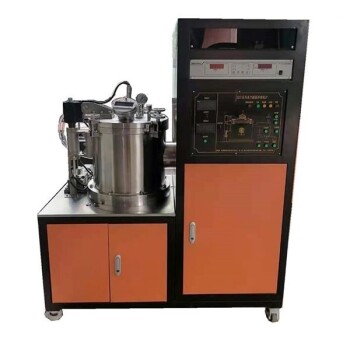
The high-vacuum annealing furnace serves as the critical reaction chamber for transforming a raw platinum layer into a resilient diffusion coating. Its primary function is to maintain an ultra-low pressure environment—typically at $10^{-4}$ Pa—which allows the material to endure heat treatment temperatures around 1175°C without suffering from chemical degradation.
Core Takeaway The furnace creates a "pure thermodynamic environment" that is strictly necessary for the diffusion process. By eliminating atmospheric oxygen, it forces platinum atoms to diffuse into the substrate to form a uniform bond, rather than reacting with the air to form oxides.
The Mechanics of Vacuum Diffusion
Preventing Uncontrolled Oxidation
At the extreme temperatures required for annealing (approx. 1175°C), standard metal alloys and platinum layers are highly reactive.
Without a vacuum, oxygen would immediately attack the surface. The high-vacuum furnace removes these contaminants, preventing the uncontrolled oxidation of both the platinum plating and the underlying substrate.
Creating a Pure Thermodynamic Environment
Successful coating preparation is not just about heating; it is about controlling atomic movement.
The furnace provides a contaminant-free space known as a pure thermodynamic environment. This purity ensures that the thermal energy is used exclusively to drive the diffusion of platinum atoms into the substrate, rather than fueling unwanted chemical side reactions.
Formation of the Diffusion Layer
The ultimate goal of this heat treatment is structural integration.
Under these high-vacuum, high-heat conditions, a uniform diffusion layer is formed. This transforms the distinct platinum plating into a coherent ($\gamma+\gamma'$) structure that is metallurgically bonded to the superalloy beneath it.
Understanding the Trade-offs
Sensitivity to Vacuum Integrity
While high vacuum is essential for purity, it introduces significant process sensitivity.
If the furnace fails to maintain the strict $10^{-4}$ Pa threshold, even minor micro-leaks can introduce enough oxygen to compromise the diffusion boundary. The equipment requires rigorous maintenance to ensure the vacuum seal remains absolute throughout the cycle.
Thermal Lag and Uniformity
Heating in a vacuum relies on radiation rather than convection, which can change how heat is distributed.
Operators must account for the fact that components may heat unevenly depending on their placement in the furnace. Ensuring the specific 1175°C target is met uniformly across complex geometries is a challenge inherent to vacuum processing.
Making the Right Choice for Your Goal
When configuring your annealing process, your specific priorities will dictate your control limits.
- If your primary focus is Coating Adhesion: Prioritize the vacuum level integrity ($10^{-4}$ Pa) to ensure the interface between the platinum and substrate remains oxide-free.
- If your primary focus is Layer Depth: Focus on the precise maintenance of the 1175°C temperature, as thermal energy is the primary driver of how deep the platinum atoms diffuse.
The vacuum furnace is not merely a heater; it is the tool that guarantees the chemical fidelity of the final coating system.
Summary Table:
| Feature | Specification/Requirement | Impact on Coating |
|---|---|---|
| Vacuum Level | $10^{-4}$ Pa | Prevents uncontrolled oxidation and ensures chemical purity |
| Process Temperature | ~1175°C | Drives the diffusion of Pt atoms into the substrate |
| Environment | Pure Thermodynamic | Ensures energy is used for metallurgical bonding, not side reactions |
| Final Structure | (gamma+gamma prime) | Creates a uniform, resilient, and metallurgically bonded layer |
Elevate Your Advanced Coating Processes with KINTEK
Precision is non-negotiable when developing high-performance diffusion coatings. At KINTEK, we specialize in high-vacuum and high-temperature furnace technology designed to maintain absolute environment integrity for your most critical heat treatments.
Whether you are refining platinum diffusion layers, conducting battery research, or requiring specialized high-temperature high-pressure reactors, our comprehensive range of laboratory equipment—including vacuum, CVD, and muffle furnaces—provides the stability your research demands.
Ready to achieve superior coating adhesion and structural uniformity? Contact our specialists today to find the perfect vacuum solution for your lab.
References
- B. Pint, Y. Zhang. The Effect of Water Vapor and Superalloy Composition on Thermal Barrier Coating Lifetime. DOI: 10.7449/2012/superalloys_2012_723_732
This article is also based on technical information from Kintek Solution Knowledge Base .
Related Products
- Laboratory High Pressure Vacuum Tube Furnace
- Vacuum Heat Treat Furnace with Ceramic Fiber Liner
- Vacuum Heat Treat and Pressure Sintering Furnace for High Temperature Applications
- Ultra-High Temperature Graphite Vacuum Graphitization Furnace
- Vacuum Heat Treat and Sintering Furnace with 9MPa Air Pressure
People Also Ask
- What is the role of a high-vacuum tube furnace in preparing Co3S4@NiS2/C composite materials? Expert Synthesis Insights
- What role does a high-vacuum tube furnace play in synthesizing manganese nitride? Achieve Precise Phase & Stoichiometry.
- What is the primary function of a high-vacuum tube furnace in CVD synthesis of Sb-doped Bi2Se3? Precision Growth Control
- Role of High-Pressure Tube Furnace in Ru/OMC Synthesis: Achieve Precise Reduction & Nanostructure Control
- What are the primary functions of a high-pressure tube furnace? Expert Guide to MWCNT/Metal Oxide Synthesis