Knowledge What role does a laboratory freeze dryer play in preserving lignin foam pores? Secure Microscopic Integrity.
Author avatar

Tech Team · Kintek Solution

Updated 1 day ago

What role does a laboratory freeze dryer play in preserving lignin foam pores? Secure Microscopic Integrity.


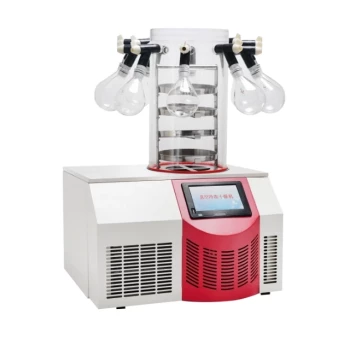
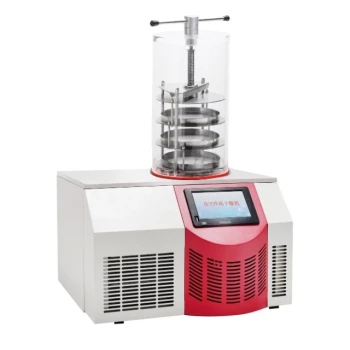
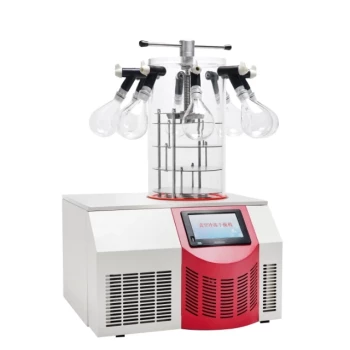
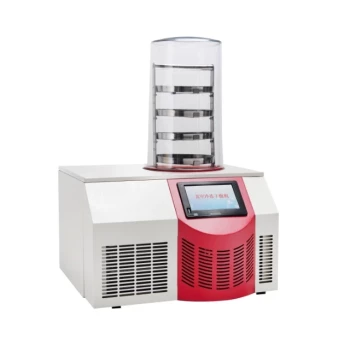
A laboratory freeze dryer serves as the critical preservation mechanism for lignin foams, safeguarding their delicate internal architecture against collapse. By removing water through sublimation rather than evaporation, this equipment prevents the destructive capillary forces associated with liquid drying, ensuring the microscopic "honeycomb" structure remains intact.

By subjecting samples to ultra-low temperatures and high vacuum, freeze drying bypasses the liquid phase entirely. This eliminates the surface tension that typically destroys micron-scale channels, allowing the lignin foam to retain the precise geometry etched by the original ice templates.

The Mechanism of Preservation

Bypassing the Liquid Phase

The fundamental role of the freeze dryer is to facilitate sublimation. Instead of melting ice into water and then evaporating it, the machine converts solid ice crystals directly into water vapor.

This is achieved by maintaining specific, extreme environmental conditions. The primary reference highlights conditions such as ultra-low temperatures of -80 °C combined with a high vacuum of 10 Pa.

Eliminating Surface Tension

In standard air drying, as water evaporates, surface tension creates powerful capillary forces within the material's pores.

These forces are often strong enough to crush delicate structures, leading to significant shrinkage or total collapse of the foam.

Because freeze drying removes the liquid phase from the equation, surface tension is effectively eliminated. This ensures the walls of the lignin foam are never subjected to the physical stress of evaporating water.

Locking in the "Ice Template"

The microstructure of lignin foam is initially defined by ice crystals that form during the freezing stage. These crystals act as a temporary mold or template.

The freeze dryer removes the ice "mold" without disturbing the surrounding material.

The result is an oriented honeycomb microstructure. The void spaces left behind by the sublimated ice become the pore channels, preserving the exact architecture intended by the researcher.

Understanding the Trade-offs

Operational Complexity

While effective, this process is technically demanding. It requires precise control over environmental parameters to ensure sublimation occurs efficiently.

Failing to maintain the required vacuum (e.g., 10 Pa) or temperature (e.g., -80 °C) can result in partial melting. If any ice melts back into liquid water, the structural integrity of the foam is immediately compromised.

degradation Prevention

Beyond structure, the freeze dryer plays a secondary role in chemical preservation. As noted in general laboratory contexts, this method prevents biological or chemical degradation.

For lignin foams, this ensures the material remains stable for analysis or storage without rotting or chemically altering over time.

Maximizing Material Quality

To ensure your lignin foams retain their engineered properties, consider how this process aligns with your specific research goals.

  • If your primary focus is Structural Analysis: Rely on freeze drying to retain the micron-scale pore channels and honeycomb geometry for accurate microscopy (SEM) imaging.
  • If your primary focus is Material Density: Use this method to prevent shrinkage, ensuring the final volume matches the frozen state for accurate low-density calculations.

The freeze dryer is not just a drying tool; it is a structural fixation device that permanently sets the transient architecture of your material.

Summary Table:

Feature Impact on Lignin Foam Structure Preservation Mechanism
Sublimation Prevents pore collapse Bypasses liquid phase directly to vapor
Vacuum (10 Pa) Maintains structural geometry Eliminates surface tension stress
Temp (-80 °C) Locks in ice templates Prevents melting and shrinkage
Structural Fixation Preserves honeycomb pores Retains precise micron-scale channels

Elevate Your Material Research with KINTEK Precision

Preserving the delicate architecture of lignin foams and advanced polymers requires more than just basic equipment—it requires the specialized precision of KINTEK laboratory freeze dryers. As experts in laboratory equipment and consumables, KINTEK offers a robust portfolio of cooling solutions, including ultra-low temperature (ULT) freezers, cold traps, and high-performance freeze dryers designed to eliminate surface tension and lock in your material's precise geometry.

Beyond structural preservation, our range extends to crushing and milling systems, high-temperature furnaces, and specialized reactors to support every stage of your material synthesis. Ensure your research integrity by partnering with a leader in lab technology.

Ready to optimize your drying process? Contact our technical specialists today to find the perfect freeze-drying solution for your laboratory.

References

  1. Zhihui Zeng, Xuehong Lu. Biomass-based honeycomb-like architectures for preparation of robust carbon foams with high electromagnetic interference shielding performance. DOI: 10.1016/j.carbon.2018.08.061

This article is also based on technical information from Kintek Solution Knowledge Base .

Related Products

People Also Ask

Related Products

Benchtop Laboratory Freeze Dryer for Lab Use

Benchtop Laboratory Freeze Dryer for Lab Use

Premium benchtop laboratory freeze dryer for lyophilization, preserving samples with ≤ -60°C cooling. Ideal for pharmaceuticals & research.

Vacuum Cold Trap Chiller Indirect Cold Trap Chiller

Vacuum Cold Trap Chiller Indirect Cold Trap Chiller

Boost vacuum system efficiency and prolong pump life with our Indirect Cold Trap. Built-in chilling system with no need for fluid or dry ice. Compact design and easy to use.

Heated Hydraulic Press Machine with Heated Plates for Vacuum Box Laboratory Hot Press

Heated Hydraulic Press Machine with Heated Plates for Vacuum Box Laboratory Hot Press

Enhance your lab's precision with our lab press for vacuum box. Press pills and powders with ease and precision in a vacuum environment, reducing oxidation and improving consistency. Compact and easy to use with a digital pressure gauge.

Laboratory Hydraulic Press Lab Pellet Press for Button Battery

Laboratory Hydraulic Press Lab Pellet Press for Button Battery

Efficiently prepare samples with our 2T Button Battery Press. Ideal for material research labs and small-scale production. Small footprint, lightweight, and vacuum-compatible.

30T 40T Split Automatic Heated Hydraulic Press Machine with Heated Plates for Laboratory Hot Press

30T 40T Split Automatic Heated Hydraulic Press Machine with Heated Plates for Laboratory Hot Press

Discover our split automatic heated lab press 30T/40T for precise sample preparation in material research, pharmacy, ceramics, and electronics industries. With a small footprint and heating up to 300°C, it's perfect for processing under vacuum environment.

Horizontal High Temperature Graphite Vacuum Graphitization Furnace

Horizontal High Temperature Graphite Vacuum Graphitization Furnace

Horizontal Graphitization Furnace: This type of furnace is designed with the heating elements placed horizontally, allowing for uniform heating of the sample. It's well-suited for graphitizing large or bulky samples that require precise temperature control and uniformity.

Vacuum Heat Treat Sintering Brazing Furnace

Vacuum Heat Treat Sintering Brazing Furnace

A vacuum brazing furnace is a type of industrial furnace used for brazing, a metalworking process that joins two pieces of metal using a filler metal that melts at a lower temperature than the base metals. Vacuum brazing furnaces are typically used for high-quality applications where a strong, clean joint is required.

Circulating Water Vacuum Pump for Laboratory and Industrial Use

Circulating Water Vacuum Pump for Laboratory and Industrial Use

Efficient circulating water vacuum pump for labs - oil-free, corrosion-resistant, quiet operation. Multiple models available. Get yours now!

Custom PTFE Teflon Parts Manufacturer for PTFE Tweezers

Custom PTFE Teflon Parts Manufacturer for PTFE Tweezers

PTFE tweezers inherit the excellent physical and chemical properties of PTFE, such as high temperature resistance, cold resistance, acid and alkali resistance, and corrosion resistance to most organic solvents.

Graphite Vacuum Furnace IGBT Experimental Graphitization Furnace

Graphite Vacuum Furnace IGBT Experimental Graphitization Furnace

IGBT experimental graphitization furnace, a tailored solution for universities and research institutions, with high heating efficiency, user-friendliness, and precise temperature control.

Oil Free Diaphragm Vacuum Pump for Laboratory and Industrial Use

Oil Free Diaphragm Vacuum Pump for Laboratory and Industrial Use

Oil-free diaphragm vacuum pump for labs: clean, reliable, chemical-resistant. Ideal for filtration, SPE, and rotary evaporation. Maintenance-free operation.

Laboratory Vacuum Tilt Rotary Tube Furnace Rotating Tube Furnace

Laboratory Vacuum Tilt Rotary Tube Furnace Rotating Tube Furnace

Discover the versatility of Laboratory Rotary Furnace: Ideal for calcination, drying, sintering, and high-temperature reactions. Adjustable rotating and tilting functions for optimal heating. Suitable for vacuum and controlled atmosphere environments. Learn more now!

Lab-Scale Vacuum Induction Melting Furnace

Lab-Scale Vacuum Induction Melting Furnace

Get precise alloy composition with our Vacuum Induction Melting Furnace. Ideal for aerospace, nuclear energy, and electronic industries. Order now for effective smelting and casting of metals and alloys.

Vacuum Hot Press Furnace Machine for Lamination and Heating

Vacuum Hot Press Furnace Machine for Lamination and Heating

Experience clean and precise lamination with Vacuum Lamination Press. Perfect for wafer bonding, thin-film transformations, and LCP lamination. Order now!

Electric Heated Hydraulic Vacuum Heat Press for Lab

Electric Heated Hydraulic Vacuum Heat Press for Lab

The Electric Vacuum Heat Press is a specialized heat press equipment that operates in a vacuum environment, utilizing advanced infrared heating and precise temperature control for high quality, rugged and reliable performance.

Small Vacuum Heat Treat and Tungsten Wire Sintering Furnace

Small Vacuum Heat Treat and Tungsten Wire Sintering Furnace

The small vacuum tungsten wire sintering furnace is a compact experimental vacuum furnace specially designed for universities and scientific research institutes. The furnace features a CNC welded shell and vacuum piping to ensure leak-free operation. Quick-connect electrical connections facilitate relocation and debugging, and the standard electrical control cabinet is safe and convenient to operate.

Ultra-High Temperature Graphite Vacuum Graphitization Furnace

Ultra-High Temperature Graphite Vacuum Graphitization Furnace

The ultra-high temperature graphitization furnace utilizes medium frequency induction heating in a vacuum or inert gas environment. The induction coil generates an alternating magnetic field, inducing eddy currents in the graphite crucible, which heats up and radiates heat to the workpiece, bringing it to the desired temperature. This furnace is primarily used for graphitization and sintering of carbon materials, carbon fiber materials, and other composite materials.

Dental Porcelain Zirconia Sintering Ceramic Vacuum Press Furnace

Dental Porcelain Zirconia Sintering Ceramic Vacuum Press Furnace

Get precise dental results with Dental Vacuum Press Furnace. Automatic temperature calibration, low noise tray, and touch screen operation. Order now!

Vacuum Heat Treat Furnace with Ceramic Fiber Liner

Vacuum Heat Treat Furnace with Ceramic Fiber Liner

Vacuum furnace with polycrystalline ceramic fiber insulation liner for excellent heat insulation and uniform temperature field. Choose from 1200℃ or 1700℃ max. working temperature with high vacuum performance and precise temperature control.

Large Vertical Graphite Vacuum Graphitization Furnace

Large Vertical Graphite Vacuum Graphitization Furnace

A large vertical high-temperature graphitization furnace is a type of industrial furnace used for the graphitization of carbon materials, such as carbon fiber and carbon black. It is a high-temperature furnace that can reach temperatures of up to 3100°C.


Leave Your Message