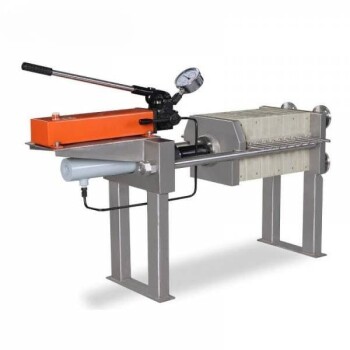
A laboratory hydraulic press is the critical instrument used to transform loose $Li_xScCl_{3+x}$ solid-state electrolyte powders into the dense, consolidated pellets required for valid testing. By applying high axial pressure, the press eliminates voids between particles to ensure the sample is physically uniform and robust. This densification is a mandatory prerequisite for obtaining meaningful electrochemical data.
The Core Takeaway Electrochemical Impedance Spectroscopy (EIS) is designed to measure material properties, not the air gaps between particles. The hydraulic press minimizes grain boundary resistance and interfacial contact resistance, ensuring the test results reflect the material's intrinsic ionic conductivity rather than its packing efficiency.
The Physics of Densification
Eliminating Microscopic Voids
The primary role of the press is to mechanically force loose powder particles together. In the synthesis of $Li_xScCl_{3+x}$, the raw material exists as a powder with significant air gaps.
The hydraulic press applies pressure (often around 300 MPa) to collapse these voids. This creates a "cold-pressed" pellet where particles physically touch, forming a continuous path for ion migration.
Reducing Grain Boundary Resistance
Ionic conductivity relies on ions hopping from one crystal grain to another. Loose contact between grains acts as a barrier, creating high resistance.
By compressing the powder into a dense pellet, the press maximizes the contact area between grains. This directly reduces grain boundary resistance, allowing the EIS measurement to capture the true performance of the electrolyte.
Optimizing the Electrical Interface
Ensuring Electrode Contact
EIS testing requires the application of current collectors, such as platinum paste or metal foils, to the electrolyte pellet.
The hydraulic press ensures the pellet surfaces are flat and uniform. This allows for tight physical contact between the electrolyte and the external electrodes.
Lowering Interfacial Contact Resistance
Poor contact between the sample and the testing equipment creates "noise" in the data, known as interfacial contact resistance.
A laboratory press provides uniform axial pressure to minimize this resistance. Establishing a good contact interface enhances the reproducibility of the test data, ensuring that results are consistent across different samples.
Understanding the Trade-offs
The Risk of Density Gradients
While pressure is necessary, how it is applied matters. If the press does not deliver uniform axial pressure, the pellet may develop density gradients.
This means some parts of the sample are denser than others, which can lead to warped ion flow paths and inaccurate EIS readings.
Mechanical Integrity vs. Over-pressing
The goal is to create a "green body" with sufficient handling strength. However, excessive or uncontrolled pressure can induce microscopic defects or cracks.
Precise pressure control is required to arrange particles tightly without causing the pellet to fracture or deform significantly after ejection from the mold.
Making the Right Choice for Your Goal
To get the most accurate EIS data for your $Li_xScCl_{3+x}$ samples, consider the following:
- If your primary focus is intrinsic conductivity: Prioritize high pressure to maximize density and eliminate grain boundary effects, ensuring you are measuring the material, not the porosity.
- If your primary focus is data reproducibility: Focus on the precision of the mold and the uniformity of the pressure application to ensure every sample has identical interfacial contact.
Ultimately, the hydraulic press converts a pile of powder into a measurable electronic component, bridging the gap between synthesis and verifiable data.
Summary Table:
| Feature | Impact on EIS Testing | Benefit for $Li_xScCl_{3+x}$ Analysis |
|---|---|---|
| Void Elimination | Removes air gaps between particles | Ensures a continuous path for ion migration |
| Grain Boundary Reduction | Lowers resistance between crystals | Measures intrinsic material conductivity |
| Surface Flattening | Improves electrode-electrolyte contact | Reduces noise and interfacial resistance |
| Axial Pressure Control | Ensures physical uniformity | Enhances data reproducibility and accuracy |
Elevate Your Battery Research with KINTEK Precision
To obtain verifiable electrochemical data for $Li_xScCl_{3+x}$ and other solid-state electrolytes, the quality of your pellet is paramount. KINTEK specializes in high-performance laboratory hydraulic presses (pellet, hot, and isostatic) designed to provide the precise axial pressure and uniformity required for sensitive EIS testing.
Our comprehensive range of equipment supports every stage of energy research, including:
- Advanced Crushing & Milling Systems for powder preparation.
- High-Temperature Furnaces (Muffle, Vacuum, CVD) for electrolyte synthesis.
- Specialized Electrolytic Cells & Battery Research Tools for performance testing.
- Durable Consumables including ceramic crucibles and PTFE products.
Ready to minimize resistance and maximize your lab's efficiency? Contact KINTEK today to find the perfect pressing solution for your material science applications!
Related Products
- Laboratory Hydraulic Press Lab Pellet Press Machine for Glove Box
- Laboratory Hydraulic Press Split Electric Lab Pellet Press
- Laboratory Hydraulic Press Lab Pellet Press for Button Battery
- Automatic Laboratory Hydraulic Press for XRF & KBR Pellet Press
- Automatic Laboratory Hydraulic Pellet Press Machine for Lab Use
People Also Ask
- What is the function of a laboratory hydraulic press in W-Cu composites? Control Porosity and Material Ratio
- What is the role of a laboratory hydraulic press in the initial stages of Li6PS5Cl preparation? Key to Green Pellets
- What role does a laboratory hydraulic press play in triboelectric testing? Achieve Precision Alloy Sample Prep
- How can a laboratory hydraulic press be applied to chitosan for wastewater treatment? Optimize Pores & Strength
- How do a precision laboratory hydraulic press and specialized molds contribute to the fabrication of spherical ceramic samples? Achieving High-Density Material Precision