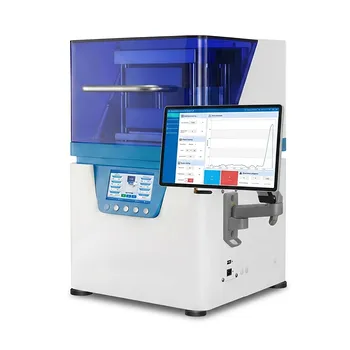
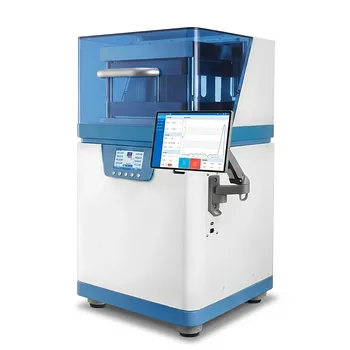
A laboratory hydraulic press is the critical tool for densifying active material mixtures onto current collectors. By applying precise, uniform pressure (typically around 10 MPa), it transforms loose hierarchical porous carbon into a coherent electrode sheet with minimized contact resistance and enhanced mechanical stability. This compaction ensures efficient electron transport and structural integrity, which are essential for high-rate electrochemical performance in devices like supercapacitors and batteries.
The hydraulic press facilitates the mechanical integration of hierarchical carbon, conductive agents, and binders onto a current collector. This process optimizes the balance between electronic conductivity and ionic diffusion while ensuring the electrode remains stable under high-current cycling.
Enhancing Electrical Conductivity and Electron Transport
Reduction of Contact Resistance
The primary role of the hydraulic press is to apply vertical pressure that compacts the mixture of hierarchical carbon, conductive carbon black, and binders onto the current collector. This compaction significantly reduces the contact resistance between the active material and the metal framework, such as nickel foam or copper foil.
Shortening Electron Transmission Paths
By densifying the electrode layer, the press reduces the physical distance between particles. This creates shorter electron transmission paths, allowing for faster charge transfer throughout the electrode. This is critical for maintaining excellent rate performance even at high current densities, such as 100 A g⁻¹.
Optimizing Electrode Structure and Density
Tuning Porosity and Thickness
Precise pressure control allows researchers to adjust the electrode porosity and thickness to a specific target density. This balance is vital for high volumetric specific capacity, ensuring that the electrode is dense enough to store energy efficiently while remaining porous enough for electrolyte penetration.
Elimination of Internal Voids
The pressing process eliminates internal voids and air pockets within the active material slurry. Removing these gaps ensures a uniform current distribution across the electrode surface and prevents localized hotspots or inactive regions during electrochemical testing.
Ensuring Mechanical Stability and Longevity
Strengthening Bonding and Adhesion
High-pressure compaction enhances the physical contact and bonding strength between the active material and the current collector. This prevents the carbon layer from peeling off or delaminating when submerged in the electrolyte or during repeated charge-discharge cycles.
Maintaining Structural Integrity
The use of precision molds and stable pressure ensures that the resulting electrode sheets have consistent compaction density. This minimizes density gradients and ensures the mechanical strength required for the electrode to survive long-term cyclic testing without structural failure.
Understanding the Trade-offs
Balancing Density vs. Diffusion
While higher pressure increases volumetric capacity and conductivity, excessive pressure can crush the hierarchical pore structure. If the pores are collapsed, ionic diffusion is restricted, which can paradoxically decrease the power density and high-rate performance of the electrode.
Pressure Uniformity Risks
Inconsistent pressure application can lead to cracking or uneven thickness in the electrode sheet. These structural defects create uneven resistance across the electrode, leading to premature failure and unreliable experimental data during cycling.
How to Apply This to Your Project
Recommendations for Electrode Assembly
- If your primary focus is High-Rate Performance: Use a calibrated pressure of approximately 10 MPa to minimize contact resistance while preserving the hierarchical pore pathways for rapid ion transport.
- If your primary focus is Volumetric Specific Capacity: Gradually increase the compaction pressure to maximize the density of the active material, ensuring you monitor the threshold where ionic diffusion becomes limited.
- If your primary focus is Long-Term Cycling Stability: Prioritize the bonding phase by maintaining constant pressure to ensure the active material is securely anchored to the current collector framework.
Proper utilization of a laboratory hydraulic press ensures that hierarchical porous carbon electrodes achieve the necessary synergy between mechanical robustness and high-efficiency electrochemical transport.
Summary Table:
| Role in Assembly | Technical Impact | Key Benefit |
|---|---|---|
| Densification | Reduces contact resistance between material and collector | Enhanced electrical conductivity |
| Porosity Tuning | Adjusts electrode thickness and void volume | Optimized ion diffusion & volumetric capacity |
| Mechanical Bonding | Strengthens adhesion to nickel foam or copper foil | Improved cyclic stability and longevity |
| Void Elimination | Removes internal air pockets and gaps | Uniform current distribution |
| Structural Integrity | Ensures consistent compaction density | Prevents delamination during cycling |
Elevate Your Electrode Research with KINTEK Precision
Achieving the perfect balance between ionic diffusion and electronic conductivity requires absolute precision. KINTEK specializes in high-performance laboratory equipment designed for the most demanding energy storage applications. Our comprehensive range of hydraulic presses (pellet, hot, and isostatic) ensures uniform compaction and mechanical integrity for your hierarchical porous carbon electrodes.
Beyond pressing, KINTEK supports your entire workflow with:
- High-temperature furnaces (muffle, vacuum, and CVD) for carbon synthesis.
- Crushing and milling systems for active material preparation.
- Electrolytic cells and battery research tools for rigorous electrochemical testing.
Don't let inconsistent pressure compromise your high-rate performance. Partner with KINTEK for reliable, laboratory-grade solutions that deliver repeatable results.
Contact our technical experts today to find the perfect press for your lab!
References
- Qian Zhang, Shuijian He. High Rate Performance Supercapacitors Based on N, O Co-Doped Hierarchical Porous Carbon Foams Synthesized via Chemical Blowing and Dual Templates. DOI: 10.3390/molecules28196994
This article is also based on technical information from Kintek Solution Knowledge Base .
Related Products
- Laboratory Hydraulic Press Split Electric Lab Pellet Press
- Laboratory Hydraulic Press Lab Pellet Press Machine for Glove Box
- Laboratory Hydraulic Press Lab Pellet Press for Button Battery
- Automatic Laboratory Hydraulic Pellet Press Machine for Lab Use
- Fully Automatic Heated Hydraulic Lab Press for Materials Sintering and Sample Preparation
People Also Ask
- What are the roles of a laboratory hydraulic press and stainless steel molds in the preparation of graphite samples?
- What is the role of a laboratory hydraulic press in electrode prep? Maximize Energy Density & Sealing Precision
- How does a laboratory hydraulic press ensure the quality of alumina-forming alloy green bodies? Optimize CSP Research
- How is a laboratory hydraulic press used to evaluate the mechanical performance of nano-modified concrete? Expert Guide
- Why is a laboratory hydraulic press used for ASSB assembly? Achieving 392 MPa for Optimal Solid-State Battery Density