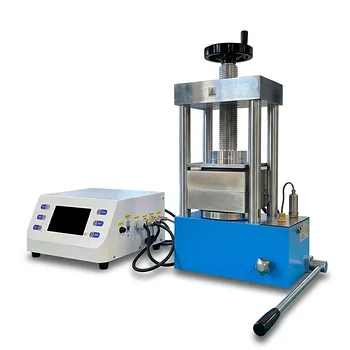
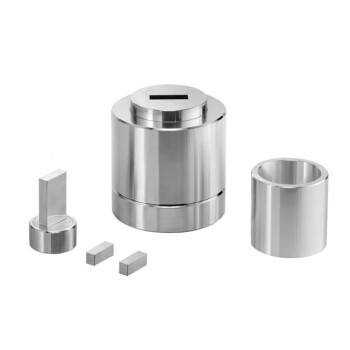
A laboratory hydraulic press serves as the fundamental mechanism for establishing the structural integrity and electrical connectivity of electrode sheets. It applies precise, adjustable static pressure to compress a mixture of active substances, conductive carbon black, and binders onto a current collector, converting loose composite materials into a dense, functional component.
While chemical synthesis defines the material's potential, the hydraulic press defines its reality. By ensuring uniform density and strong adhesion, pressure application minimizes electrical resistance and prevents physical failure during operation.
Enhancing Electrochemical Performance
Minimizing Internal Resistance
The primary function of the press is to reduce the internal contact resistance of the electrode.
By forcing particles closer together, the press creates a continuous conductive pathway between the active material and the conductive carbon black.
Optimizing Current Collector Contact
Effective compression ensures a robust interface between the active material layer and the metallic substrate (current collector).
Without this pressure, the electrode creates a high-impedance barrier that severely hampers electron transport and overall battery efficiency.
Ensuring Mechanical Stability
Preventing Delamination
During long-term cyclic electrochemical testing, electrodes undergo repeated stress that can cause materials to detach.
The hydraulic press increases the bonding strength of the composite, locking the active layer to the substrate to prevent peeling or delamination.
Improving Durability
Compaction creates a mechanically stable structure that can withstand the physical expansion and contraction associated with ion insertion.
This physical stability is non-negotiable for maintaining capacity over hundreds or thousands of charge cycles.
The Role in Precursor Design
For open-framework materials, the role of the press extends back to the material synthesis stage.
Controlling Precursor Uniformity
In the stages prior to dealloying (a common method for creating open frameworks), the press is used for the high-pressure molding of green bodies or alloy forging.
Precise pressure control here ensures the precursor alloy achieves a uniform internal composition.
Managing Porosity
For open-framework materials, the starting density matters.
The press ensures low porosity in the precursor, which is an essential requirement for producing a homogeneous nanoporous structure during subsequent chemical processing.
Understanding the Trade-offs
The Risk of Over-Compression
While density is good for conductivity, excessive pressure can destroy the open-framework structure you are trying to utilize.
Crushing the pores reduces the surface area available for electrolyte infiltration, potentially choking the reaction despite high conductivity.
Uniformity vs. Distortion
Applying pressure unevenly can warp the current collector or create density gradients across the sheet.
This leads to "hot spots" of current density during operation, accelerating degradation in specific areas of the electrode.
Making the Right Choice for Your Goal
To maximize the utility of your hydraulic press, align your pressure strategy with your specific material requirements:
- If your primary focus is Long-Term Cycle Life: Prioritize higher bonding strength to prevent delamination, ensuring the active material stays attached to the collector.
- If your primary focus is High-Rate Capability: Balance compression to maintain porosity, ensuring the electrolyte can penetrate the open-framework structure while maintaining connectivity.
- If your primary focus is Material Synthesis (Dealloying): Focus on extreme uniformity during the precursor molding stage to ensure a homogeneous nanoporous architecture later.
Success lies in finding the exact pressure threshold that maximizes electrical contact without compromising the material's porous architecture.
Summary Table:
| Feature | Impact on Electrode Performance | Key Benefit |
|---|---|---|
| Pressure Control | Reduces internal contact resistance | Enhanced electron transport |
| Compaction Force | Increases bonding to current collector | Prevents delamination & peeling |
| Structural Density | Balances porosity and surface area | Optimizes electrolyte infiltration |
| Precursor Molding | Ensures uniform green body composition | Homogeneous nanoporous architecture |
Elevate Your Material Research with KINTEK Precision
Unlock the full potential of your open-framework materials with KINTEK’s advanced laboratory hydraulic presses. Whether you are performing high-pressure precursor molding or delicate electrode sheet compaction, our range of manual, electric, and isostatic presses provides the precise pressure control required to maximize conductivity without compromising porous structures.
From high-temperature furnaces for material synthesis to specialized crushing and milling systems, KINTEK offers a comprehensive ecosystem for battery research and material science. Ensure the structural integrity and electrochemical efficiency of your electrodes—contact our technical experts today to find the perfect solution for your lab.
References
- Weijin Li, Roland A. Fischer. Open Framework Material Based Thin Films: Electrochemical Catalysis and State‐of‐the‐art Technologies. DOI: 10.1002/aenm.202202972
This article is also based on technical information from Kintek Solution Knowledge Base .
Related Products
- Laboratory Hydraulic Press Split Electric Lab Pellet Press
- Heated Hydraulic Press Machine with Integrated Manual Heated Plates for Lab Use
- Automatic Laboratory Hydraulic Press for XRF & KBR Pellet Press
- Automatic High Temperature Heated Hydraulic Press Machine with Heated Plates for Lab
- Manual High Temperature Heated Hydraulic Press Machine with Heated Plates for Lab
People Also Ask
- What role does a laboratory hydraulic press play in platinum recovery research? Enhancing Sample Precision
- What are the specific applications of a lab hydraulic press in biochar evaluation? Optimize density and data accuracy.
- What are the roles of a laboratory hydraulic press and stainless steel molds in the preparation of graphite samples?
- What is the role of a laboratory hydraulic press in electrode prep? Maximize Energy Density & Sealing Precision
- Why must a laboratory hydraulic press equipped with cylindrical molds be used when preparing BZY green bodies? High Density