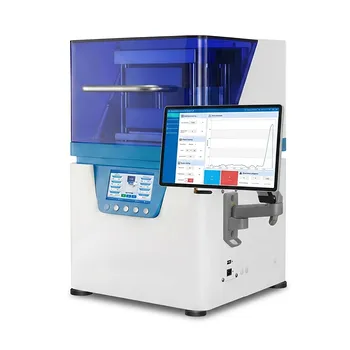
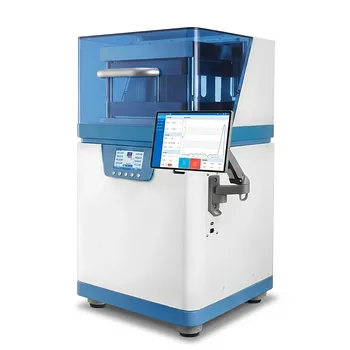
In the solid-state synthesis of Columbite-(Fe), a laboratory hydraulic press is the essential tool used to compress stoichiometric mixtures of niobium pentoxide and ferrous oxalate powders into dense pellets. This mechanical densification reduces the distance between reactant particles, enabling the atomic diffusion required for the chemical reaction to occur during subsequent high-temperature furnace treatments.
The laboratory hydraulic press serves as a critical facilitator for solid-state reactions by transforming loose powders into high-density pellets. This process ensures intimate particle contact, which is the fundamental requirement for achieving chemical completeness and mineral phase uniformity.
The Role of Mechanical Force in Atomic Diffusion
Minimizing Inter-Particle Voids
The primary function of the press is to eliminate the air gaps and "dead space" found in loose powder mixtures. By applying significant mechanical force, the press forces the niobium pentoxide and ferrous oxalate particles into close physical proximity.
Shortening Diffusion Pathways
Solid-state synthesis relies on the movement of atoms across the boundaries of adjacent particles. By compressing the mixture into a pellet, the hydraulic press effectively shortens the diffusion distance, allowing ions to migrate more easily and react more thoroughly at high temperatures.
Establishing Physical Pre-conditions
The pelletizing step creates the necessary physical environment for the solid-state reaction to proceed efficiently. Without this initial compaction, the reaction in the furnace would be sluggish, likely resulting in an incomplete conversion or a mixture of unreacted precursors.
Ensuring Structural and Phase Integrity
Achieving Mineral Phase Uniformity
Consistent pressure across the sample ensures that the stoichiometric ratio of the raw materials is maintained in a uniform state throughout the pellet. This uniformity is vital for producing Columbite-(Fe) with a consistent crystal structure and predictable physical properties.
Enhancing Thermal Stability
The high-density pellets produced by the press possess the mechanical strength needed to survive the thermal stresses of the sintering process. This structural integrity prevents the sample from crumbling or dispersing during the heating cycle, ensuring the final mineral product remains intact.
Maximizing Reaction Completeness
Because the press ensures tight bonding between ceramic particles, it minimizes internal micro-pores. This high level of contact ensures that the solid-state reaction can reach the center of the material, leading to a more homogenous and complete synthesis of the target mineral.
Understanding the Trade-offs and Pitfalls
Pressure-Induced Micro-cracking
Applying excessive pressure can lead to internal stresses within the green body pellet. If the pressure exceeds the material's limits, it may result in "capping" or micro-cracks that can expand during high-temperature treatment and compromise the final structure.
Density Gradients and Non-uniformity
If the hydraulic press does not apply pressure evenly, or if the mold is improperly lubricated, density gradients can form within the pellet. These variations in density lead to uneven reaction rates, which can cause warping or localized impurities in the synthesized Columbite-(Fe).
How to Apply This to Your Synthesis Project
When utilizing a laboratory hydraulic press for solid-state synthesis, your approach should be dictated by your specific research or production requirements:
- If your primary focus is Phase Purity: Ensure the stoichiometric powder mixture is thoroughly homogenized before pressing to prevent localized pockets of unreacted material.
- If your primary focus is High Throughput: Optimize the pellet size and pressing pressure to ensure rapid diffusion, which can potentially reduce the required dwell time in the high-temperature furnace.
- If your primary focus is Structural Characterization: Use precise and stable pressure control to minimize density gradients, ensuring the pellet provides a consistent substrate for subsequent analysis.
Properly calibrated mechanical compression is the silent engine behind successful solid-state synthesis, turning simple powder mixtures into sophisticated mineral phases.
Summary Table:
| Feature | Impact on Columbite-(Fe) Synthesis | Key Advantage |
|---|---|---|
| Powder Densification | Eliminates air gaps and reduces particle distance | Accelerates atomic diffusion during heating |
| Pelletizing | Creates a stable, high-density 'green body' | Ensures structural integrity in the furnace |
| Stoichiometric Control | Maintains uniform distribution of precursors | Prevents localized impurities and phase gradients |
| Pressure Precision | Prevents internal micro-cracking and 'capping' | Maximizes reaction completeness and homogeneity |
Elevate Your Material Synthesis with KINTEK Precision
Achieving high-purity mineral phases like Columbite-(Fe) requires absolute control over your compaction and thermal processes. KINTEK specializes in high-performance laboratory equipment designed for rigorous research environments. From our precision hydraulic presses (pellet, hot, and isostatic) that ensure perfect sample densification to our advanced high-temperature furnaces (muffle, tube, and vacuum) for flawless sintering, we provide the tools you need for reaction completeness.
Explore our comprehensive range of equipment, including crushing and milling systems, PTFE and ceramic consumables, and cooling solutions, all engineered to enhance your lab's efficiency and output.
Ready to optimize your solid-state synthesis? Contact our technical experts today to find the perfect solution for your research goals!
References
- Xiao Guo, Qiuju Li. The Surface Structure Change of Columbite-(Fe) Dissolution in H2SO4. DOI: 10.3390/min13030445
This article is also based on technical information from Kintek Solution Knowledge Base .
Related Products
- Laboratory Hydraulic Press Split Electric Lab Pellet Press
- Laboratory Hydraulic Press Lab Pellet Press Machine for Glove Box
- Laboratory Hydraulic Press Lab Pellet Press for Button Battery
- Automatic Laboratory Hydraulic Pellet Press Machine for Lab Use
- Fully Automatic Heated Hydraulic Lab Press for Materials Sintering and Sample Preparation
People Also Ask
- What role does a laboratory hydraulic press play in platinum recovery research? Enhancing Sample Precision
- What are the specific applications of a lab hydraulic press in biochar evaluation? Optimize density and data accuracy.
- What are the roles of a laboratory hydraulic press and stainless steel molds in the preparation of graphite samples?
- What is the role of a laboratory hydraulic press in electrode prep? Maximize Energy Density & Sealing Precision
- Why must a laboratory hydraulic press equipped with cylindrical molds be used when preparing BZY green bodies? High Density