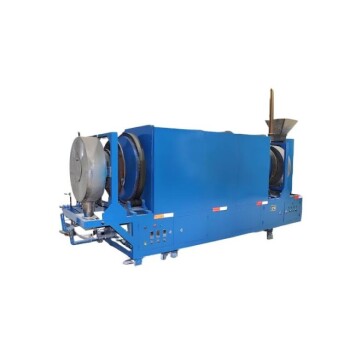
A precision heat treatment furnace acts as the critical control mechanism for maximizing the mechanical properties of A356-SiCp composites during the T6 tempering process. Its role is to execute strictly regulated thermal cycles—specifically solution treatment and artificial aging—to fundamentally alter the material's microstructure by dissolving alloying elements and precipitating strengthening phases.
The furnace’s primary value lies in its ability to maintain exact temperature stability during distinct heating cycles. This precision is required to spheroidize silicon phases and precipitate Mg2Si, directly transforming the composite’s raw structure into one with superior hardness and compressive strength.
The Mechanics of Microstructural Transformation
Enabling Effective Solution Treatment
The first critical function of the furnace is to raise the composite to a high solution treatment temperature, typically around 540°C.
At this specific thermal plateau, the furnace ensures the dissolution of alloying elements into the aluminum matrix.
Strict control at this stage is vital to prepare the supersaturated solid solution necessary for subsequent hardening.
Facilitating Precipitation Hardening
Following solution treatment, the furnace must transition to a lower, precise aging temperature, often near 155°C.
This controlled aging environment drives the precipitation of key strengthening phases, specifically Mg2Si (Magnesium Silicide).
The furnace's ability to hold this temperature stable allows these precipitates to form uniformly, which is the primary driver of the T6 temper's effectiveness.
Optimizing the Silicon Phase
Beyond precipitation, the thermal processing regulated by the furnace induces the spheroidization of the silicon phase.
Changing the silicon from acicular (needle-like) to spherical shapes reduces stress concentrations within the material.
This morphological change is essential for improving the composite's ductility and overall mechanical reliability.
The Impact on Mechanical Properties
Increasing Compressive Strength
By successfully managing the precipitation of Mg2Si, the furnace directly contributes to a significant increase in the compressive strength of the A356-SiCp composite.
The uniform distribution of these strengthening phases impedes dislocation movement within the matrix.
Enhancing Material Hardness
The precise execution of the T6 cycle results in a measurable increase in the material's hardness.
This is a direct outcome of the optimized microstructure achieved through the strictly controlled heating and cooling rates provided by the equipment.
Understanding the Critical Variables
The Necessity of Thermal Stability
While general heat treatment can alter properties, precision is the defining factor for composites.
Variations in temperature can lead to incomplete dissolution or uneven precipitation, failing to achieve the target material strengths.
Cycle Control and Uniformity
The furnace must not only reach temperature but strictly control the duration of the solution and aging heat cycles.
Inadequate control over these time-temperature profiles prevents the full realization of the spheroidization process, leaving the composite vulnerable to premature failure.
Making the Right Choice for Your Goal
If your primary focus is Maximum Strength:
- Ensure the furnace can maintain the specific aging temperature (approx. 155°C) without fluctuation to maximize the precipitation of the Mg2Si strengthening phase.
If your primary focus is Microstructural Homogeneity:
- Prioritize a furnace with uniform heating zones to guarantee consistent spheroidization of the silicon phase throughout the entire component.
Precision in the T6 process is not merely about heating; it is about strictly governing the phase transformations that define the composite's final performance.
Summary Table:
| T6 Process Stage | Temperature Requirement | Primary Role of the Furnace | Microstructural Impact |
|---|---|---|---|
| Solution Treatment | ~540°C | High-temp stability & dissolution | Dissolves alloying elements into matrix |
| Artificial Aging | ~155°C | Precise thermal holding | Precipitates Mg2Si strengthening phases |
| Morphology Control | Uniform Heating | Stress reduction mechanism | Spheroidization of acicular silicon phases |
| Final Tempering | Cycle Regulation | Controlled cooling/heating | Increases compressive strength and hardness |
Elevate Your Material Performance with KINTEK Precision
Achieving the perfect T6 temper for A356-SiCp composites requires uncompromising thermal accuracy. KINTEK specializes in advanced laboratory equipment, offering a comprehensive range of high-temperature muffle, tube, and vacuum furnaces designed for rigorous solution treatment and aging cycles.
Whether you are refining microstructures or maximizing compressive strength, our precision heating solutions—alongside our specialized crushing systems, hydraulic presses, and ceramic consumables—provide the reliability your research demands.
Ready to optimize your heat treatment results? Contact our technical experts today to find the ideal furnace for your laboratory’s unique requirements.
Related Products
- 600T Vacuum Induction Hot Press Furnace for Heat Treat and Sintering
- Vacuum Heat Treat Furnace with Ceramic Fiber Liner
- 2200 ℃ Graphite Vacuum Heat Treat Furnace
- Molybdenum Vacuum Heat Treat Furnace
- Vacuum Heat Treat and Pressure Sintering Furnace for High Temperature Applications
People Also Ask
- What role does an induction vacuum hot pressing furnace play in sintering? Achieve 98% Density in Carbide Blocks
- What advantages does a vacuum hot press furnace provide for LSLBO ceramic electrolytes? Achieve 94% Relative Density
- What role does a Vacuum Hot Press (VHP) furnace play in the densification of austenitic stainless steel 316 composites?
- What are the advantages of a vacuum hot press furnace for W-50%Cu? Achieve 99.6% Density at Lower Temperatures
- What role does mechanical pressure play during the vacuum diffusion bonding of tungsten and copper? Keys to Solid Bonding