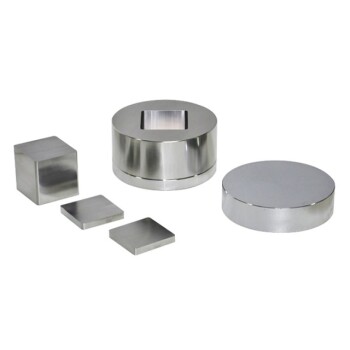
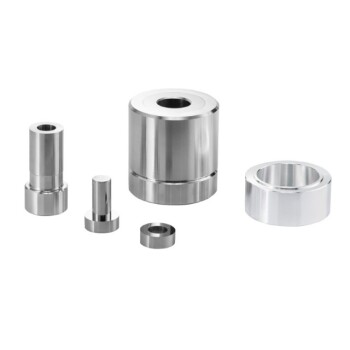
The rigid mold functions as the primary stabilization and transmission interface during the hot pressing of iron-based amorphous alloy and aluminum foil stacks. It serves a dual purpose: physically confining the materials to prevent lateral movement and acting as a conduit to distribute hydraulic force evenly across the sample's surface.
By imposing strict lateral constraints and ensuring uniform pressure transmission, the rigid mold eliminates interlayer misalignment and guarantees consistent stress distribution throughout the composite's thickness.
The Mechanics of Composite Assembly
Securing the Stacking Position
When amorphous ribbons and aluminum foils are stacked, they are inherently unstable and prone to shifting. The rigid mold provides the necessary lateral constraint to lock these layers in place.
This physical boundary secures the stacking position effectively. It prevents interlayer misalignment that would otherwise occur due to thermal expansion or mechanical shifts during the heating and pressurization stages.
Uniform Pressure Transmission
A hydraulic press head applies a massive load, but it does not always apply it perfectly evenly on its own. The rigid mold acts as a critical intermediary between the press and the material.
It ensures that the load applied by the hydraulic system is distributed uniformly across the entire surface area of the sample. This prevents localized pressure points that could damage the delicate foils or create uneven bonding.
Consistent Through-Thickness Stress
The uniformity achieved on the surface extends into the material's internal structure. Because the mold distributes surface pressure evenly, it generates consistent stress along the thickness of the composite material.
This through-thickness consistency is vital for creating a homogeneous material. It ensures that every layer, from the top to the bottom of the stack, experiences the same bonding conditions.
Critical Considerations for Mold Design
The Importance of Precision
While the mold provides constraint, its effectiveness relies heavily on dimensional accuracy. The fit between the stack and the mold walls must be precise.
If the tolerance is too loose, the lateral constraint fails, and misalignment will persist. Conversely, if the fit is too tight, it may impede the natural settling of materials under pressure.
Rigidity vs. Thermal Expansion
The mold must be rigid enough to resist deformation under high loads. However, this rigidity must be balanced against the thermal behavior of the alloy and foil.
The mold must maintain its shape to ensure pressure transmission, regardless of the high temperatures involved in the hot press process.
Making the Right Choice for Your Process
To achieve high-quality iron-based amorphous alloy composites, consider the following optimization strategies:
- If your primary focus is Structural Integrity: Prioritize tighter mold tolerances to maximize lateral constraint and eliminate any possibility of layer shifting.
- If your primary focus is Material Homogeneity: Ensure the mold platens are perfectly parallel to guarantee uniform pressure distribution and consistent stress through the thickness.
The rigid mold is not just a container; it is the active mechanical component that dictates the geometric and structural quality of your final composite.
Summary Table:
| Function | Mechanism | Impact on Final Composite |
|---|---|---|
| Lateral Constraint | Physically confines ribbons and foils | Prevents interlayer misalignment and shifting |
| Pressure Distribution | Acts as a conduit for hydraulic force | Eliminates localized stress points and surface damage |
| Through-Thickness Stress | Transmits load evenly through layers | Ensures material homogeneity and consistent bonding |
| Structural Stability | Resists deformation under high loads | Maintains geometric accuracy at high temperatures |
Elevate Your Composite Manufacturing with KINTEK Precision
Achieving the perfect bond in amorphous alloy composites requires more than just heat—it requires superior mechanical control. KINTEK specializes in advanced laboratory solutions, including high-performance hydraulic presses (pellet, hot, and isostatic) designed to deliver the uniform pressure transmission your research demands.
Whether you are developing next-generation electronics or structural materials, our comprehensive range of high-temperature furnaces, crushing systems, and specialized consumables like PTFE and ceramic crucibles ensure your lab operates at the cutting edge of technology.
Ready to optimize your stacking and bonding process? Contact KINTEK today to discover how our high-precision equipment and expert support can enhance your material homogeneity and structural integrity.
Related Products
- Double Plate Heating Press Mold for Lab
- Lab Infrared Press Mold
- Warm Isostatic Press for Solid State Battery Research
- High Temperature Wear-Resistant Alumina Al2O3 Plate for Engineering Advanced Fine Ceramics
- Copper Foam
People Also Ask
- How to use a press mold? Master the Art of Creating Consistent Ceramic Forms
- What is the process of mold press? A Step-by-Step Guide to Compression Molding
- What is the primary function of mold pressing for LAGP powders? Achieve High-Performance Solid Electrolytes
- Why are pressure molds with non-conductive resin inner walls required for battery testing? Ensure Data Accuracy
- What is the press mould method? A Guide to Consistent, Detailed Ceramic Forms