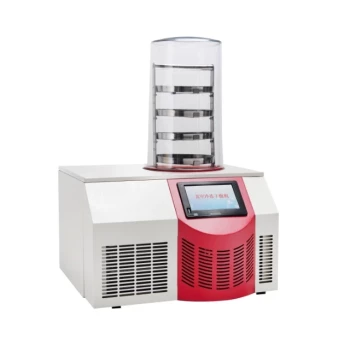
The vacuum drying oven plays a pivotal role in establishing the structural integrity of High-Entropy Alloy Nanoparticles (HEA-NPs) before high-temperature processing begins. By utilizing a uniform thermal field and negative pressure, typically around 355 K, it gently removes residual moisture and solvents from the carrier material without disrupting the distribution of metal precursors.
Core Takeaway The vacuum drying oven is not merely for dehydration; it is a critical stabilization step that "locks in" the dispersion of metal ions. By enabling solvent removal at lower temperatures, it prevents the uneven crystallization and migration of metal salts, ensuring that the components remain mixed at the molecular level to avoid phase separation during the final pyrolysis stage.
Preserving Precursor Dispersion
The primary challenge in synthesizing supported HEA-NPs is preventing the metal precursors from clumping together before the alloy is actually formed.
Maintaining Ionic States
The vacuum drying oven operates at a relatively low temperature (e.g., 355 K) under negative pressure. This environment ensures that metal ions remain in a highly dispersed molecular or ionic state on the carrier surface.
If the drying is too aggressive or uneven, the metal salts may precipitate prematurely. This leads to uneven crystallization, where the metals separate rather than remaining a homogeneous mix.
Preventing Aggregation
By removing solvents gently, the vacuum oven prevents the physical movement of precursors across the carrier surface. This minimizes the risk of aggregation, where distinct metal particles bunch together.
Keeping the precursors isolated and well-distributed at this stage is essential for the subsequent high-temperature pyrolysis.
Facilitating the Pyrolysis Process
The success of the final heating stage (pyrolysis) is determined by the quality of the dried precursor.
Avoiding Phase Separation
The primary reference highlights that proper vacuum drying avoids significant phase separation during pyrolysis.
High-entropy alloys require a precise mix of multiple elements. If the drying step fails to keep these elements mixed homogeneously, the final product will likely separate into different phases rather than forming a single, unified solid solution.
Enhancing Structural Stability
While the primary focus is on chemical dispersion, the removal of solvents also protects the physical structure.
As noted in supplementary contexts, thorough drying prevents the formation of internal pores or cracks that can occur if residual water vaporizes explosively at high temperatures.
Understanding the Trade-offs
While vacuum drying is superior to standard drying for HEA-NPs, it is important to understand the risks of improper implementation.
The Risk of Rapid Evaporation
If the temperature is set too high or the pressure drops too suddenly, solvents may evaporate violently. This can cause the physical structure of the support to collapse or force the precursors into severe agglomerates, defeating the purpose of the step.
Oxidation and Contamination
Standard ovens often expose materials to air. A key advantage of the vacuum oven is the prevention of oxidation.
By removing air from the chamber, you protect sensitive metal precursors from reacting with oxygen or adsorbing atmospheric impurities, which preserves the purity of the raw materials before the alloy is formed.
Making the Right Choice for Your Goal
To maximize the quality of your High-Entropy Alloy Nanoparticles, tailor your drying process to your specific objectives.
- If your primary focus is Elemental Homogeneity: Prioritize a low-temperature, high-vacuum setting to freeze metal ions in place and prevent phase separation.
- If your primary focus is Structural Integrity: Ensure the drying duration is sufficient to remove all deep-seated solvents to prevent pore formation or cracking during pyrolysis.
- If your primary focus is Material Purity: Rely on the vacuum environment to shield precursors from oxidation and atmospheric contaminants during the drying phase.
The vacuum drying step is the bridge between a simple mixture of salts and a high-performance alloy; treat it with the same precision as the final pyrolysis.
Summary Table:
| Feature | Role in HEA-NP Pretreatment | Benefit to Final Product |
|---|---|---|
| Uniform Thermal Field | Gentle dehydration at low temperatures (~355 K) | Prevents premature crystallization and aggregation |
| Negative Pressure | Rapid solvent removal without high heat | Protects precursors from oxidation and contamination |
| Ion Stabilization | "Locks in" metal ions on the carrier surface | Ensures molecular-level mixing for pyrolysis |
| Structural Control | Eliminates deep-seated moisture | Prevents internal cracking and pore formation |
Elevate Your Nanomaterial Synthesis with KINTEK Precision
Precision in the pretreatment stage is the key to unlocking superior material performance. KINTEK specializes in advanced laboratory equipment designed for the most demanding research applications. Whether you are synthesizing High-Entropy Alloys or developing next-gen catalysts, our high-performance vacuum drying ovens, high-temperature furnaces (CVD, PECVD, vacuum, and atmosphere), and crushing systems provide the stability and control you need.
From high-temperature high-pressure reactors to specialized PTFE and ceramic consumables, KINTEK delivers the tools that ensure your precursors remain homogeneous and your results remain reproducible.
Ready to optimize your lab's workflow? Contact our technical experts today to find the perfect solution for your research goals!
References
- Shaojie Gao, Jun Lü. Synthesis of high-entropy alloy nanoparticles on supports by the fast moving bed pyrolysis. DOI: 10.1038/s41467-020-15934-1
This article is also based on technical information from Kintek Solution Knowledge Base .
Related Products
- 56L Vertical Laboratory Vacuum Drying Oven
- 23L Laboratory Vacuum Drying Oven
- Laboratory Scientific Electric Heating Blast Drying Oven
- Benchtop Laboratory Vacuum Freeze Dryer
- Dental Porcelain Zirconia Sintering Ceramic Vacuum Press Furnace
People Also Ask
- Why is a laboratory vacuum drying oven recommended for rice straw residues? Protect Your Biomass Integrity
- What role does a laboratory vacuum drying oven play in the preparation of modified multi-walled carbon nanotubes?
- What is the importance of using a laboratory vacuum drying oven? Preserving Slow-Release Microcapsule Integrity
- Why is a Laboratory Vacuum Drying Oven recommended for PBAT microspheres? Protect Sensitive Polymer Integrity
- What role does a laboratory vacuum drying oven play in processing nanoparticle powder samples? Protect Sample Integrity