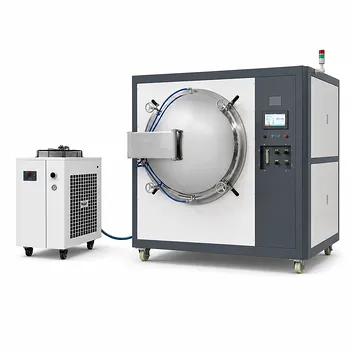
The primary function of a Vacuum Hot Press (VHP) furnace in bonding aluminum and copper is to create a controlled environment that simultaneously applies high temperature, mechanical pressure, and a vacuum.
By maintaining temperatures between 623 K and 923 K and applying a constant compression deformation rate (typically 0.2 mm/min), the VHP furnace forces the two metals into intimate contact. Crucially, the vacuum environment prevents the formation of oxide layers, allowing atoms to diffuse across the interface to create a high-quality metallurgical bond without melting the materials.
Core Takeaway Successful solid-state bonding relies on removing physical and chemical barriers between materials. The VHP furnace solves this by utilizing a vacuum to ensure a chemically clean surface and mechanical pressure to close microscopic gaps, enabling atomic diffusion to occur effectively at the aluminum-copper interface.
The Mechanism of Solid-State Bonding
The VHP furnace operates by integrating three critical variables: vacuum, temperature, and pressure. Understanding how these variables interact is the key to mastering the aluminum-copper bonding process.
The Role of the Vacuum Environment
Preventing Oxidation
Aluminum and copper are highly reactive to oxygen, especially at elevated temperatures. If oxygen is present, oxide layers form instantly on the metal surfaces.
Enabling Atomic Interaction
These oxide layers act as a barrier, blocking atoms from moving between the two metals. The VHP creates a vacuum to eliminate oxygen, preserving the purity of the interface and ensuring that metal atoms, rather than oxides, are in contact.
The Role of Thermal Energy
Increasing Atomic Mobility
The furnace heats the assembly to a specific window, typically between 623 K and 923 K for aluminum and copper.
Driving Diffusion
Heat provides the energy required for atoms to vibrate and migrate. This thermal energy drives the solid-state diffusion process, where aluminum atoms migrate into the copper structure and vice versa, creating the actual bond.
The Role of Mechanical Pressure
Ensuring Intimate Contact
On a microscopic level, metal surfaces are rough and uneven. Simply placing them together leaves gaps and voids where no bonding can occur.
Overcoming Surface Irregularities
The VHP applies significant force, often defined by a constant compression deformation rate (e.g., 0.2 mm/min). This pressure physically deforms the surface asperities, closing gaps and ensuring the "intimate contact" required for atomic exchange.
Understanding the Trade-offs
While the VHP is effective, precise control of the parameters is required to avoid common defects.
Temperature Sensitivity
If the temperature is too low, atomic diffusion is too slow to form a strong bond within a reasonable time. If the temperature is too high, you risk excessive deformation or the formation of brittle intermetallic compounds that weaken the joint.
Pressure Balance
Insufficient pressure leads to voids and weak adhesion. However, excessive pressure can distort the shape of the components beyond tolerance, particularly as the aluminum softens at bonding temperatures.
Making the Right Choice for Your Goal
To maximize the effectiveness of a VHP furnace for your specific application, consider which parameter requires the most stringent control based on your desired outcome.
- If your primary focus is bond purity: Prioritize the vacuum level to ensure the absolute elimination of oxidation, which is the primary inhibitor of diffusion.
- If your primary focus is process speed: Optimize the temperature within the upper safe limits (near 923 K) to accelerate atomic mobility, but monitor strictly for unwanted material deformation.
- If your primary focus is geometric precision: Reduce the compression deformation rate slightly to maintain the structural integrity of the softer aluminum component while maintaining adequate contact pressure.
The VHP furnace is not just a heat source; it is a precision tool designed to force dissimilar materials to behave as a single unit through atomic-level integration.
Summary Table:
| Parameter | Role in Bonding Process | Key Range/Rate |
|---|---|---|
| Vacuum | Prevents oxide layer formation and ensures interface purity | High Vacuum |
| Temperature | Increases atomic mobility to drive solid-state diffusion | 623 K - 923 K |
| Pressure | Closes microscopic gaps for intimate material contact | ~0.2 mm/min (def. rate) |
| Atmosphere | Eliminates oxygen to prevent chemical barriers | Controlled Vacuum |
Achieve Superior Metallurgical Bonds with KINTEK
Don’t let oxidation or uneven pressure compromise your material research. KINTEK specializes in advanced laboratory equipment designed for the most demanding thermal processes. Our precision Vacuum Hot Press (VHP) furnaces and hydraulic hot presses provide the exact control over temperature and deformation rates needed for successful solid-state diffusion bonding.
Whether you are working on battery research, specialized metallurgy, or high-temperature ceramics, KINTEK offers a comprehensive range of solutions—from tube and vacuum furnaces to isostatic presses and high-purity crucibles.
Ready to elevate your lab’s bonding capabilities? Contact KINTEK experts today to find the perfect furnace for your application.
Related Products
- Vacuum Hot Press Furnace Heated Vacuum Press Machine Tube Furnace
- 600T Vacuum Induction Hot Press Furnace for Heat Treat and Sintering
- Vacuum Hot Press Furnace Machine Heated Vacuum Press
- Vacuum Hot Press Furnace Machine for Lamination and Heating
- Vacuum Heat Treat and Pressure Sintering Furnace for High Temperature Applications
People Also Ask
- What advantages does a vacuum hot press furnace provide for LSLBO ceramic electrolytes? Achieve 94% Relative Density
- What role does a Vacuum Hot Press (VHP) furnace play in the densification of austenitic stainless steel 316 composites?
- What are the advantages of using a vacuum hot pressing furnace? Superior Densification for 2024Al/Gr/SiC Composites
- What are the advantages of a vacuum hot press furnace for LTPO solid electrolytes? Boost Density and Conductivity
- What core processing conditions does a vacuum hot press furnace provide? Achieve High-Density Cu-SiC/Diamond Composites