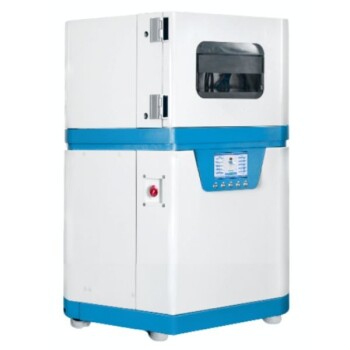
A vacuum hot pressing furnace serves as the central fabrication environment for creating Ti2AlNb/TA15 laminated composites. It acts as an integrated processing unit that simultaneously applies high vacuum, precise elevated temperatures (specifically around 1050°C), and mechanical hydraulic pressure to facilitate solid-phase diffusion bonding between these dissimilar titanium alloy layers.
The Core Mechanism The furnace functions not merely as a heater, but as a synergy-enabling device. By eliminating atmospheric interference through vacuum while forcing atomic interaction through heat and pressure, it transforms separate alloy sheets into a singular, fully densified structural composite in a one-step process.
The Three Pillars of Fabrication
To understand the furnace's role, we must analyze the three distinct physical conditions it imposes on the material. These elements work in concert to overcome the natural barriers to bonding titanium alloys.
1. Oxidation Prevention via High Vacuum
Titanium alloys like Ti2AlNb and TA15 are highly reactive chemically.
At the elevated temperatures required for bonding, these metals would instantly oxidize in a standard atmosphere. The furnace creates a high-vacuum environment to strip away oxygen. This prevents the formation of brittle oxide layers on the surface of the foils, which would otherwise inhibit bonding and degrade the mechanical properties of the final composite.
2. Thermal Activation at 1050°C
The furnace provides the thermal energy necessary to initiate atomic movement.
According to standard processing parameters, the furnace maintains a temperature of approximately 1050°C. This specific thermal input facilitates phase transitions within the alloys and increases the kinetic energy of the atoms. This energy is the driver that allows atoms to migrate across the interface between the Ti2AlNb and TA15 layers.
3. Mechanical Densification via Hydraulic Pressure
Heat alone is insufficient to bond solid metal layers that have microscopic surface irregularities.
The furnace's integrated hydraulic system applies continuous mechanical pressure (axial load). This pressure forces the layers into atomic-scale contact, overcoming microscopic roughness. It physically closes the gaps between layers, ensuring that the diffusion process occurs across the entire surface area rather than just at high points.
Understanding the Bonding Mechanism
The physical conditions created by the furnace drive specific metallurgical mechanisms that define the quality of the composite.
Solid-Phase Diffusion Bonding
The primary role of the furnace is to enable solid-phase diffusion bonding.
Unlike welding, which melts the base materials, this process occurs while the materials remain in a solid state. The combination of heat and pressure causes atoms from the Ti2AlNb layer to diffuse into the TA15 layer, and vice versa. This mutual atomic exchange creates a seamless metallurgical bond stronger than a simple mechanical adhesion.
Eliminating Porosity
A critical challenge in laminating composites is the presence of voids or pores, often caused by the "Kirkendall effect" (uneven diffusion rates) or trapped gas.
The furnace's application of pressure during the sintering phase actively compacts the material. This forces plastic flow in the metal matrix, effectively squeezing out voids and closing internal pores. The result is full densification, which is essential for the structural integrity and fatigue resistance of the composite.
Critical Process Constraints
While the vacuum hot pressing furnace is a powerful tool, it requires precise control to avoid fabrication failures.
The Temperature-Pressure Balance
There is a narrow window for success. If the temperature is too low, atomic diffusion is sluggish, leading to weak bonds. If the temperature is too high, you risk excessive grain growth or unintended phase changes that weaken the alloy. Similarly, insufficient pressure results in "delamination" (layers peeling apart), while excessive pressure can distort the component geometry.
Surface Roughness Sensitivity
Even with high pressure, the furnace cannot compensate for poor sample preparation. The mechanical pressure is designed to overcome microscopic roughness. If the initial foils have significant surface defects or contamination, the vacuum hot pressing process will fail to achieve a uniform bond, regardless of the temperature or vacuum levels applied.
Making the Right Choice for Your Goal
To maximize the effectiveness of the vacuum hot pressing furnace for your specific application, focus on the following parameters:
- If your primary focus is Bond Strength: Prioritize surface preparation and vacuum integrity to ensure zero oxidation exists at the interface before diffusion begins.
- If your primary focus is Material Homogeneity: Optimize the "soak time" at 1050°C to allow sufficient time for atomic diffusion to stabilize the phase distribution between layers.
- If your primary focus is Geometric Precision: Carefully calibrate the hydraulic pressure to achieve densification without causing excessive macroscopic deformation of the laminate stack.
Ultimately, the vacuum hot pressing furnace acts as the enabler of atomic cooperation, forcing dissimilar titanium alloys to behave as a single, high-performance material.
Summary Table:
| Parameter | Role in Ti2AlNb/TA15 Fabrication | Key Benefit |
|---|---|---|
| High Vacuum | Prevents chemical reactivity at high temperatures | Eliminates brittle oxide layers |
| Thermal Energy | Maintains 1050°C for atomic movement | Initiates solid-phase diffusion |
| Hydraulic Pressure | Overcomes microscopic surface roughness | Ensures full densification & zero porosity |
| Bonding Mechanism | Facilitates mutual atomic exchange | Creates high-strength metallurgical bonds |
Elevate Your Material Research with KINTEK Precision
Unlock the full potential of your Ti2AlNb/TA15 laminated composites with KINTEK’s industry-leading vacuum hot pressing furnaces. Whether you are focused on bond strength, material homogeneity, or geometric precision, our advanced thermal systems provide the stable, high-vacuum environment and precise hydraulic control necessary for flawless solid-phase diffusion.
Why choose KINTEK?
- Comprehensive Range: From high-temperature vacuum and atmosphere furnaces to specialized hydraulic presses and crushing systems.
- Total Solutions: We supply everything from high-pressure reactors and dental furnaces to essential PTFE and ceramic consumables.
- Expert Support: Tailored solutions for battery research, metallurgical sintering, and advanced material fabrication.
Ready to achieve superior densification and eliminate delamination in your lab? Contact our experts today to find the perfect furnace for your application!
Related Products
- 600T Vacuum Induction Hot Press Furnace for Heat Treat and Sintering
- Vacuum Hot Press Furnace Heated Vacuum Press Machine Tube Furnace
- Vacuum Hot Press Furnace Machine for Lamination and Heating
- Vacuum Hot Press Furnace Machine Heated Vacuum Press
- Vacuum Heat Treat and Pressure Sintering Furnace for High Temperature Applications
People Also Ask
- What role does an induction vacuum hot pressing furnace play in sintering? Achieve 98% Density in Carbide Blocks
- What advantages does a vacuum hot press furnace provide for LSLBO ceramic electrolytes? Achieve 94% Relative Density
- What role does a Vacuum Hot Press (VHP) furnace play in the densification of austenitic stainless steel 316 composites?
- What are the advantages of a vacuum hot press furnace for W-50%Cu? Achieve 99.6% Density at Lower Temperatures
- What role does mechanical pressure play during the vacuum diffusion bonding of tungsten and copper? Keys to Solid Bonding